Search
Search
History
The College of Letters and Science Library (later renamed to the Tomás Rivera Library) was one of the original five buildings at UCR. Designed by Graham Latta and Carl Denny, the building was completed in December 1953 and opened when classes began at UCR in February 1954. The original 33,000 volume collection consisted of the Citrus Experiment Station library and materials compiled by Edwin T. Coman Jr., UCR's first University Librarian, to support the university's undergraduate teaching program.
International Open Access Week 2016
The University of California, Riverside Library hosted International Open Access Week 2016, an event that was part of a global effort called Open Access Week.
Open Access Week is an opportunity for the academic and research community to learn about the potential benefits of sharing what they’ve learned with colleagues, and to help inspire wider participation in helping to make “open access” a new norm in scholarship and research.
The Open Access movement is made of up advocates (librarians, publishers, university repositories, etc.) who promote the free, immediate, and online publication of research. The event was held on Tuesday, Oct. 25, in the Orbach Science Library, room 240, from 1-3 p.m. “Open in Action” was the 2016 event theme – the program provided information on new publishing models, including those based on Open Access and other alternative publishing models for faculty. The panel at UC Riverside discussed, “Challenges of Open Access in the Digital Age.”
“We organized this panel to provide a thoughtful discussion space for these emerging open access models and show how faculty can benefit from wider and more visible distribution of their research articles,” said Rhonda Neugebauer, the Open Access coordinator at UCR. “We will also discuss UCR’s current Open Access discount and waiver agreements, and ways the library can assist faculty to increase the citing and impact of their research.”
The program included:
- Gabriel J. Gardner, Senior Assistant Librarian for Criminal Justice, Linguistics and Romance, German, and Russian Languages and Literatures at the California State University, Long Beach. Gardner discussed the guerilla open access movement.
- Alison Scott, Associate University Librarian for Collections and Scholarly Communication at UCR, addressed the significance of transformative scholarly publishing projects and best practices.
- Kent LaCombe, Water Resources Librarian at UCR, talked about how librarians at the University of Nebraska, Lincoln fostered high deposit rates of faculty scholarly articles into the “Digital Commons,” the campus institutional repository.
The program concluded with a presentation from three UCR librarians, Kat Koziar (engineering), Tiffany Moxham (medicine), and Michele Potter (engineering), who provided an update on UCR’s Open Access discount and waiver agreements, and a brief look at emergent open access publishing models.
This was the seventh International Open Access Week program hosted by the UCR Library.
Library moves & construction updates: What you need to know
Over the next few months, construction and several moves will be occurring in the Rivera and Orbach Libraries.
Here is the overview. This webpage will be updated as projects are completed, or as timeframes shift.
Rivera Library
Basement
 Completed: Microfilms have been relocated to circulating shelves in the basement to the right of the metal microfiche cases.
- Currently: Construction has started in the former microfilm stacks to create a new secured stack area for Special Collections and University Archives.
First Floor
- Completed: Interlibrary Loan operations has relocated to the Circulation/Reserves service desk in Rivera Library.
Second Floor
- Completed - June 3 - August 9:
- Staff will move items in the Education Services collection to the basement (includes juvenile books, puppets, manipulatives, textbooks), where the microfilm was previously housed. This will allow greater patron accessibility on a non-quiet floor with more open space — conducive for a collection that sometimes is used by parents/caregivers with children.
- Items with K-L call numbers will be moved to the shelves where the Education Services materials were previously housed, on the second floor of Rivera Library.
- Completed - August 12 - September 20:
- Items with ML-MT call numbers will be temporarily moved to mobile carts on the second floor, while new, broader shelving is being installed. During this time, for your convenience, we suggest that patrons submit a hold/request for items in this collection, so that library staff can retrieve the items for you.
Orbach Library
First Floor
- Completed: Poster Printing services has moved from the ground floor to room 121 on the first floor.
- Completed: The Map Collection has moved from the ground floor to first floor. Map cases, GIS workstations, aerial photos, light table, and work tables are adjacent to the Creat'R Lab, now labeled as "Geospatial Resources."
Ground Floor
- June: The UCR School of Medicine will begin construction of their Clinical Skills Simulation Lab in the space formerly occupied by the Map Collection and some adjacent library spaces.
Music Library
The Music Library will close at the end of the day on Friday, September 6, and reopen on Monday, September 16. It will be closed for a week on September 9.
- Completed - September 9 - 13: The Music collection will move to the Rivera Library.
- M call number materials will be moved and shelved after the new location of the L call numbers on the second floor of Rivera Library.
- ML and MT call numbers will then be shelved after the M call numbers.
- Music Study Score will be shelved separately following the MT call numbers.
- Completed - Music Media (CD, VHS, LP, etc.)
- Music media will be interfiled into the current Media Collection on the first floor of Rivera Library. New security cases are being ordered for the collection.
- Rivera Reference will be shifted to the last two ranges behind the reference desk.
- The Media Collection will expand to the first range on the left side—shelves will be added accordingly.
Chicano Latino Studies
Located in: Tomás Rivera Library, Special Collections & University Archives
The Chicano/Latino Studies collections at the UCR Library consist of broad, interdisciplinary coverage in the social sciences and humanities, supporting undergraduate and programs and research.
UCR Library’s First Robotics Camp for Undergrads is Underway
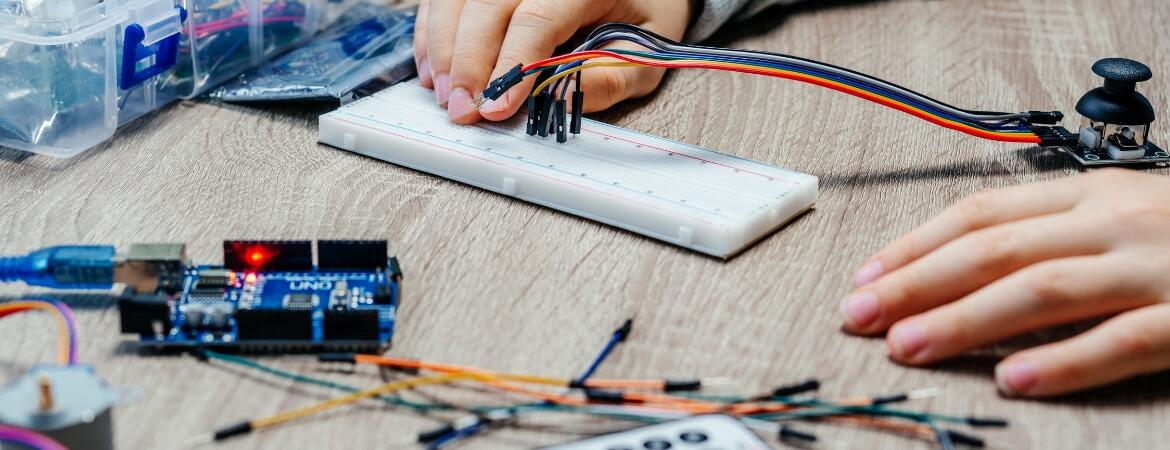
Participants will build robots and learn AI basics through hands-on activities
This summer, the UCR Library is hosting its first-ever robotics camp for undergraduate students led by Maker Services Coordinator Brendon Wheeler and Innovative Media Librarian Alvaro Alvarez.
The month-long camp began Monday, June 17 and aims to provide hands-on experience in robotics and artificial intelligence, giving students from science and non-science backgrounds an opportunity to explore these cutting-edge fields in a collaborative and supportive environment.
Brendon and Alvaro, who both previously worked at the University of La Verne, drew inspiration for the UCR summer robotics camp from a K-12 summer camp they were involved with at La Verne. They wanted to create a similar but more advanced experience for undergraduates.
“The focus of our camp is on the fundamentals of robotics, AI, and computer science. We want to offer a deeper dive into these areas than typical K-12 programs,” Brendon explained.
The camp has attracted a diverse group of around 20 students with backgrounds ranging from physics to art. This diversity reflects the growing interest in robotics and AI among today’s students.
Sessions are held twice a week, on Mondays and Wednesdays, with additional time set aside for team projects. The camp kicked off with Python programming workshops in collaboration with Data Librarian Kat Koziar. Students are introduced to the basics of Python before moving on to build and program robots using the SunFounder Kit. This hands-on approach encourages critical thinking and problem-solving as students modify existing code to understand how and why it works.
While this year’s camp serves as a trial run, Brendon has high hopes for the future. He envisions the UCR Library becoming a significant player in robotics and AI projects on campus, potentially leading to groundbreaking innovations. The current camp is just the beginning, with hopes to expand and refine the program in the coming years.
Harry Potter's World comes to UCR Library
UCR Library is presenting a pop-up exhibition about the historical roots of Harry Potter.
“It is our choices, Harry, that show what we truly are, far more than our abilities.” And, it is with pleasure that the UCR Library Special Collections has chosen to present Harry Potter’s World: Renaissance Science, Magic, and Medicine an exhibition at the Rivera Library from Monday, May 15 to Saturday, June 23.
This traveling exhibition was originally developed and produced by the Exhibition Program at the National Library of Medicine, National Institutes of Health, and curated by Elizabeth J. Bland. The exhibit panels explore Harry Potter’s world, its roots in Renaissance science, and the ethical questions that effected not only the wizards of Harry Potter, but also the historical thinkers featured in the series.
As a complement to the traveling exhibition, also showcased will be selections from the UCR Library’s Special Collections 16th to 19th century original illustrated materials related to magic, witchcraft, herbal medicine, magical creatures and fantastic beasts. Included are some of the foundational works which serve as sources for Harry Potter’s magical world of wonder and wizarding.
“These early illustrated printed materials are crucial in their ability to transmit a wide body of knowledge about science and medicine over a broad geographical expanse. For example, one of the works on display will be Gerard’s Herbal, printed in London in 1597. It’s the first work to record and describe American plants, and it also includes early printed images and descriptions of deadly Nightshade and Mandrake, both of which figure prominently in the Potter novels,” noted Cherry Williams, the UCR Library’s Director of Distinctive Collections. The Special Collections display will also include Ulisse Aldrovandi’s illustrated work on the history of dragons and serpents printed in 1640 in Bologna Italy.
In 1997, British author J. K. Rowling introduced the world to Harry Potter and a literary phenomenon was born. Millions of readers have followed Harry to the Hogwarts School of Witchcraft and Wizardry where he discovers his heritage, encounters new plants and animals, and perfects his magical abilities.
According to the National Library of Medicine, “Although it is a fantasy story, the magic in the Harry Potter books is partially based on Renaissance traditions that played an important role in the development of Western science - including alchemy, astrology, and natural philosophy, …Incorporating the work of several 15th- and 16th-century thinkers, the … series examines important ethical topics such as the desire for knowledge, the effects of prejudice, and the responsibility that comes with power.”
Harry Potter’s World: Renaissance Science, Magic, and Medicine will be located in the Special Collections Department located on the fourth floor of the Rivera Library – which is open Monday through Friday, from 10 a.m. to 5 p.m. For more information about the pop-up exhibition, please visit the UCR Library’s Harry Potter’s World: Renaissance Science, Magic, and Medicine exhibition event website.
Spring UCR Library Workshops & Events
Join the UCR Library this spring for a variety of free workshops and events where you can learn new skills for free!
Attend our general workshops to build foundational research and data skills and learn how you can incorporate AI into your research and study. This quarter, we’re excited to feature our special Maker Week events featuring speakers Garner Holt and Reza Aslan plus workshops for hands-on creation. We're also hosting our regular GIS & Digital Scholarship Meetup events for ongoing casual learning.
Browse the full schedule below to find the right workshop/event for your goals and register for free.
Spring 2026 UCR Library Workshops |
||
|
Title |
Date(s) |
Description |
|
Research & Data Science Series |
Thursday, April 9, 2026 from 2p to 3p |
Join us to learn the basics of Python in a beginner-friendly environment. This workshop will guide you through the syntax, or "grammar", of coding. By the end, you’ll be able to write your first "Hello World" program, understand the logic behind the code, and have the resources needed to continue your learning journey at home. |
|
AI 101 for Research: From AI Chatbot to AI Agent AI Tools Series |
Thursday, April 9, 2026 from 3:30p to 4:30p |
This workshop explores current AI trends and the underlying mechanics of various AI tools for research. Participants will learn how to leverage these technologies for their research and discover the specific AI platforms currently offered by UCR to support diverse research tasks. |
|
AI Tools Series |
Thursday, April 16, 2026 from 2p to 3p |
This hands-on workshop explores the versatile features of NotebookLM to transform how you interact with academic readings. We will dive into core features including Audio Overviews, and learn how to leverage AI to generate structured content for slide decks, video scripts, mindmaps, quizzes, and infographics. |
|
Friday, April 17, 2026 from 2p to 3:30p |
Join us to learn the basics of research in a unique, gamified environment! This workshop applies game thinking to the research process, turning the development of search strategies and keywords into a series of interactive challenges, designed like your favorite RPG. |
|
|
Exploring Literature Mapping Tools AI Tools Series |
Tuesday, April 21, 2026 from 3p to 4p |
This workshop breaks down the literature review process into manageable steps, from understanding the core concept to identifying different types of reviews. We will dive into undergraduate-friendly mapping tools that help you visualize how papers connect, and introduce the new Google Scholar Lab to streamline your discovery process. |
|
Building Your Academic Profile Online Digital Scholarship Certificate Program |
Thursday, April 23, 2026 from 11a to 12p |
This workshop is part of the Digital Scholarship Certificate Program. The workshop offers practical advice on how to strengthen your online scholarly presence using platforms, including ORCID, Google Scholar, and institutional open access repositories. |
|
Using Zotero for Citation Management Citation Series |
Tuesday, April 28, 2026 from 2p to 3p |
Zotero is a free, easy-to-use tool that assists in gathering, organizing, and integrating sources into research papers. This workshop will introduce some of the key functions of Zotero, including creating libraries and importing and organizing citations from a variety of locations. |
|
Finding and Using Imagery in a GIS Geospatial Series |
Wednesday, April 29, 2026 from 2p to 3p |
Are you new to using imagery in a GIS? This workshop will cover imagery characteristics, where to search for historical and recent aerial imagery and how to bring imagery into a GIS. It will also provide a high-level review of methods for extracting information from imagery. |
|
Navigating OA Repositories & Publishing Digital Scholarship Certificate Program |
Thursday, April 30, 2026 from 11a to 12p |
This workshop is part of the Digital Scholarship Certificate. The workshop introduces the landscape of open access repositories and publishing with a special focus on eScholarship, the University of California's open access repository and publishing platform. You'll learn how to deposit your work in open access repositories, understand your rights as an author, and choose the right repository for different types of research outputs, from articles and preprints to datasets and code. |
|
Data Cleaning for Machine Learning w/Python AI Development Series |
Thursday, April 30, 2026 from 2p to 3p |
Join us to learn how to transform raw datasets into clean, machine-learning-ready data. This workshop will guide you through the essentials of key libraries for data manipulation. By the end, you’ll be able to load messy files, understand the structure of a DataFrame, and produce the high-quality, structured data required to train effective predictive models. |
|
Creat’R Lab Series |
Monday, May 4, 2026 from 2p to 3p |
Join us this May the 4th for a hands-on workshop where we bridge the gap between imagination and reality. Whether you’re a Padawan to 3D modeling or a seasoned Knight, you’ll learn how to use Autodesk Fusion to design a custom LEGO lightsaber hilt. No prior experience with Fusion is required—just bring your creativity and a passion for the Galaxy Far, Far Away. Space is limited, so grab your spot before they vanish into hyperspace! |
|
Computational Methods on Text Analysis Digital Scholarship Series |
Wednesday, May 6, 2026 from 11a to 12p |
This workshop introduces three computational text analysis methods—topic modeling, sentiment analysis, and the use of LIWC-22 (Linguistic Inquiry and Word Count)—along with an introduction to web scraping for building custom text datasets. You’ll learn how researchers and practitioners use these tools to analyze patterns across corpora, from interviews and social media texts to archival documents. |
|
Introduction to Gemini API: How to customize AI models AI Tools Series |
Monday, May 11, 2026 from 2p to 3p |
As a researcher, you may wish to extend AI models for your specific projects rather than relying on standard chatbots or fixed interfaces. This guide introduces how to use Gemini API keys in alignment with UCR data security guidance and explores key research use cases for the API. |
|
AI Tools Series |
Tuesday, May 12, 2026 from 10a to 11:30a |
This workshop dives deep into the current AI LLM benchmark landscape, examining use cases for both academic research and learning. Participants will review recent top benchmarks against the current top global LLM models, including both Western and open-source Chinese models, exploring various models' unique affordances, strengths, and limitations. The session will be valuable for researchers at all levels — students, faculty, and staff — who want to make informed decisions about which models to integrate into their research and learning workflows. |
Maker Week (April 20 - 24) Workshops/Events & the May 1 Maker Faire Competition |
||
|
Title |
Date(s) |
Description |
|
About Maker Week 2026: From sketching ideas and wiring electronics to 3D printing and crafting a compelling story, gain the tools, techniques, and confidence to take an idea from concept to reality! Learn more at library.ucr.edu/makerweek2026. |
||
|
Keynote from Animatronics Maker Week Series |
Monday, April 20, 2026 from 1p to 2p |
Hear from local businessman Garner Holt on how he forged an animatronic business for the southern California region. What happens when a high school student follows his passion and builds it into a company that reaches millions? Join us for the Maker Week 2026 Keynote featuring Garner Holt, founder of Garner Holt Productions. Since founding his company in 1977, Garner has created animatronic figures and experiences for Disneyland, Knott's Berry Farm, Chuck E. Cheese, and more. Don't miss this inspiring kickoff to Maker Week 2026. |
|
Maker Week Series |
Tuesday, April 21, 2026 from 10a to 11a |
Learn how to draw your ideas to help conceptualize ideas and creativity. Have an idea but don't know how to get it out of your head? This hands-on workshop with UCR Library's Sara Stilley will teach you the sketching techniques you need to turn your ideas into clear, visual plans.No art experience required! Just bring your imagination. |
|
Storytelling Creative with Reza Aslan Maker Week Series |
Tuesday, April 21, 2026 from 1p to 2p |
Learn how to use creative storytelling to bring your project to life with UCR faculty member, Reza Aslan. Every great prototype needs a great story. In this workshop, Reza Aslan will guide you through the art of creative storytelling, helping you find the purpose, meaning, and narrative behind your idea. Learn how to communicate your prototype's vision in a way that resonates with any audience. |
|
Tinkering with Electronics in Prototypes Maker Week Series |
Wednesday, April 22, 2026 from 10a to 11a |
Learn how to embed electronic circuits with controllers to add personalization to your prototype. Get hands-on with electronics and learn how to build them directly into your prototype. In this workshop, Creat'R Lab Maker Services Coordinator Brendon Wheeler will walk you through how to integrate electronic components into your projects using equipment from the UCR Library Robotics Lab. Learn how, when, and where to use the tools available to you, right here on campus! |
|
Iterative Design with 3D CAD Modeling Maker Week Series |
Wednesday, April 22, 2026 from 1p to 2p |
UCR Library's Innovative Media Librarian Alvaro Alvarez will lead this workshop on 3D modeling and printing, showing you how to design and iterate on a prototype using CAD software and the Creat'R Lab's 3D printers. No prior experience needed. |
|
Marketing Practices for Prototypes Maker Week Series |
Thursday, April 23, 2026 from 9:45a to 10:45a |
Join UCR's Blackstone representative Francis Reyes Aguilar for a practical workshop on marketing strategies that real businesses use to promote their products. Walk away knowing how to position, present, and pitch your prototype to any audience. |
|
Designing Prototypes through Sustainable Design Maker Week Series |
Thursday, April 23, 2026 from 2p to 3p |
In this workshop, you'll learn how to design and construct prototypes using recycled and sustainable materials. Discover how to think creatively about the resources you already have and apply sustainable design principles to your own ideas. |
|
Maker Week Series |
Friday, April 24, 2026 from 10a to 12p |
Learn how to create your own poster that can be used for academic and other related presentations. In this workshop hosted by the UCR Library's Student Success and Engagement Librarian Carrie Cruce, you'll learn the principles of academic poster design, a skill that will serve you at the Maker Faire and throughout your academic career. |
|
Closing Ceremony & Learn About the Maker Faire Competition Maker Week Series |
Friday, April 24, 2026 from 1p to 2p |
Drop in for our Closing Ceremony to celebrate the week of workshops, creativity, and prototyping with the UCR Library Creat'R Lab community. You'll also get a full rundown of the Maker Faire Competition happening May 1, including the format of the competition and what judges are looking for. Whether you're ready to compete or just curious, this is the event to attend before competition day. |
|
Maker Week Series |
Friday, May 1, 2026 from 1p to 4p |
Show off your prototype project in a Maker Faire competition! Compete for a chance to win prizes such as a 3D printer and AutoCAD book! This is it, the grand finale! Throughout Maker Week, each workshop will give you a prompt and an artifact that contributes to your final project. At the Maker Faire Competition, you'll present your completed prototype science-fair style, alongside the artifacts you built and collected along the way. Judging criteria will be shared at every workshop so you always know what to work toward. Prizes:
All participants receive printing credit redeemable at the UCR Library Creat'R Lab, and every project has a chance to be featured in a future library exhibit. |
 First Place — Bambu A1 Mini 3D Printer
 Second Place — Mastering AutoCAD Book
 Third Place — Blueprinting Book & Multitool Pen
Spring 2026 UCR Library Meetups |
||
|
Title |
Date(s) |
Description |
|
Tuesday, April 7, 2026 from 12p to 12:50p |
High-Resolution Aerial Mapping of the UCR Botanic Gardens by Drone |
|
|
Tuesday, April 21, 2026 from 2p to 3p |
Join us for a demonstration of Glycerine, a IIIF-compatible image annotation platform for research, curation, and education. |
|
|
Tuesday, May 12, 2026 from 12p to 12:50p |
The PARC Toolkit for Desert Climate Resilience |
|
Celebrating our Class of 2022 library student employees
The UCR Library’s Student Employee Appreciation Event returns after a two-year pause.
The UCR Library is one of the largest student employers on campus. Each spring, the UCR Library usually holds an in-person appreciation event celebrating our student workers.
However, due to the 2020 and 2021 campuswide closure, the last in-person Student Employee Appreciation Event was in 2019. We are pleased to announce that this event returned on May 25, 2022.
At the safari-themed 2022 Student Employee Appreciation Event, held in the lower courtyard at the Rivera Library, we recognized 14 library student employees who will graduate with UCR’s Class of 2022: Yaneli Alvarado, Cynthia Cruz, Lina Cun, Isabel Fryett, Marlen Gonzalez Duran, Valerie Gonzalez, Hunter Courtney Kern, Romyrl Labuen, Miranda Lara, Jennifer Perez Lara, Michelle Rawlings, Xavier Rodriguez, Karen Rachel Rosales, and Danielle Velarde.
We asked some of our 2022 graduates what they will miss most about working at the UCR Library. Here are their responses:
“I will miss walking around the library and looking for books during my shift. I find this calming. I will also miss talking to my supervisor and my co-workers. They are the best!” — Romyrl Labuen
“What I’ll miss the most is the work culture. I was able to achieve personal and professional growth while simultaneously creating long-lasting friendships. I was never afraid to admit to a mistake, ask questions and I was even given several opportunities to learn and grow. It’s a culture that you cannot find anywhere else and is absolutely valuable for student workers such as myself.” — Miranda Lara
“My coworkers! Especially my supervisor, Margarita. I've worked here at Orbach for four years and while I've seen some of my coworkers come and go, there have been a few constants. We've all shared laughs and troubles, and have had our silly moments. I'll miss that all when I'm gone.” — Valerie Hernandez
“I'm going to miss the employees the most! Everyone is so nice and welcoming and I would always look forward to coming back once the school year would begin. I am also going to miss the flexibility and the laid-back environment that was present at the UCR Library. Overall, the staff make working at the library a great experience.” — Jennifer Perez Lara
Congratulations, class of 2022!
Robotics Camp Emphasizes Critical Thinking and Design
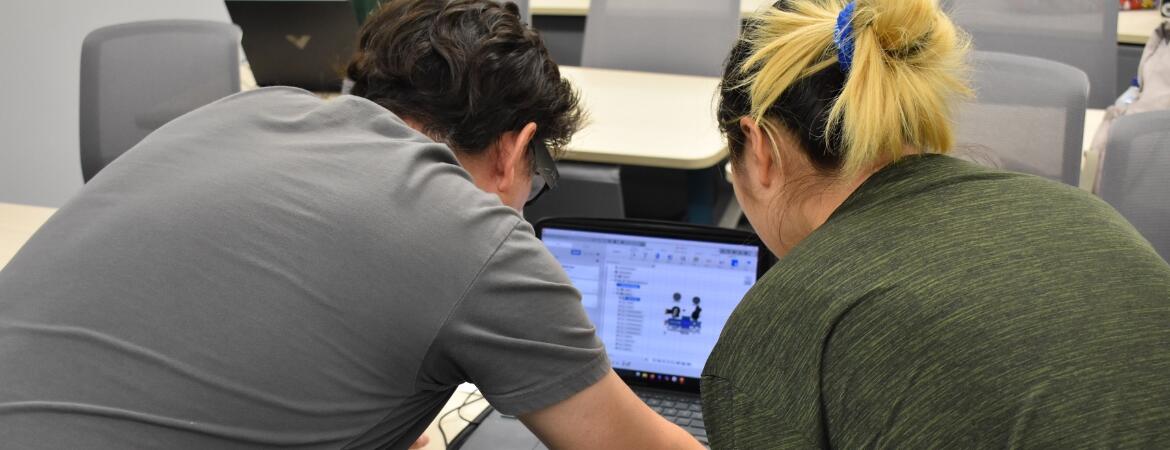
This summer, the UCR Library hosted its second annual summer Robotics Camp, held June 16 to July 18, 2025.
The camp, led by Maker Services Coordinator Brendon Wheeler and Innovative Media Librarian Alvaro Alvarez, brought together undergraduate students from across university disciplines to explore 3D modeling, coding, and robotics in a collaborative, hands-on environment.
Participants at this year’s camp gained hands-on experience with 3D modeling to create prototypes and programmed their robots using Python and C++. As part of the project, they built an Artificial Intelligence Convolutional Neural Network (CNN) capable of identifying red, green, and yellow signals. This in turn activated motors to mimic Mario Kart–inspired power-ups such as banana peels, mushrooms, and shells.
Innovative Media Librarian Alvaro Alvarez supported workshops and presented on Fusion 360 and 3D modeling. Alvaro noted the camp offered a richer curriculum comparatively. “I think overall it had higher quality content compared to last year and very useful for future projects and majors as it combined both robotics with AI,” he said.
Maker Services Coordinator Brendon Wheeler, who acted as the camp’s project manager and guided student participants through the development cycle, emphasized this year’s camp also deepened engagement. “This year our camp featured hands-on coding, robot 3D printer customization, and AI. Unlike last year, where students uploaded pre-written code, this camp emphasized critical thinking and higher levels of design. The curriculum was notably improved, fostering creativity and deeper engagement,” he explained.
A total of 26 students signed up for the camp, with participation highest in the first few weeks with 45% taking part from non-STEM majors, reflecting the camp’s interdisciplinary appeal.
Alvaro and Brendon confirmed that the camp will continue in the future. There are hopes to expand by including a K-12 camp and partnering with our community and a local school next year. The team also plans on designing next year’s summer camp with a more flexible schedule in the hopes of attracting more students.
Through programs like the open interdisciplinary Robotics Camp for wider university audiences, UCR Library continues to inspire curiosity, support creativity, and provide amazing opportunities for students to explore new technologies that will serve them well at UCR and beyond.
George Brown Legacy Project Documents Congressman's Career
The service of a Congressional champion of science and civil rights is being documented at the UCR Library.
In what was formerly the Copy Center in the quiet basement of the Tomás Rivera Library, Jessica Geiser and her student workers process the papers and materials of former U.S. Congressman George E. Brown, Jr. who represented Inland Southern California in Congress for 14 terms. Known as a champion for science and a staunch defender of civil liberties and human rights, Congressman Brown's papers document his life and career from the late 1930s to his passing in 1999.
In 2010, Congressman Brown's widow, Marta Brown, donated 600 boxes of documents, photographs, and other materials that detailed the Congressman's 14 terms to UCR. Included were approximately 7,000 photographs, 114 VHS tapes, 89 audio cassettes, nearly 600 color slides, and a multitude of reels, floppy discs, and CDs. With the gift of this collection, a mission for the purpose of the project was developed: to ensure the preservation and accessibility of George Brown’s extensive collection at UCR for future generations of scholars, reporters, and leaders in science, labor, business, and public service.
The processing of this comprehensive project began when Geiser was hired as a project archivist in September 2014. Her first task was to relocate and reorganize the unopened boxes prior to unpacking. Once moved, she opened each box and created a content list. "This step was probably the most important step of the entire project and needed to be as detailed as possible," Geiser writes. This information would inform the arrangement of materials, the supplies and staff needed, and the processing time required to complete the project.
As Geiser combed through each box, she collected information on the subjects and dates of the materials, their physical extent in inches, the estimated amount of folders, and the condition of the enclosed materials. Consulting other congressional archival collections, she devised an arrangement scheme that mirrored the ways in which Brown and other Congressmen created and stored their records while in use. A high level of detail and close attention were vital to this success. Finally, she developed the plan which dictates the goals, and methodology to meet those goals, for the entirety of the two-year project.
She and her team then began re-foldering the materials in acid-free folders and boxes that allow for better preservation in long-term storage. Ms. Geiser also ensures that other basic preservation activities take place, such as removing metal paperclips and rubber bands which cause damage, and photocopying fragile and acidic materials — such as newsprint and fax paper — to prevent further deterioration. Although some material is confidential and restricted and must be redacted, the goal is to keep as much information accessible to researchers as possible.
The George Brown papers hold clues to key advances of today and major innovations of tomorrow, and a blueprint for bipartisan problem-solving spanning four decades of federal decision-making. This unique trove of knowledge will be accessible to current and future entrepreneurs and students of effective public service.
As she works towards opening the collection at the end of this two-year project, Ms. Geiser maintains a blog in order to connect with any potential researchers or other interested parties.