Search
Search
Sherman Indian Museum digitized collection on track to surpass 13,000 items
The Sherman Indian Museum digitization project now has more than 9,000 items available online through Calisphere; at the completion of the project, this figure will surpass 13,000.
The Sherman Indian Museum holds the archives of the Sherman Indian High School, an off-reservation boarding high school for Native Americans, with students from grades 9 through 12 who represent 76 federally recognized tribes from across the United States. Originally called the Perris Indian School when it opened in 1892 in Perris, California, it was moved to Riverside in 1903 under the name of The Sherman Institute. Then in 1971, it was accredited by the Western Association of Schools and Colleges and renamed as the Sherman Indian High School.
Over the past two years, the UCR Library’s Digitization Project Coordinator Charlotte Dominguez has worked with four UCR students and 12 student workers from Sherman Indian High School to make items from the museum’s archival collections available online worldwide. Project completion is set by fall 2019.
“Native Americans were a big part of Southern California history that people don’t know a lot about, outside of academia,” explained Dominguez, who has worked with the Indigenous community for about 10 years, including her time with UC Riverside. “The native community is very active, very present. People with indigenous heritage only make about 1-1.5% of the population, but their culture is strong and thriving.”
The digitized collection spans more than a century of the school’s history: from the early years of the Perris Indian School in the 1890s, the Sherman Institute in the early 1900s, to when Sherman Indian High School was founded in the early 1970s, up to contemporary students in 2009.
“It has been a dream come true to have this project come to reality. Our boarding school story needs to be told, shared, and available to the world. That story has impacted our tribes in many ways, good and bad,” said Lorene Sisquoc, Director of the Sherman Indian Museum. “Now the photos and documents our museum holds can be accessed in a safe way. The alumni, families and researchers who are seeking this information can now have it at their fingertips. These records of our school’s history are now preserved for future generations to know this story.”
“Even though what we’re showing is mostly history, it’s still relevant to the present,” Dominguez added. “They’re living in modern times, but still keeping their history, traditions and culture relevant.”
Early on, Digitization Program Services Manager Eric Milenkiewicz knew that having this collection available digitally would have a deeply rewarding impact for the Native American community and researchers worldwide.
“Successful projects like this demonstrate what can be achieved when academic institutions and local community archives join forces,” Milenkiewicz added. “Not only does this help to preserve and increase access to these cultural heritage collections, but it also helps to strengthen the bond between the university and the community it serves."
The project’s goals went beyond purely digitizing the collection and publishing it on the Internet. Dominguez also spent time teaching the students and Sherman Indian Museum Director Lorene Sisquoc how to use their newly-acquired tools and equipment, how to create metadata, and how to research using the internet to cross-reference details, so that the museum could continue the work independently after this project’s term ends.
The computer and scanning equipment used for the project will remain on-site at the Museum, and Dominguez added that Sisquoc intends to have Sherman Indian High School students continue scanning photos and documents, though they may not be published immediately on Calisphere. Even with the projected 13,000 items published online at project’s end, Dominguez said that there are still several thousand items remaining to be digitized, which were not part of the original project.
After digitization, a lot of behind-the-scenes work still remained before the team could publish this massive collection on Calisphere, which is where Digital Assets Metadata Librarian Noah Geraci made significant contributions to the project’s success. Geraci’s work transformed the collection from a group of files on a hard drive to a publicly accessible online resource. “It’s been really wonderful to work with the Sherman community and be part of such a meaningful project,” he said.
"The Sherman Digital Project has already had an incredible impact on Native American individuals, families, and tribes who have accessed the collections online. Until the digital project, many American Indians had been unable to visit Sherman Indian Museum to access records germane to their families and people. Now they have easy access to documents, and they are able to learn about their friends and relatives who were former students of Sherman Institute,” explained Dr. Clifford E. Trafzer, Distinguished Professor of History and Rupert Costo Chair in American Indian Affairs. “In addition to supporting new scholarship, digital access has opened new research opportunities to Native Americans. The project is a major contribution and welcomed by many researchers, including student researchers of all ages."
Milenkiewicz originally collaborated with Dr. Trafzer to write and submit the grant proposal in April 2016. In January 2017, the library received the grant totaling $376,191 from the Council on Library and Information Resources (CLIR), generously funded by the Andrew W. Mellon Foundation.
Getting a Library Card & Borrowing Privileges
| Applying for Library Privileges | Borrowing Privileges |
|---|---|
UCR ACADEMICCurrent UCR faculty and lecturersYour UCR card is your library card. Privileges are automatically granted. |
Discovering treasures in the Sherman Indian Museum's archives
Digitization Project Coordinator Charlotte Dominguez grew up hearing her father exclaim, “There’s Sherman!” whenever they drove past the Sherman Indian High School in Riverside, CA.
Little did she know that one day, she would be part of a monumental, two-year collaborative project between the Sherman Indian Museum and UCR Library’s Inland Empire Memories initiative, that was made possible by a grant received from the Council on Library and Information Resources’ Digitizing Hidden Special Collections and Archives: Enabling New Scholarship through Increasing Access to Unique Materials program.
Dominguez joined the library team in mid-July 2017. Since September, she and her three Sherman Indian High School student workers Kassie, Marisa, and Koby have been busy digitizing Sherman’s archival materials and preparing them for online publication via Calisphere.
“It's kind of like a treasure hunt because you never know what you're going to see,” Dominguez said. “I really like seeing the pictures of the younger kids. After you see the same face four or five times, you start to get attached.”

The photographs and archival documents that Dominguez and her team are digitizing depict a cultural odyssey that spans many decades, rich with the history of local Native American people as well as those who have come to study at Sherman from all over the continental United States. They chronicle the early days of the Sherman Institute, years when it served as a vocational school, and the era after 1970, when it became Sherman Indian High School. “The school has a really solid cultural program, and that's a really big draw for a lot of the kids,” Dominguez explained.
The project aims to not only preserve and increase access to these materials online, but also to help Sherman Indian High School students gain valuable, hands-on work experience with handling, digitizing, and creating descriptive metadata for cultural heritage materials.
Work experience can be hard to come by for boarding school students, who aren't allowed to leave campus without supervision from their parents or school staff. Dominguez explained, “One of the main goals of this project is to give the Sherman students a chance to learn skills that they can use in the future and allow them to be less financially dependent on their families. For all of them, it's their first real job.”
Koby said that he enjoys learning about Sherman’s history while working with the photos and seeing how fashion trends and hairstyles changed over the decades. Kassie enjoys the digitization process. “It’s fun to enlarge the scans to see the hidden details,” she said.

Their goal is to digitize an estimated 10,000 items and complete descriptions for each so that they can be indexed by search engines when made available online. To date, they have digitized over 2,000 items and finished the accompanying metadata for 1,200 of those files. That puts them on target to complete the project on-time by the summer of 2019.
These three students will work with Dominguez until the end of this semester, and then she will train four new students over the next term. “I made the decision to rotate the kids in conjunction with the museum curator, Lori (Lorene Sisquoc),” Dominguez explained. “We wanted to make sure as many kids as possible had the experience, if they wanted it.”
Once published online, this collection will be a valuable resource to researchers worldwide, as well as to Sherman Indian High School alumni. “A lot of the researchers who come here are doing genealogy, or they're alumni looking for things to show their kids or grandkids, and a lot of them can't travel like they used to,” Dominguez said. “So having things published online will be so useful to them.”
They are also hoping to crowd-source captions and other identifying details for the photographs. “Lori is hoping that, once these get published, family members or maybe even the alumni themselves will come forward and say, ‘Hey, that's me!’ or, ‘Hey, that's my aunt!’ and help us put names to these faces.”
Dominguez said that the Sherman Indian Museum and the UCR Library project team plan to share information about what the project has accomplished, how they plan to use it, and why they did it within both the Native American and academic communities.
Library Support for the UCR School of Medicine: Focus on Tiffany Moxham
Medical Library Programs Coordinator Tiffany Moxham just marked her three-year anniversary at the UCR Library on July 1, 2017. Her presence has been auspicious for the inaugural class of 40 students who graduated from UC Riverside’s School of Medicine this June.
The UCR Library played an integral part in the formative years of UCR’s School of Medicine (SOM), and Moxham has been involved almost since the beginning. “I was very fortunate to be on the search committee for Tiffany’s position, and she just jumped out right away,” said Dr. Michael Nduati, CEO of UCR Health and Senior Associate Dean of Clinical Affairs. Nduati believes that hiring her was “the best decision we could have made for the library and the medical program.”
While clinical faculty may be the core of the program, Moxham has been their unwavering ally in her role at UCR Library. “We are supporting multiple clinical sites and campus locations because it embraces our community aspect,” Moxham explained. “This allows the library to align as a core piece of the research and educational programs, modeling integrated library services.”
Dr. Nduati credits many achievements by School of Medicine students directly to Moxham’s contributions. “Tiffany has been a godsend to the SOM and our medical education program,” he commented. “She meets one-on-one with the medical students to work with them on how to do literature research. A lot of these students have published and presented nationally, and a large part of their success is due to her.”
Moxham also devotes her time to collaborations with and mentorship of faculty. “A lot of faculty would be lost if they didn’t know how to access the resources they need at the library,” Nduati added. He witnessed her commitment to the faculty: “She would go to their offices to set up their computer and walk them through how to access articles. They can’t meet during regular office hours, so she would meet with them at nights, on weekends.”
Moxham has also presented at conferences nationwide with her School of Medicine colleagues. “You feel part of something bigger even though your piece of it might be small,” she said.
The outcome speaks volumes. “One hundred percent of our inaugural class matched,” said Moxham. “This means they all got into a residency program. This does not regularly happen!” Impressive results for a new medical school, indeed.
“The piece that amazes me about the match is that we tried to do things differently,” Moxham explained. “When you see innovation in practice that allows for such great results in the end, being able to witness that effect on the students, that’s great.”
Retention of high-quality medical practitioners in Riverside and San Bernardino counties is a high priority for the School of Medicine. According to Moxham, “This school was built on the mission of improving the local community and getting more doctors here. We have a huge shortage of doctors here in the Inland Empire. Most of the scholarship money going toward the students was aimed at getting more of them to stay here.” Of the 40 graduates, 33 will complete their residencies in California, and ten of those will remain in the Inland Empire.
View photos from the 2017 School of Medicine Commencement
UCR Library and Sherman Indian Museum receive $376,191 Digitizing Hidden Collections Grant from CLIR
On January 4, 2017, the Council on Library and Information Resources (CLIR) announced that the UCR Library and the Sherman Indian Museum would receive a $376,191 Digitizing Hidden Collections grant, generously funded by The Andrew W. Mellon Foundation, for a collaborative project to digitize the museum’s collection.
“Their collection houses thousands of one-of-a-kind documents about the history, education, and culture of The Sherman Institute from 1901 to 1970, and Sherman Indian High School from 1970 to the present day,” explained Dr. Clifford E. Trafzer, UC Riverside’s Distinguished Professor of History and Rupert Costo Chair in American Indian Affairs. “The collections also have all the records of Perris Indian School from 1892 to 1904, when the Bureau of Indian Affairs transferred students to The Sherman Institute, the first off-reservation American Indian boarding school in southern California. These are valuable treasures that cannot be replaced. Documents and photographs represent many aspects of student life at Sherman and focus on the people, curriculum, sports, music, dance, and vocational education.”
“These records hold the history for so many people: Native American people who came to school here, people who have worked here, and their families,” said Lorene Sisquoc, Director of the Sherman Indian Museum. “We get many different research requests, not just from alumni. It’s been quite in-demand for the past 25 years, and the demand has gotten bigger and bigger to access these archives that are well over 100 years old. It was crucial that we got this done somehow.”
The Sherman Indian Museum collection is an invaluable resource documenting the Native American experience in the United States. The collection supports research in a range of disciplines and on a variety of topics including Native American education, the US government’s cultural assimilation efforts of Native Americans, and the history of American Indian off-reservation boarding schools.
“There are only a handful of American Indian boarding school collections out there, and the only other one that has been digitized is in Pennsylvania,” explained Eric Milenkiewicz, Manuscripts Curator and co-principal investigator on the grant. “So this project will provide the public with a glimpse into the boarding school experience from a California, west coast perspective.” Given the granting agency’s guidelines, the Sherman Indian Museum could not apply for the grant on their own; they also didn’t have the resources needed to digitize their collection. That was all the incentive that UCR Library needed to complete the grant application last April.
“Serving this type of community need is exactly why the Inland Empire Memories initiative exists,” Eric explained. Founded in 2013, the mission of Inland Empire Memories is to identify, preserve, interpret, and share the rich cultural legacies of the Inland Empire’s diverse communities. “It’s really about safeguarding these materials, this community treasure for future generations. This is part of Riverside’s history, which UCR is also a part of, and we want to make sure that the collection is preserved and accessible to the community.” The digital collection will be made available through Calisphere, thanks to CLIR and The Andrew W. Mellon Foundation, allowing worldwide online access to this rich resource.
As part of this grant, UCR Library will help build infrastructure for future digitization efforts at the Sherman Indian Museum. The grant will also procure scanning equipment for the Museum, and students from the Sherman Indian High School will receive training so that they can participate in digitization. “This is something that’s been needed for a long time,” said Lorene, “and we’re very fortunate to get this.”
“One of our project’s primary goals is to embed these technical skills in the community that will be carrying this digitization work forward,” Eric explained. “We believe that the skills learned by the students over the course of this project will positively impact the museum and community, promoting a greater understanding of digital initiatives work. And we hope that this grant project will inspire further community support from other interested organizations or individuals who will want to step in, to carry this torch into the future,” Eric added.
Benefits of digitizing the Sherman Museum’s collection are many, but three come to the forefront. As Lorene explains, “It’s going to benefit people all over to be able to access these, and also to protect them so we won’t be using originals as research access.” According to Dr. Trafzer, “Scholars will produce many books and articles from the rich documents found in the collections,” he explained. “Equally important, former Native American students of Sherman and their families will have easy access to documents and photographs, school newspapers and annuals. Native American people and families will be able to learn more about the lives of their loved ones. This will provide contemporary American Indians and scholars with images and voices of past generations of students, faculty, and staff at Sherman.”
“It’s not just great news for UCR’s own graduate students,” Associate University Librarian for Collections & Scholarly Communication, Alison Scott concurred. “This will be great for the world.”
Information for K-12 Class Visits to the UCR Library
Elementary Class Visits (K-5)
Elementary class visits to the UCR Library may be arranged. Library staff will work with you to arrange a visit that aligns with your goals.
Due to space limitations, field trips are limited to groups of 65. For more information, or to arrange a visit, please contact Teaching & Learning Services.
Middle and High School Class Visits (6-12)
Public Services Assistant wins scholarship to Rare Book School
This past quarter, Public Services Assistant Zayda Delgado received word that she had received a scholarship from the National Endowment for the Humanities-Global Book Histories Initiative (NEH-GBHI) to attend Rare Book School at Amherst College during summer 2018.
Rare Book School (RBS) is an independent institute housed at the University of Virginia that provides continuing education and community-building opportunities through hands-on, seminar-style classes taught by distinguished faculty.
At RBS, Delgado will take a course called A History of Native American Books & Indigenous Sovereignty.
Delgado applied to the program for personal and professional development, but also with the purpose of sharing her knowledge here at UCR. “We have a significant collection of Native American books, particularly on California’s first people,” she explained.
“This award presents an opportunity for Zayda to develop her skill sets in culturally diverse book collections,” said Tiffany Moxham, Assistant University Librarian for Collections. “It also ties into our initiatives to support the documentation and research support of our local communities, which are manifested in such initiatives as Inland Empire Memories.”
This will be Delgado’s second time attending Rare Book School. She first received a fellowship in 2016, along with a group of 20 fellows. That year, she took the course History of the Book 200-2000, which was taught jointly by John Buchtel, Director of the Booth Family Center for Special Collections at Georgetown University and Mark Dimunation, the Chief of Rare Books at the Library of Congress. “He gave us a behind-the-scenes tour,” Delgado said. “I got to hold the rarest and most precious materials that they have at the Library of Congress.”
Traditionally, scholarships are reserved for those who have not previously attended Rare Book School. Coordinator of Scholarships Danielle Culpeper encouraged Delgado’s group to apply for the NEH-GBHI fellowship because it was open to people who had attended RBS before.
“It’s just so fun, the opportunity to go back to RBS. It’s like a summer camp for people who really love books,” Delgado explained. “From the time you wake up in the morning until the time you go to bed at night, you’re learning something new every minute. It’s really exciting for me, so I’m really looking forward to that.”
Christopher Martone Chosen as California Instructional Materials Reviewer
Many people grumble over their inability to effect change. However, UCR Library’s Coordinator of Education Services Christopher Martone will serve on a team of influencers to determine which textbooks are used throughout California’s elementary and middle schools.
Recently selected as an Instructional Materials Reviewer by the California State Department of Education and appointed to the 2017 committee for History - Social Science Adoption of Instructional Materials, Christopher will collaborate with a small team of individuals and the Curriculum Frameworks Unit to make state-wide recommendations for textbooks. Christopher’s appointment as a Reviewer will last for approximately eight months.
Prior to joining the UCR Library, Christopher taught high school AP US History and social studies for six years. Christopher has been with the Library for more than 10 years working with the education resources and maintaining the Learning Resources Display Center (LRDC) on the second floor of Rivera Library. Graduate School of Education (GSOE) students and local teachers can find materials in the Rivera Library to supplement and enhance the lessons they deliver in the classrooms – from children's books for all ages, to textbook materials, to non-book resources like manipulatives, videos, flash cards, science lab equipment, and more.
“This is a wonderful opportunity for Chris and for the UCR Library!” said Christina Cicchetti, Education/Reference Librarian. “The first-hand look at California's textbook adoption process afforded by Chris's service on this committee will inform his work in the LRDC, and help Education Services to communicate more effectively about the adoption process with GSOE students.”
The Instructional Materials Reviewers will review textbooks to determine whether they present historical facts and stories in an even-handed way, with a voice given to all sides and a balanced perspective, while still meeting state benchmarks for educational criteria in history and social studies. “Sometimes history has a tendency to be somewhat biased,” Christopher stated. “We want to encourage open-mindedness in students, and the best way to do that is to present all sides of the story.”
“Chris’ role on this committee is an excellent extension of his role with the LRDC, which provides local educators with a voice in the process of statewide and local textbook selection,” said Dani Brecher Cook, Director of Teaching & Learning. “By participating in this committee, Chris will be able to advocate for the inclusion of textbooks in the curriculum that rely on historical evidence for their claims, as well as deepen his depth of knowledge about the resources available to California educators.”
Christopher credits his 16 years of experience in the field for why he was chosen to fulfill this role on the Adoption of Instructional Materials committee, which will have a significant public impact state-wide. “What we decide will influence what students and teachers can use in the future, from kindergarten through eighth grade,” he explained.
“Anybody who wants to submit textbooks that fit these frameworks can send them to the California Department of Education for review. I’ve always wanted to encourage people to get more involved in this,” Christopher added. “If me being on this committee promotes the fact that we can get more involved and do something rather than complaining about it, then that’s great.”
After the review process is finalized around the end of November 2017, a certain number of texts will be approved and school districts state-wide will receive the list of books adopted for use in classrooms. The committee’s recommendations will take effect in 2018.
The LRDC at UCR Library is one of 10 similar centers around the state of California which houses copies of textbooks that have been either adopted or are under review by the California Department of Education for all subject areas in Grades K-8. Local educators and the public may visit an LRDC to review textbooks to determine which to use in their districts. The UCR Library agreed to house this regional LRDC in 2004, particularly to provide students in the Graduate School of Education Teacher Education program with access to current textbooks and ancillary materials.
The LRDC is open by appointment only. To schedule an appointment, please contact the Education Services unit.
Congrats to our Graduating Student Employees
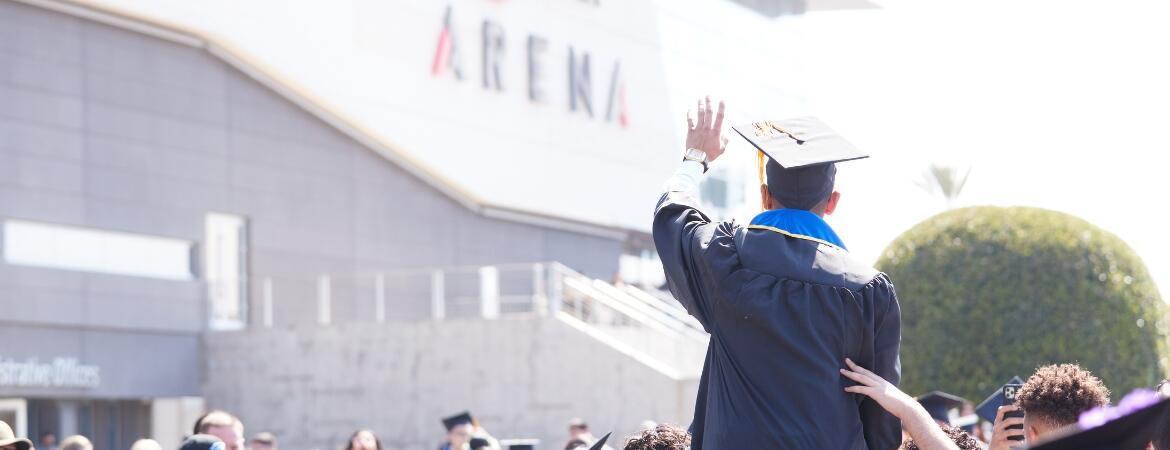
Congratulations to our graduating student employees! 23 of our student employees have, or will, graduate this school term (Fall 2023, Winter 2023, Spring 2024, or Summer 2024).
Thank you to our graduating student employees and to those who have already graduated this school year! We appreciate all of your hard work and wish you luck in your future endeavors.
Circulation/Reserves (Rivera)
- Luana Mora
- Isamary Topete
Circulation/Reserves (Orbach)
- Angelo Velasquez
- Nawaal Khan
- Ruby Servin
- Denise Castaneda
Collection Maintenance
- Alfredo Lanuza Bravo
- Katelyn DePew
Digitization Services
- Karen Huynh
Research Services
- Fred Garcia
- Daisy Flores
- Ashley Alvarez
Creat'R Lab
- Mrinisha Adhikari
Robotics Lab
- Max(Chi) Wong
- Ernest Romero
Security
- Mike Ribowo
- Daniel Miranda
Special Collections and University Archives
- Adan Gutierrez
- Angelina Martinez
- Katya Vasquez
- Tristyn Tarver-Layfield
Teaching and Learning
- Katherine Callejas
- Gabrielle Torrez
Incoming students learn about resources at Highlander Orientation
The last time the Library participated in an in-person Highlander Orientation event was back in 2019.
The summer of 2022 saw the return of in-person Highlander Orientation sessions. The two-day orientation, mandatory for all incoming first-year students, has 11 sessions throughout July and August and is an opportunity for incoming Highlanders to familiarize themselves with campus technology tools, register for classes, and discover campus services and resources.
The UCR Library participates on the first day of the orientation, during the Involvement Fair on Pierce Lawn. The fair offers incoming Highlanders and their parents a relaxed environment where they can learn about UCR departments and clubs on campus.
Early Experience Teaching Librarian Michael Yonezawa was thrilled to have the opportunity to connect with incoming Highlanders once again.
“Words cannot express how meaningful it has been to welcome our newest Highlanders to UCR in-person,” Michael said. “Seeing their smiling faces and sharing with them the many services and resources waiting for them when they return to campus in the fall is special and should never be taken for granted.”
Students coming to UCR from high school or a community college may not know all that a university academic library at a tier 1 research institution like UCR offers.
“The closest comparison would be going from a pond or lake in the case of a high school library, to perhaps the rivers and seas at a community college, to the vastness of the oceans at a university academic library — such as the one at UCR. In addition, UCR students have access to information available across the entire UC System and beyond through services such as Interlibrary Loans,” Michael explained.
Special Collections Public Services Outreach & Community Engagement Librarian Sandy Enriquez also participated in the Involvement Fairs. Sandy sees the value in connecting with students early in their college careers.
“I think it's important to plant a seed early on about what the Library offers. The longer you’re in your academic program, the more central the Library and its resources become. If you know from the get-go that there are experts here, ready to help you and connect you to different resources, it saves you time and energy later on,” Sandy said.
Highlander Orientation is also an opportunity to let incoming students know that the UCR Library is a welcoming space and it’s here for all Highlanders to use.
“Students will often experience library anxiety which can include a sense of not knowing how to use the Library to feelings of not belonging,” Michael explained. “The sooner we can reach out to new students, the sooner we can let them know that the UCR Library is our Library and that it is a welcoming space for everyone to come learn, explore, and discover.”