Search
Search
Special Collections & Manuscripts
Special Collections at the UCR Library consists of archival collections and related books documenting a wide range of subject areas that reflect the research needs and interests of the UCR community. This includes over 275 manuscript collections of both personal and family papers and organizational records, along with over 50,000 books, journals, and other print materials related to those collections.
UCR Library Celebrates Successful Completion of First Summer Digital Scholarship Program
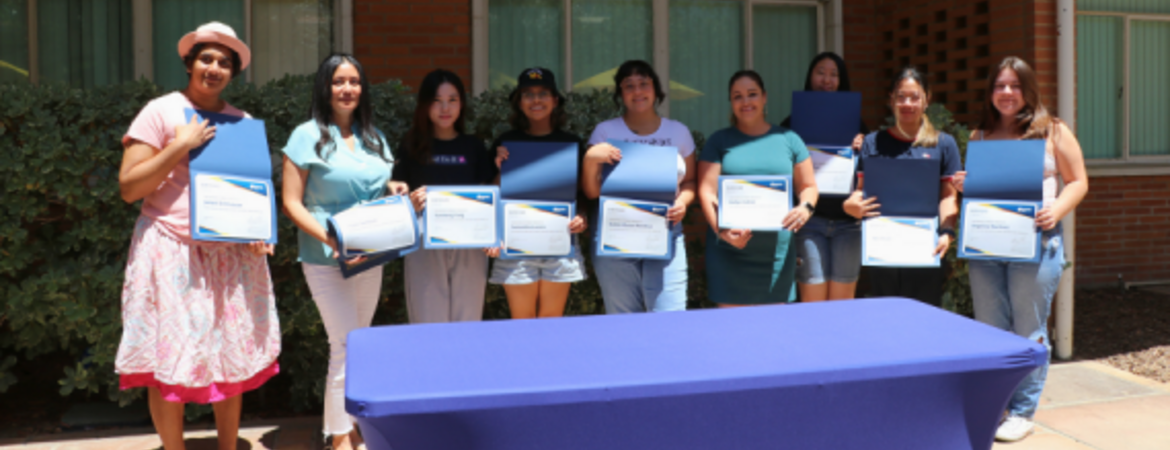
The program provided undergraduate students with new skills and tools they’ll carry with them throughout their academic careers.
As a concept, digital scholarship broadly refers to the use of digital tools or methods for scholarly activities like research, teaching, and publishing. The goal is to leverage digital tools and platforms to enhance the traditional scholarly process.
UCR Library staff led 24 undergraduate students through a six-week digital scholarship program that saw the students explore primary sources from UCR's Special Collections & University Archives. This experience focused on student activism and BIPOC student voices from UCR’s past while also teaching the students valuable digital research skills.
Digital Scholarship Librarian Rachey Starry (who left the UCR Library in August 2023), Digital Initiatives Specialist Krystal Boehlert, Special Collections Public Services, Outreach & Community Engagement Librarian Sandy Enriquez, and Innovative Media Librarian Alvaro Alvarez led the effort to get the Digital Scholarship Program up and running for summer 2023 and are happy with the results.
“It was great to be able to share different skills, ideas, and techniques with the students,” Krystal said. “Being able to do a deep dive in the archives as an undergraduate is valuable — they gained practical research skills they’ll be able to apply in their courses moving forward.”
Students in the free, non-credit bearing program received hands-on training using different kinds of software to create and analyze digitized materials and produced their own findings about the past through workshops, lab sessions, and proposing their own digital exhibit.
The workshops offered covered a range of topics, which included: Encountering Archives: Materiality and Space, DIY (Do-It-Yourself) Imaging in the Archives, Metadata & Data Management for Digitized Archival Materials, OCR (Optical Character Recognition): Turning Digitized Documents into Searchable Texts, and Close and Distant Reading: Quantitative Text Analysis for Archival Materials.
“My favorite was the Imaging workshop,” shared Bobbi Monae Mandour, an English major. “3D imaging and printing isn’t something that I had been exposed to. I’m not a techie, but it was great to learn 3D printing is something I can do here on campus.”
While at first glance it may seem like the program would only be of interest to undergraduate students in the humanities, students studying in other fields were also part of the program and found the experience rewarding.
“I’m a business major, but when I saw words like metadata and 3D/2D imaging, I was interested,” said Yumeng Yang. “I really liked the program and what I learned, plus it was free and it didn’t conflict with any classes.”
Many students are eager to apply the new skills and research methods they learned in the program to their own coursework.
"With the tools I learned in the program, I feel like I can really impress my professors,” said Samantha Lucero, a Sociology/Law and Society major reflecting on her own experience. “Having a better understanding of primary sources, different ways to cite, and research skills are things I’m excited to carry with me. "
This program provided a unique opportunity for undergraduates to access archives, explore digital research tools, and engage in hands-on learning. Students who participated in the program, like Samantha, recommend applying to the program if the UCR Library offers it again next summer.
“You’ll learn really useful skills you can use at UCR,” Samantha said. “And as someone interested in graduate school, I feel like I strengthened skills I’ll need for the future.”
Mad about monster movies: Mark Glassy
“Mark Glassy and Frankenstein: Men of Many Parts” features UCR alumnus’ passion for science and science fiction. His SF collectibles will be on exhibit through Dec. 14.
Over the decades Mark Glassy has collected more than 100,000 science fiction items.
Visitors to his home office are greeted by B-9, the Robot from “Lost in Space.” Glassy, a 1978 UC Riverside graduate-turned-cancer research scientist spends most of his evenings sculpting figurines that capture scenes from his favorite science fiction films.
His creations and a small selection of his collectibles became a special exhibit titled “Mark Glassy and Frankenstein: Men of Many Parts” at UCR’s Tomás Rivera Library’s Special Collections and University Archives in honor of the 200th anniversary of Mary Shelley’s Frankenstein.

The 12-week exhibit on the fourth floor of the Rivera Library will feature guided tours with Glassy. In October and November he’ll offer six guided tours, including one on Halloween. Visitors who arrive at the Special Collections and University Archives will hear how his fandom for science fiction grew over the decades and will also learn how his sculptures evolve from an idea to an actual piece of art. Included in the exhibit are sculptures, comic books, posters, and other Science Fiction and Horror collectables that reflect Glassy’s life-long passion.
Exhibit events also include UCR Professor of English and Director of Speculative Fictions and Cultures of Science program Sheryl Vint, who will lead a conversation with German author and journalist Dietmar Dath, on Oct. 15. Dath is currently working on a Frankenstein screenplay.
All events are free and open to the public, but RSVPs are recommended, as space is limited:
- Guided Tours with Mark Glassy: frankenstein-tours.eventbrite.com
- Dietmar Dath with Sheryl Vint: dath-vint.eventbrite.com

Glassy’s connection to UCR goes back to 1975 when he started his doctoral research in biochemistry. He said UCR granted him both support and independence while he spent endless hours in the lab, designing his own experiments and researching B-lymphocytes, a type of white blood cell that supports the immune system by fighting off germs and diseases. For the past 37 years he’s been working at UC San Diego, most recently taking a role as a visiting scholar at UCSD’s Moores Cancer Center. Throughout those decades, Glassy has developed pritumumab, a pharmaceutical drug designed to cure brain cancer. His drug has been submitted to the Food and Drug Administration for review, he said.
UCR’s education helped steer his career. When Glassy heard UCR Chancellor Kim A. Wilcox speak during a San Diego reception two years ago, he was impressed with UCR’s growth, diversity, its mission to support first-generation students, while simultaneously supporting faculty who conduct world-class research.
Glassy’s two passions: finding a cure for brain cancer and delving into Science Fiction, lead him to his home office every day. There, he either writes articles for the scientific journal he founded, Human Antibodies, watches films that inspire his art, or sits in an old elementary school desk, surrounded by wire and stainless steel molding tools, small paint bottles, and jars of Apoxie Sculpt clay.
“In terms of the research environment, I cannot separate the two, science and science fiction. It’s impossible for me. When I’m at the lab, I’m still making analogies and metaphors,” said Glassy, who has authored three books.

Shelves line the office walls, holding thousands of little mementos of decades of Science Fiction history: triceratops, R2-D2, Stormtrooper masks, Pez candy dispensers, a Superman comic book collection from the 1950s, an 1831 edition of Frankenstein the novel, and a human-sized Creature from the “Black Lagoon.”
“It’s me. Look around, it’s me,” said Glassy, 66. “No matter how hectic, how stressful my day has been, when I walk into my room, it all washes away. I can’t help but smile.”
Featuring Glassy’s works and collection brings to the exhibit “the things that make him a ‘Mad Doctor,’” said JJ Jacobson, UCR’s Jay Kay and Doris Klein Science Fiction librarian. Jacobson is one of two exhibit curators. Glassy’s anti-cancer drug addresses brain tumors, the “the way one of his beloved comic book heroes cleans out a secret lab full of supervillains,” Jacobson said.
“Mark has the kind of vision, passion, energy, and concentration that make it really fortunate for the rest of us is that he’s not the kind of Mad Doctor who wants to rule the world. Instead, he’s mad for science fiction, comic books, and horror movies; absolutely mad about the range and power of the human imagination, and, of course, really mad at cancer,” Jacobson said. “There are many collectors out there who love Frankenstein, there are many model makers who do wonderful work, but what sets the material in ‘Men of Many Parts’ apart is all that combined with Mark’s incredible eye for detail, the scientific understanding with which he views the popular culture of monsters, and his extraordinarily wacky sense of humor.”
- Written by Sandra Baltazar Martinez
Library student employees who are “Living the Promise”: Mohamed Jawara
If you’ve visited Rivera Library in the past three years, you’ve likely seen Mohamed Jawara’s smiling face behind the front desk.
What you might never have guessed is that Jawara took the job at the Circulation / Reserves Desk to help him conquer shyness and to improve his communication and interpersonal skills.
“I saw how the staff at the front desk would help patrons, and I thought it would be a great way for me to get out of my comfort zone,” Jawara explained. “Working at the library, it’s a really positive environment. Everyone is very caring and supportive and they’ve played a great role in me improving myself and becoming a better person. We treat each other as a family.”
“Mohamed is a true servant leader at heart,” said Leslie Settle, Rivera Library's Access Services desk coordinator. “As a student supervisor, he sets the tone for the front desk and is an exemplary example of phenomenal customer service. When I think of training others in leadership and customer service, the things I have seen Mohamed do come to mind -- from how to greet patrons to making everyone feel like they belong.”
Born in the Republic of Sierra Leone in West Africa, Jawara immigrated to the United States in 2008 with his mother, a certified nurse assistant. At first, they stayed with his uncle’s family in Torrance, CA, but eventually settled in Loma Linda.
In 2016, Jawara’s younger brother and two sisters arrived from Sierra Leone. His father, formerly an accountant for the Sierra Leone Ministry of Defense, finally joined his family in May 2018, more than a decade after his wife and eldest son first came to the U.S.
“I felt like my mother did a great job trying to substitute whatever support my father would have given me, had he been here,” he said. “Even though it was difficult, she made the process a bit easier.”
He chose to attend UC Riverside because of its proximity to home. “It’s easy to commute here, and it would have been very expensive to live in the dorms,” he said.
Once he arrived, he was pleased to discover that UCR lived up to its reputation as a diverse campus. “It’s been great to meet people with different backgrounds of different races and develop friendships with them. That has enhanced my education here at UCR.”
Jawara graduated with the Class of 2018 with a Bachelor of Arts in political science with a focus on law and society. He hopes to pursue graduate study and work in the field of public health, an interest that stemmed from tragedies he witnessed in his homeland.
Before Jawara came to California at age 12, he saw many horrors in the midst of Sierra Leone’s civil war, which only compounded challenges the country already had with meeting basic healthcare needs.
“I was born in the middle of that upheaval,” he said. “Growing up, I got to see those casualties of war, people who had limbs amputated. It was common to see close friends that I grew up with dying from malaria. I also had an uncle who suffered from a liver condition. The right professionals weren’t even available, so he relied heavily on native healing. Unfortunately, it just got worse and he ended up passing away.”
His father and siblings were still in Sierra Leone during the Ebola crisis of 2014. “It was really excruciating to hear their calls and how frightened they were,” he said. As a result of these experiences, Jawara has devoted his studies to learning how to improve healthcare so that he can someday make a difference in Sierra Leone by building more hospitals staffed with trained medical professionals.
Settle commented, “Mohamed was born to understand and love all people in sincerity without judgment. Not only is he talented, but he has a purity about him that is unexplainable.”
How can someone who has seen firsthand so many gruesome tragedies still have such optimism? In a word: travel. “It plays a big role in me having a more positive outlook on life because I’ve had the opportunity to see the difference between having to struggle for basic things,” Jawara said.
“See how the rest of the world lives. By traveling, you get to compare and contrast and have a much deeper appreciation for what you have, no matter how little,” he added. “For you, it might seem like it’s nothing, but to someone else out there, it’s the whole world.”
In June 2018, Jawara was hired as a Research Assistant at UC Riverside's School of Medicine's Center for Healthy Communities. Additionally, he continued at an internship with the Riverside County Department of Public Health.
While interning and working, Jawara will begin applying for a variety of graduate programs in social science and healthcare.
New archival collections available for winter quarter 2018
Special Collections & University Archives staff are constantly working to process recently acquired collections and make those materials ready for use by students, faculty, and researchers.
Each quarter, we will provide a list of UCR Library's newly processed archival and primary source collections. Check out the list below to see if there are any items that fit your research area, or share with a friend!
Below you'll find brief descriptions and links to the finding aids or collection guides for each new collection. To use any of these materials, simply click the "Request Items" button at the top to submit a request, and log in with our Special Collections Request System. For more on conducting research in Special Collections, see this page.
SCUA is open to the public on weekdays from 11:00 am – 4:00 pm. Check here for closures or other changes to our regular hours.
For questions, email specialcollections@ucr.edu.
Newly Processed Collections – Winter 2018
1.83 linear ft. (3 boxes)
This collection contains role-playing games including Advanced Dungeons & Dragons, Marvel Super Heroes, and DC Heroes. Items in the collection include player and master manuals, as well as maps and character pieces.
1.75 linear ft. (7 boxes)
This collection consists of around 1500 photographs and photographic postcards featuring the people, places, and events significant to the Mexican Revolution (1910-1920) from the studio of Luis Ramirez Pimentel, including many images from the Chihuahua Campaigns (circa 1910-1913).
0.21 linear ft. (1 box)
This collection contains transcripts, MP3 audio files, and digital images related to the Inlandia Institute's oral history project, "'Making Waves: Women's Environmental Movement," which documented the stories of seven Inland Empire area environmentalists. Women interviewed for the project included Jane Block, Liz Cunnison, Melba Dunlap, Beverly Wingate Maloof, Sue Nash, Penny Newman, and Ruth Anderson Wilson.
Seminario International Escenarios Politicos de la Transición a la Democracia records, 1989 (MS 017)
0.42 linear ft. (1 box)
This collection contains newspaper clippings and conference papers related to the "Seminario Internacional Escenarios Politicos de la Transición a la Democracia," a seminar held in July of 1989 that discussed the various political transitions from socialism to democracy occurring in Latin America.
3.33 linear ft. (8 boxes)
This collection consists of photographs and documents related to the Mission Inn, a national historic landmark located in Riverside, California, generally considered to be the largest Mission Revival Style building in the United States. The collection also includes images of Frank Miller, the first owner of the Mission Inn, Riverside's Mount Rubidoux, and other historic buildings in Riverside.
1.67 linear ft. (4 boxes)
The collection consists of items collected by Laura Klure related to the Young Women's Christian Association (YWCA) of Riverside, a women's organization dedicated to empowering women and advocating for civil rights. Materials in the collection mostly consist of interviews, research, notes, and other documents related to the Riverside YWCA History Project, which was an effort by Klure and others undertaken in the early 1990s to document the history of the local branch and create an archive of Riverside YWCA records.
0.42 linear ft. (1 box)
This collection contains schedules and proceedings from the "Seminario Partidos Políticos en los Procesos de Democratización," a seminar on the democratization of political parties in Paraguay held in 1989 and organized by the Grupo de Trabajo de Partidos Politicos (CLACSO) and the Centro Paraguayo de Estudios Sociologicos (CPES).
1.25 linear ft. (1 box)
This collection contains correspondence, documents and other material from Eloise Emerson, an accomplished public health nurse who worked for the Riverside County Department of Health. The majority of materials in the collection focus on her nursing career, and her lobbying effort against the California State mandatory retirement age.
1.5 linear ft. (6 photograph albums)
The collection consists of photographs from the Mexican Revolution (1910-1920) taken by Agustín Victor Casasola, a Mexican photographer and co-founder of the Mexican Association of Press Photographers. Photographs in the collection include depictions of daily life in Mexico, and Mexican presidents in the early 20th century. In addition to photographs taken by Casasola, there are additional photographs on Mexico and its politics taken by Casasola's sons after his death in 1938.
0.83 linear ft. (1 box)
This collection consists of an album of photographs depicting various scenery, people, agriculture, and ruins in Paraguay in the early 1900s. Photographs in the album include views of a fleet from the 1912 Revolution, the Encarnación cyclone disaster of 1926, the Jesuit ruins at Jesus y Trinidad, and of the inauguration of the Salesian Agricultural School at Ypacaraí.
0.5 linear ft. (2 photograph albums)
This collection contains photographs of various people and landscapes of Mexico taken by Hugo Brehme, a German-born photographer that moved to Mexico in 1905.
0.71 linear ft. (2 boxes)
This collection consists of 60 cartes de visite, owned by José Antonio Ulloa of Zacatecas, Mexico. Items in the collection include photographs and portraits of European, South American, and Central American royalty and military members from the 19th century. Many of the cartes de visite depict members of European royalty related to Napoleon I, as well as cartes de visite of figures surrounding the trial and execution of Mexican Emperor Maximilian I in 1867.
1.67 linear ft. (5 boxes)
This collection contains a variety of lantern slides depicting geographical areas, buildings and ruins, famous individuals, and people of various countries.
2.33 linear ft. (3 boxes)
The collection contains black and white photographs taken during the Mexican Revolution in the early 20th century. Photographs in the collection cover various locations, battles, soldiers, and important figures such as Álvaro Obregón, Francisco Madero, Pancho Villa and Pascual Orozco.
2.0 linear ft. (1 photograph album, 1 box)
The collection consists of photographs of Mexican revolutionary and President Venustiano Carranza, including depictions of Carranza on national tours and in areas being attacked by Revolutionaries during his time as Mexico’s president (1917-20). Photographs in the collection also include portraits of Carranza and other prominent Mexican figures, including Isidro Fabela and Álvaro Obregón.
0.54 linear ft. (1 photograph album, 1 box)
The collection consists mainly of photographs of Francisco “Pancho” Villa, a Mexican Revolutionary general and prominent figure during the Mexican Revolution in the early 20th century. Photographs in the collection include portraits of Villa, Villa with his troops and other military figures, Villa's murder in 1923, and photographs of Villa’s family.
0.42 linear ft. (1 box)
This collection contains newspaper clippings, articles, and other material on the history of the Gage Canal, the system built in 1898 to supply water to the city of Riverside, California. Materials in the collection cover the sale of the Gage Canal company, various lawsuits and legal issues, and correspondence and photographs belonging to John M. Mylne, the superintendent and engineer of the Gage Canal System.
0.42 linear ft. (1 box)
The collection consists of 27 stereoscopic photographs depicting various locations in Jerusalem published by Underwood & Underwood at the turn of the 20th century. The majority of the photographs come from the "Jerusalem Tour" set published in 1904.
Celebrating our Class of 2020 library student employees
Each spring, the UCR Library typically hosts a Student Employee and Staff Appreciation Picnic to honor the people who serve the UC Riverside community through their work at the library.
Due to the COVID-19 closure, we were not able to hold the celebration this year, nor could we recognize the 22 library student employees who would be graduating with UC Riverside’s Class of 2020: Cristina Canales, Janely Cruz, Julianna Gil, Sheyla Hernandez Amador, Leonardo Kim, Jiayi Lin, Ayanna McDowell, Belen Meza-Hernandez, Alejandro Moody, Giselle Moreno, Sophia Mosbe, Ashley Nguyen, Jalak Patel, Victoria Pedrosa, Stacy Rodriguez Chavez, Justus Ross, Elias Sells, Jacqueline Stewart, Glen Sturgeon, Isabel Torres, Tracy Vargas, and Kimberly Wu.
We asked our 2020 graduates to share their favorite memories from their time spent working at the UCR Library, and what they would miss most about working here. Here are some of their responses:
Kimberly Wu
“My favorite memories from working at the library was getting to see parts of Orbach and Rivera that I didn't know existed if I wasn't working there. It was interesting to see where some doors led to, and I also got to learn where all the different stairwells were as well. I am going to miss joking around with my coworkers and not having to wait in a line to use the printer (because there's a printer inside the office).”
Jalak Patel
“One of my favorite parts about working in the Creat’RLab is the amount of flexibility and creativity I’ve had to grow personally and professionally. Each day, I was constantly challenging myself with new technology and engaging with various students ranging from different majors/years. At the end of the day, the best part was always interacting with students. I always enjoyed giving tours and sharing all the amazing things that Creat’RLab had to offer that I loved dearly myself. I easily fell in love with the Creat’RLab space and community that I would find myself in there often even when not on my shifts. That’s when you know your job doesn’t feel like work!
“The greatest thing about working in such a creative and innovative space was the ability to engage in a wide variety of activities. As a student technician for three years, I had an opportunity to grow and engage in various creative facets ranging from 3D printing, sewing, to VR headsets and even consulting students for laser cutting. And that was the best part, no day at work was the exact same! I am beyond thankful to UCR Library, Creat’RLab community, bosses, and my small group of close-knit co-workers who easily became family and made my first job an amazing experience!”
Ayanna McDowell
“My favorite memory was our team bonding experience last fall. We had to get over a rope without touching it. I ended up splitting my pants, but it was such a good time. I will miss the staff and student employees the most. They truly were a joy to work with; and I know that is very rare in a work environment. So I will miss them deeply.”
Giselle Moreno
“My favorite memory working at the library was setting up for Finals Week Stress Relief week with staff at the front desk. I loved collaborating with my other coworkers and being able to be a resource to my peers during finals week. What I will miss most about working at the UCR Library is working in a supportive environment. I feel very lucky to have had the opportunity to be a part of a team that uplifts their student workers and views them leaders. I will also miss my supervisors Elisha, Greg and Michelle. I am grateful to have been able to work with each and everyone of them.”
Sophia Mosbe
Favorite memory: “Playing cornhole at the Student Picnic last year with library staff.”
“I'm going to miss the staff and my fellow student workers. Everyone was always so kind and cared about each other that it really did feel like a second family. Not being able to finish my final quarter with them has been heartbreaking, but I am determined to pop in for a visit once things become relatively normal again. #OrbachPride”
Julianna Gil
Favorite memory: “Laughing and joking around with my student coworkers, and developing great friendships with them. As well as drawing little pictures on the whiteboard inside our workspace.”
What she will miss: “All my student coworkers and archivists that worked in Special Collections. They were always so kind to me. Both my supervisors were great and incredibly understanding.”
Leonardo Kim
Favorite memory: “Going out with co-workers after shifts on hangouts and grabbing last minute food.”
“I will miss having a flexible schedule and working with Shelly and Greg. I think they are some of the best people I have met at UCR and have been really helpful when I had questions. Hopefully we can still be in touch after I graduate.”
Isabel Torres
“My favorite memory from working in the library is being able to help my fellow classmates discover the amazing resources the library has to offer. I will miss working with the department of Teaching and Learning and my Information Desk coworkers.”
Glen Sturgeon
Favorite memory: “The time everyone passed around a boxed toy called a Shmoo. It was such a ridiculous object and the staff reacted to it in varying degrees of delight and horror. The library has so many quirky holdings in special collections, it always brightened my day to help process them! See attached photo of the Shmoo.

“I already miss the staff at SCUA so much! Being at Special Collections and University Archives cemented my love for archives and library science. Thanks to the support and encouragement of my supervisor, Andrew Lippert, I applied to and was accepted to UCLA’s MLIS program this fall! I’ll miss sharing strange finds from the collections and gawking at new rare acquisitions with the incredible staff of SCUA. The real treasures in the archives are the people who work there.”
Elias Sells
“My favorite memory is probably just hanging out in the office and talking with all of my coworkers and my boss on slow days. What I'll miss most is probably the Thanksgiving potlucks.”
Stacy Rodriguez Chavez
“My favorite memory from working at the library is the people that I got to work with. I had amazing people that helped me and encouraged me throughout the years that I worked at Orbach. I'm forever grateful for Kit, Pat, and Sara for making my work environment amazing and for the constant motivation they would give me. What I'll miss the most from working at Orbach would be the people I learned from and worked with. I wish them the very best and hope to see them very soon.”
Jacqueline Stewart
“My favorite memory working at the library is just being there almost everyday working with so many cool stuff at special collections. The coolest thing I saw was a really tiny book that fit on the tip of my finger. I will miss everyone I worked with. Everyone I worked with was so helpful and such a pleasure to work with.”
Belen Meza Hernandez
“My favorite memory of working at the library is during finals week, when the staff would bring in puppies to de-stress. And also, when my friends would ask me for help to find library materials. What I will miss the most is the friendliness of the staff and having a flexible schedule that allowed me to focus on school.”
Victoria Pedrosa
“To the Class of 2020, we did it! Thank you to Special Collections, you made working there one of my most memorable experiences at UCR.”
Janely Cruz
“My favorite memory from working at the library was going to the annual picnics and potlucks. Seeing everyone come together and have a good time was always something I looked forward to. I will most definitely miss all my coworkers, supervisors Shelly and Greg, and all the other staff at the UCR Library. From my first day working there, everyone was so welcoming. I am going to miss coming into the library almost every day and working with the most amazing people.”
Sheyla Hernandez
“We made it!”