Search
Search
GIS Day Poster Exhibit Showcases Diverse Data
UCR Library’s GIS Day Poster Exhibition opened on Thursday, November 3, 2016 in the atrium of Orbach Science Library, showcasing the use of Geographic Information Systems (GIS).
The 2016 display includes submissions from a diverse variety of contributors, including external community agencies as well as faculty, staff, and students of UC Riverside.
“I was really pleased with the diversity of departments that contributed posters this year,” stated Janet Reyes, Geospatial Information Librarian and the GIS Day Exhibition curator.
A number of posters focused on UCR biogeographic research. The Center for Conservation Biology produced a vegetation map of Dos Palmas Conservation Area in Coachella Valley, part of a habitat conservation plan. Environmental Sciences’ display used GIS to estimate groundwater recharge and evapotranspiration. A student in Soil and Water Sciences displayed locations suitable for irrigating avocados with recycled water.
The exhibition clearly demonstrated the application of GIS across the social science disciplines. The Psychology department submitted two posters. One shows how GIS can be applied in psychological sciences. Another is from a sibling and twins study that tracks environmental factors associated with cognitive performance from childhood to the cusp of middle adulthood.
A Public Policy poster demonstrates the relative prosperity of ethnic, minority-owned enterprises in the United States, based on location. Another poster with aerial photography of Vietnam shows how the Vietnam War affected the country’s landscape. An Anthropology graduate student created a map to show the language of origin for place names in a specific region of Mexico.
UCR administrative units contributed posters demonstrating the use of GIS for operations management. Agricultural Operations showed how GIS is used to manage UCR’s agricultural research land, and Capital Planning submitted three posters presenting information about the School of Medicine, the Sustainability Program, and the R’Garden. The Riverside Police Department contributed posters mapping crime data and demonstrating how they perform analysis on crime data.
This poster exhibition usually happens every November, in connection with GIS Day. Reyes added, “I think we’re going to see more GIS used on campus as time goes by, so that will make next year’s offerings more varied and informative. In the future, we might add workshops, live presentations, and other interactive, hands-on activities.”
Faculty and staff who contributed to this year’s event included: Hoori Ajami, Environmental Sciences; David Biggs, History; Chandra Reynolds, Psychology; Qingfang Wang, School of Public Policy; Steve Ries, Agricultural Operations; Roxann Merizan, Lynn Sweet, Bob Johnson, James Heintz, and Cameron Barrows from the Center for Conservation Biology; Elizabeth Munoz Diaz, postdoc scholar, Psychology; and Karen Jordan, Capital Planning. UCR Students included: Jenessa Stemke, Soil and Water Sciences; Joshua Lieto, Anthropology; Paige Trubenstein, Psychology; and Omar Staben, Psychology.
Reyes has initiated an ongoing monthly Brown Bag GIS Lunch for those interested in discussing the various ways that GIS can be applied across multiple disciplines at UCR. For more information, contact Janet Reyes (janet.reyes@ucr.edu).
Notable New Resources
Celebrating our Class of 2019 library student employees
As the second-largest student employer on campus, each spring the UCR Library takes time to celebrate the students who comprise half of our staff team.
At the annual Student Employee and Staff Appreciation Luncheon held in the lower courtyard at Rivera Library, we also recognized these 25 library student employees who will graduate with UC Riverside’s Class of 2019: Alma Ramos, Andrea Mares, Anthony Valverde, Cameron Tuck, Chia Wu, Cindy Chau, Daniel Chen, Dulce Melo, Gursimran Singh, Hana Tran, Jacqueline Hernandez, Janice Liu, Jessica Leon, Jose Peralta, Kaitlyn Lara, Margaret Gardner, Matthew Diep, Matthew Garrido, Matthew Moreno, Noah Nguyen, Patrick Zydziak, Reajinae Jenkins, Roger Peralta Gomez, Serena Rodholm, and Sergio Banegas.
We asked our 2019 graduates to share their favorite memories from their time spent working at the UCR Library, and what they would miss most about working here. Here are some of their responses:
"I have worked at Rivera Library since my very first weeks of my first year of being at UC Riverside, so I have a lot of great memories from these past 4 years. It took me a while to pick my favorite one, so I would have to say my favorite memory from working at the library is being able to see our wonderful diversity at this school. I come from a place where there are predominately Asian and Hispanic people and not much diversity. The Rivera Library is one of the most visited places on campus, so I was able to see many different students, staff, and visitors. After my first month working here, it was nice to see how diverse our campus is and I wish the world was more like it. Four years later, I believe I have assisted and encountered almost all the ethnic groups around the world and it's a pretty great achievement. I myself come from Poland and I do not think I have met another individual from there at UCR, but that just shows the diversity of the campus. I wish I had the time to get to know these different ethnic groups better, but I cherish the short conversations I was able to have. I think what I will miss most about working here is being able to actually encounter and talk to a diverse community. Working at the library gave me an excuse to talk to and meet people. I cannot think of any other way to be able to talk to these people unless I go up to anyone on campus and introduce myself to anyone who walks by me but that is obviously out of the norm. The food industry also experiences many different people, however, it is a much faster paced environment and gives workers not much time to see around them. I'm not sure if my future career after graduation will have a diverse community like this, so that is something I will surely miss from working at the UCR Library. " - Patrick Zydziak
"My favorite memory from working at the library is actually a collection of memories. I loved running into my professors while working at the desk. I enjoyed having conversations with them about what books they were reading, any literature recommendations they had, etc. I also enjoyed being helpful to those who were helpful to me in the classroom. It's a wonderful feeling to be able to give back to professors who have given you so much. It was also crazy to see how much they read! I am going to miss my coworkers and supervisors the most. I have been working at the library since I started undergrad and because of this, my coworkers have become close friends. We always catch up with one another during our shifts. Even outside of the library we are texting one another, making each other laugh. We are a group of students from different backgrounds, different majors, different years -- but we are all connected by our love for the library. I will especially miss my boss Leslie Settle. She always emphasizes how we are a family and we look out for one another. She would continuously go out of her way to help her student employees, and she would give us cute treats for each holiday! Her laugh is contagious and her smile lights up the room. It is truly bittersweet to leave such a caring group of people." - Andrea Mares
"It is really difficult to pick a favorite memory from working at the library because there were so many fun moments from collection maintenance projects to staff potluck events. If I had to pick one, it would have to be getting to serve pie to fellow students on Pi Day. I got to smile at stressed students during week 10 and wish them good luck on their finals while handing them free food. Moments like those made my job at the library more special. I think I am going to miss all of the friendly people I have had the opportunity to work with. It has been really fun to interact with new faces every year." - Jessica Leon
"My favorite memories are the crazy finals week festivities. I loved helping set up events to lighten the mood, listening and motivating patrons to push through until school break, and seeing all the funny things patrons would resort to sleeping on. Finals week brings a bittersweet sense of community feeling to the library as it is stressful because we all have important deadlines and tests to take, but comforting because we're all going through similar struggles. The thing I'll miss most about about working here at the library is how much the career staff here supports and cares for the student workers. It is so easy to get adjusted to working here because the staff is so helpful and friendly. I have never seen another workplace that praises and supports their workers as much as they do here. Shoutout to everyone working in circulation, you guys are wonderful." - Anthony Valverde
"Even though it was a stressful time for myself, students and staff alike (as they had to organize and put on a variety of events), my favorite memories are usually associated during the Finals Week Stress Relief events. I enjoyed working finals week because of the various events we had to host. It felt really good to see how grateful students were when we handed out food, scantrons, UCR gear, etc. My favorite event was probably working Therapy Fluffies. The dogs were honestly the best and always brought a smile to my face. I will probably miss the staff the most. My supervisor, Elisha Hankins, gave me so many opportunities to be a leader, grow, and flourish both academically and professionally. She hired me for my first real job and I will be forever grateful she took a chance on me. I will also miss the other staff; they were also so welcoming, available, and ready to help me with whatever assignment or life decision I needed to make. The environment was always cheery and even on the not so good days, they were always there to make it a little better." - Alma Ramos-Gutierrez
"Working at Special Collections has been one of the most formative experiences of my collegiate experience. I have made some of the closest friends working at the UCR Library that have influenced my life for the better." - Kaitlyn Lara
"My favorite memory from working at the library is when I helped out with the Therapy Fluffies, and was able to hold them! Something that I will miss the most from working at the library will be the people. Everyone is so kind and makes you feel welcome every time you enter the circulation desk." - Jacqueline Hernandez
Robin M. Katz receives James Harvey Robinson Prize from AHA
UCR Library is proud to congratulate our Outreach & Public Services Librarian, Robin M. Katz for receiving the James Harvey Robinson Prize from the American Historical Association.
The James Harvey Robinson Prize is awarded to the creators of a teaching aid that has made the most outstanding contribution to the teaching and learning of history for public or educational purposes. Robin and Julie Golia, her project partner at Brooklyn Historical Society, were recognized for the excellence of their work on TeachArchives.org. The award ceremony was held in Colorado at the Sheraton Downtown Denver on January 4, 2017 during the AHA Annual Convention.
Robin and Julie received a three-year grant for the US Department of Education through the Fund for the Improvement of Post-Secondary Education (FIPSE), which was intended to spur the development of innovations that improve educational outcomes and develop an evidence base of effective practices. “We wanted it to be about more than just our primary grant audience,” Robin stated. “We wanted to help educators to get their pedagogical practices up-to-date.”
They used the grant to support a program called Students & Faculty in the Archives (SAFA). "One of the great things about the project that gave birth to TeachArchives was that Robin was an archivist and I was an historian, so we brought very different perspectives to the work," said Julie. Over a period of three years, SAFA worked in partnership with three colleges that were in walking distance from the Brooklyn Historical Society, each of which did not have special collections in their own libraries.
Robin and Julie’s goal with SAFA was to bring students in to use the archives for hands-on learning. “Anyone can come use special collections,” Robin said. “We wanted the students to have a more meaningful use of the archives, more active and hands-on learning, where they could apply themselves to a problem using the collection.” From 2011 to 2013, they collaborated with over 1,100 students, 18 partner faculty, and 65 courses over four semesters on three different campuses.
They measured and assessed the impact of their program and found that the students who came to use the archives were more engaged, had better academic performance, better retention, and higher rates of course completion than their peers. The overall findings of the program determined that learning in archives can positively affect students.
“We were really passionate about getting more and more students in, and we were in a spot where we really got to focus on it, so that was a nice luxury,” Robin explained. “Our intention was to share universal lessons with a wider global audience and engage and empower educators from elementary school to graduate school with practical how-to articles, case studies, and sample exercises with agendas, lesson plans, and handouts, as well as documentation for the grant project.”
According to Robin, the grant called for dissemination to share what they had learned, so she and Julie gave countless conference presentations and published several articles to share their findings. They also advocated to create the TeachArchives.org website to make the information available online for free to a global audience.
"At the AHA awards ceremony, I had the opportunity to speak to a few of the people who did the peer review process for the award," explained Julie. "It was terrific to learn that the processes, the articles, and the other tools that we created on the website are being used at all different levels of education, from primary schools to colleges. That it is exactly what we intended it to be. It wasn’t just the design how we saw it in our heads, but it was great to see that was how it was playing out across the country. That was incredibly gratifying.”
Now that Robin is at UC Riverside, she hopes to expand on her work with TeachArchives through the instruction project that she is helping to build by bringing this new method of primary source instruction to Special Collections & University Archives.
Affordable Course Materials Initiative saved UCR students $1.5 million
Where there’s a will, there’s a way – and a team of UC Riverside faculty and staff has devoted the last few years to finding innovative ways to make course materials more affordable for our students.
Survey results indicate that the Affordable Course Materials Initiative (ACMI) program has succeeded so far, having saved students more than $1.5 million over the past two years, according to Instructional Designer Nathaniel Wildes.
Wildes calculated these savings by factoring in the current quarter and recurring courses. “On average, it’s a little over $100 cost savings per student,” he said.
He shared these facts and more on Thursday, April 5 at an event called Democratizing Access to Student Success: Student and Faculty Perspectives on Affordable Course Materials, where attendees learned about the local impact of the ACMI since its 2015 launch. Held in the Center for Teaching and Learning on the first floor of Rivera Library, the event was co-sponsored by the UCR Library, the UC Riverside chapter of CALPIRG, and ITS.
“This is a critical social justice issue and one that is especially important on our campus,” said UCR Library’s Director of Teaching and Learning Dani Brecher Cook, who also coordinates the ACMI program for UC Riverside.
Cook’s welcome remarks included statistics from the UCR Basic Needs Working Group, which reported that six out of 10 students experience food insecurity during their time at UCR and may not have sufficient funds to afford textbooks.
A panel of UCR students also shared their personal experiences with high-cost textbooks compared to open-access resources.
Miguel Ramirez, a second-year anthropology major, Vice Chair of the UC Riverside chapter of CALPIRG, and campaign coordinator for the Higher Education Affordability Campaign, ambitiously bought all his textbooks as a freshman. “But I found myself not having enough money to afford three meals a day,” he said. “The average student is expected to pay $1,200 a year in textbooks and school supplies which, for me, is equivalent to almost 3 months of rent.”
Ramirez appreciated that courses using open-access resources gave all students the same opportunity to succeed. “And in my experience as a student, I can tell that my peers in the classroom like it better, too,” he added.
Fifth-year religious studies major and member of Mujeres Unidas Abigail Garcia tried to cut costs by purchasing earlier editions of textbooks or by using eBooks, but found that those alternatives created other challenges. “With older versions of textbooks, I have to make extra efforts to find where the professor is at in my version. It is a lot cheaper, but it doesn’t allow me to be in sync with the rest of the class,” she said. “With eBooks, it doesn’t give me the opportunity to annotate as freely as I’d like to.”
Huma Khan, a first-year business major and CALPIRG member, appreciates the portability of eBooks. “I’m a commuting student, so I would have to carry like 3 textbooks in my bag every day,” she said. However, certain rules during exams can create obstacles students who rely on eBooks or online-only resources. “Sometimes in midterms, teachers are like, ‘Yeah, you can use a book but you can’t use your computer,’” she added.
Both Garcia and Khan have felt frustrated by spending high dollar amounts but only reading one or two chapters in a textbook as well as with access codes. Khan explained, “For my last math class, I had to buy a textbook for the access code and it was $160, and I never even used the textbook.”
“Like a lot of students, I actually went without,” said Semi Cole, ASUCR Vice President of Internal Affairs and a fourth-year political science & public policy major. “I decided to see what I could do, learn what I could from lecture, and just see how it would work. Ultimately, my academics suffered.”
“We need to continue to move forward on this issue and expand to a larger departmental commitment,” Cole added. “We’ve seen from the students here that allowing open source textbooks in the classroom can be successful.”
“It’s deeply appreciated by our students,” said Cook. “It can also lead to innovative and engaging pedagogies.”
Faculty guest speakers included ACMI grant recipients Ruhi Khan, associate professor in media and cultural studies; and Rachel Wu, assistant professor in psychology.
The ACMI was first spearheaded by Chikako Takeshita, associate professor of gender and sexuality studies, and launched at UCR thanks to an $18,000 grant from Computing and Communications. Due to the success of the initial program, in 2016 an additional $150,000 from the Student Technology Advisory Committee established an endeavor that would span three years. At present, the ACMI is in its second year of this longer-term effort.
UCR, CSUSB Sign Agreement to Co-house Water Resources Collections and Archives
Head librarians from both campuses articulate policies to jointly manage valuable collection of historical documents.
SAN BERNARDINO, Calif. — Cal State San Bernardino and the University of California, Riverside will co-house and share a valuable collection of water related-documents and materials.
The chief librarians from both universities, Cesar Caballero, dean of the CSUSB John M. Pfau Library, and Steven Mandeville-Gamble, University Librarian for UC Riverside, signed a memorandum of understanding on Sept. 24 that the two institutions will jointly house and manage the Water Resources Collections and Archives (WRCA).
The agreement, which was signed at the Pfau Library, lays out the policies and procedures on the collection and is an addendum to an MOU the universities signed in 2010, which enabled the collaboration, Caballero said.
The WRCA, which previously was housed at UC Berkeley, is a one-of-a-kind resource. It contains historical and contemporary water-related materials of great value to water agencies, governmental bodies, environmental groups, engineering firms, attorneys, historians and researchers.
The collection will be of great interest to students, faculty and researchers from both campuses and also researchers throughout both the University of California and the California State University systems, Caballero said.
“This is a world-class collection and will offer a lifetime of learning as a resource. It is extremely valuable,” Caballero said.
The WRCA collection will be divided between both libraries and jointly managed by Mandeville-Gamble and Caballero. The joint management of the archives will expand accessibility both in the state and nationwide, Caballero said.
“The agreement underlines the importance of the WRCA, which will complement and strengthen other collections at CSUSB and UCR along with the UC and CSU systems,” Caballero said.
Mandeville-Gamble said the agreement took on even more significance because of the state’s ongoing drought, which is unprecedented in the state’s written history.
He said the two universities are committed to studying issues affecting water in all aspects including environmental, public policy and social issues.
“It’s absolutely essential if we’re going to solve water issues. We’re in this together,” said Mandeville-Gamble, who added that the collection “will serve as a roadmap for greater collaboration between the two universities regarding water issues.”
The co-housing of the collection will work well with both universities as both institutions have strong backgrounds in water resources. UCR has a number of water policy experts in the School of Public Policy. CSUSB is home to the Water Resources Institute, which serves as a regional center for research and public policy analysis and houses the Joseph Andrew Rowe Water Resources Archives.
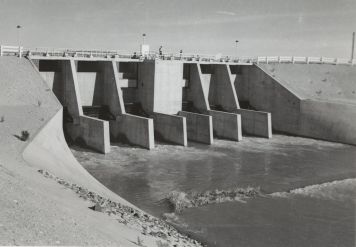
This photo of the junction of the All American Canal and the Coachella Canal was taken by Walter Leroy Huber and is part of a collection of the engineer’s correspondence, documents and photographs in the Water Resources Collections and Archives.
The WRCA collection is comprised of approximately 4,138 linear feet of published circulating materials, and more than 3,000 linear feet of special collections and archives. Approximately 5,545 linear feet of printed circulating materials are also housed in off-site storage facility near the UC Berkeley campus.
The original archive contained approximately 200 archival collections, 200,000 technical reports, 1,500 specialized newsletters, 5,000 maps and videos, 2,200 serials, 25,000 land photographs, 45,000 aerial photographs of coastlines, and digital resources in the form of CDs, DVDs, VHS tapes, and websites.
Since 2011, the archive has gained another 2,500 books, electronic documents, and thousands of hard-to-find publications such as conference proceedings, association publications, technical reports and bulletins, and meeting minutes that deal with water resources in California and the West.
More than 15,000 people visit the WRCA website every year, and another 80,000 visit the California Water Districts & Associations list. UCR librarians scan more than 6,000 pages of material from the collection for researchers and government employees across the state.
The collaboration of the two universities came about in 2010 when the statewide Water Resources Center was to be closed because of budget cuts. The University of California’s Agriculture and Natural Resources Center sought a new location to house the archives, which led CSUSB and UCR to develop an innovative and collaborative plan for joint management of the collection.
The acquisition of the new collection also coincided with the California State University system-wide Water Resources and Policy Initiative, which is centered at Cal State San Bernardino. The WRPI facilitates water-related research capabilities within the 23 CSU campuses.
Water policy experts in the UCR School of Public Policy conduct research on critical issues related to the interactions between water policy, water quality and water scarcity. They also contribute policy-relevant input to dialogues at the local, regional, national and international levels.
Founded in 1999, the Water Resources Institute of Cal State San Bernardino is an academic partnership with the Southern California communities that it serves. The institute is driven by the vision that sustaining water resources rests on sound research, analysis and public policy collaboration. The institute is active in the areas of science, public policy and history, and serves as a regional hub for providing information on water resources.
Let there be lightboards: One student’s role in the creation of Creat’R Lab
When Gustavo Correa’s Honors Principles of Civic Engagement assignment in fall quarter 2016 was to “find a way to be civically engaged,” that task could have unfolded very differently in the hands of another student.
As it happened, the Creat’R Lab owes a part of its inception to Correa, a fourth year electrical engineering major and project manager for the UCR chapter of the Institute of Electrical and Electronics Engineers (IEEE), who saw the need for a campus-wide makerspace.
“I was at a coffee shop in downtown Riverside and thought, ‘What if I create this space?’” Correa explained. “We had a space for electrical engineering students, but when it came to having a space for everyone to create, we didn’t have that at all. It helps us to apply the concepts we learn, so why not give this opportunity to everybody else, too?”
As the saying goes, great minds think alike. In a stroke of serendipity, in fall quarter 2016 the UCR Library had formed a committee comprised of representatives from the Library, Research and Economic Development (RED), and other campus stakeholders whose intent was to explore building a makerspace on the UCR campus. When committee member and UCR lecturer Jeff McDaniel heard that Correa was also considering that idea, he invited Correa to help shape the vision and identify the initial equipment needed.
After the Creat’R Lab launch, Correa’s workshops in the Lab were some of the most highly-attended. More than 60 students attended his first Arduino workshop, 80% of whom had never before worked with the tool (an open-source electronic prototyping platform that enables users to create interactive electronic objects).
“It was my first time teaching workshops and being a leader in an organization. It was a really cool experience, giving back to the community, to have a big impact on a lot of people at one time,” Correa reflected. “We had everyone from first years to graduate students from all majors, and the majority of them had no experience whatsoever with anything that I was showing them.”
With such a strong start, it’s no surprise to learn that Correa has even bigger hopes for what the Creat’R Lab could become, with additional community involvement and development funding.
“The school has recognized that we have a need. They made the space, they made it happen,” he said. “If nobody would have used it, then we wouldn’t need it – but we have demonstrated that there obviously is a need for this space. If we scale it up, it will be used more and more for many other things.”
Correa would like to see more of UCR’s student organizations get involved with Creat’R Lab, more collaborations with the individual colleges, more professional workshops, industry speakers, and of course more space and tools to accommodate the increased demand on resources.
“A lot of other schools have a whole building dedicated to this. What if we had a whole building?” Correa mused. “If we could take over that whole wing on the first floor of Orbach Library, with big glass windows and lots of lighting, a lot of huge tables, all the machining tools, things to build at any scale, huge animatronic sculptures, and then we could be as loud as we want in there.”
Beyond building, Correa would also like to see professional development workshops offered, including “soft” skills workshops such as how technical majors can better express themselves in writing or speech. “Let’s say we had a professional teaching advanced techniques on how to use a laser printer, or Garner Holt teaching us how to build animatronics, or someone from NASA!” Correa added. “A lot of them come from humble and diverse backgrounds so we’re able to relate to them.”
Before the Creat’R Lab can expand, however, Correa recognizes that there needs to be more direct involvement from the colleges. “When it’s one student trying to do it, it’s harder. If the school is trying to push it, it’s easier. We need to see emails from the faculty saying, ‘We want all you guys to work together to do these things – in the Creat’R Lab.’”
University Archives
Library Student Employees who are Living the Promise: Moises Martinez Cortez
Moises Martinez Cortez is a fourth-year Global Studies major who has worked as a Front Desk Assistant at UCR Library since fall quarter of his freshman year.
He grew up in the Lynwood – Downey area of Los Angles as the youngest of six children, raised by a single mother who immigrated from Nayarit, along the central west coast of rural Mexico. Cortez says, “I love her to bits.”
Though he’s the youngest in his family, Cortez is the first person in his family to attend a four-year university. “My older brother and sister went to community college for a while, but ended up dropping out,” he explained.
At first, Cortez considered attending UCLA so he could live at home, but a few things about UC Riverside helped to change his mind. “I come from a low-income background and UCR I felt had the right resources, both financial and the right kind of community, to carry on my education here,” he said.
While he felt out of place for the first quarter, he adjusted quickly, partly due to working at Tomás Rivera Library. “I’ve met a lot of people at the front desk,” he said. “I feel more connected to campus as well. I’ve made a lot of new friends with fellow student employees and also expanded my academic network.”
After getting better acquainted with many people here at UCR, Cortez added, “It’s the community that makes us stand out. There’s an environment of, ‘We want to collectively get ahead, make sure our students graduate, we want to grow.’”
He’s also grateful for the mentors he’s met here at the library. “All the staff in Circulation are super helpful, and Leslie [Settle, Access Services Desk Coordinator] is hands-down the best supervisor I’ve ever had,” he said. “She tries to help us out however she can. She always sends us emails about events on campus, and where we can get free food.”
“Moises is a selfless employee who always looks out for the interest of others,” Settle commented. “He’s willing to help where needed and never hesitates to do what is best for the team. Moises is innovative, in that he developed a communication chain for student workers.”
Cortez’s understanding and appreciation of the intersection between cultures is part of what led him to pursue a degree in Global Studies.
“It’s a major that’s becoming more and more relevant with the interconnected, global world that we live in,” he said. “A lot of political issues that are relevant here are also relevant in other parts of the world, as well. Climate change, global security, so many other things.”
Cortez studied abroad last fall as part of a human rights and cultural memory program in Buenos Aires, Argentina and Santiago, Chile. This experience gave him an outside-in perspective of the 2016 Presidential election. “It gave me an inside view of how people around the world view American politics,” he said. “The fact that they knew so much about the US really surprised me, and made me wonder why people in the US don’t know much about people in this part of the world.”
He currently divides his time between work, study, painting (primarily working with acrylics and graffiti art), and tutoring Italian, French, and Spanish for the Academic Resource Center.
“I’m kind of a nerd, to be honest. I really like learning languages,” he said. “I get a kick out of learning how to communicate with somebody else in a different way, in their language. I’m a native Spanish speaker, and I picked up French in high school. I studied Arabic and Italian here on campus. I’m currently trying to learn Portuguese because I’ll be studying abroad in Brazil in January.”
After he graduates, Cortez hopes to work for the US State Department as a Foreign Service Officer. “I’m interested in working abroad in US embassies with foreign governments, working on issues like security, immigration, development, and seeing what I can do as a representative of the US to help foster that growth and that development,” he explained.