Search
Search
Enhanced library catalog will launch July 2018
The library catalog will undergo a significant transformation this July when the UCR Library deploys an enhanced search tool with a modern, mobile-responsive visual display.
Designed by Ex Libris, the search tool will provide a streamlined user experience (UX) with improved access to library materials and intuitive ways for students, faculty and researchers to discover new content.
The added value to users will include:
- Combined access to both print materials and online licensed e-resources
- Easy-to-tailor search results using active content filters in the sidebar
- Book and journal cover image previews
- Table of contents previews
- Full text access to digital items when searching through the on-campus network or VPN
In addition to user benefits, the new back-end software will give library staff a set of robust, cutting-edge tools to manage collection inventory, track user analytics, and guide future acquisition efforts. This gives staff a way to manage the life cycle of resources, so the library has a better understanding of how patrons use resources, to allow us to allocate our funding more strategically.
Prior to selection, a library-wide task force reviewed proposals from several companies and concluded that the Ex Libris software suite was the best “next generation” system for the library.
UC Santa Barbara and UC Davis have already adopted the Ex Libris suite, while UC Santa Cruz and UC Irvine will go live this summer, along with UC Riverside and almost 50 other university libraries around the globe.
“Moving to this vendor will give us the best UX and the strongest set of tools to move forward,” explained Associate University Librarian for the Digital Library Diane Bisom. “It’s cloud-hosted instead of living on our own servers, with no additional cost as new updates are released. It’s something we can grow on as the library incorporates more and more e-resources into our collections, while enhancing access to our print collection.”
Community Bulletin Board
The UCR Library Community Bulletin Board is intended to promote UCR-sponsored academic programs, events, or research projects only. Promotion for social, community, or other events, or personal requests (e.g. seeking a roommate) are not permitted.
All content must first be reviewed and approved by Library Administration. Please email a PDF of your post to libcomm@ucr.edu to request approval, prior to posting.
Basque Scholar to Read from New Novel
UCR education professor Begoña Echeverria will discuss “The Hammer of Witches” on Jan. 22
RIVERSIDE, Calif. – Noted Basque scholar Begoña Echeverria will read from her novel, “The Hammer of Witches: A Historical Novel,” at UC Riverside at noon on Thursday, Jan. 22, in Orbach Library, Room 240.
The event is sponsored by the Librarians Association of the University of California, Riverside Division, and is free and open to the public. Parking permits may be purchased at the kiosk on West Campus Drive near the University Avenue entrance to the campus.
Echeverria is an associate professor in the UCR Graduate School of Education who is known for her ethnographic and archival research on Basque identity, language and culture.
“The Hammer of Witches” (2014, Center for Basque Studies) takes place in a small Basque town convulsed by accusations of witchcraft in 1610. The novel tells the story of Maria, a girl determined to honor her mother’s memory by learning to read and improving her lot in life; the priest Salvador Zabaleta, who has sworn to protect Maria but whose own identity is beset by struggles; and the mysterious and sophisticated Sabine Elizalde. Based on historical events during the Spanish Inquisition, “The Hammer of Witches” shows that even in the face of tremendous evil, justice can prevail.
For more information contact Christina Cicchetti, education subject specialist in UCR’s Rivera Library, at (951) 827-5138 or christina.cicchetti@ucr.edu.
Rupert Costo Library of the American Indian
Located in: Special Collections & University Archives
Thousands of books, documents, and audio recordings documenting Native American history and culture form the Rupert Costo Library of the American Indian, making it a center for studies about the native people of inland Southern California, the Southwest, and North America.
Rupert and Jeannette Henry Costo, Native American scholars, activists, and founders of the American Indian Historical Society, gave the collection to UCR in 1986.
Diane Bisom Is Now AUL for the Digital Library
Effective August 9, 2016, Diane Bisom’s title has been changed to Associate University Librarian for the Digital Library.
This development will position the UCR Library for continued success as a major academic research library. Diane will retain her existing departments and units; she will also begin planning and implementing the creation of a Digital Initiatives unit.
Every aspect of contemporary academic research librarianship is intimately tied in with digital technologies and digital strategies, regardless of the formats of the materials acquired or managed. Two-thirds of our acquisition dollars go towards digital content; the tools that libraries use to describe and provide access to materials are digital in nature, regardless of the format of those materials, and academic research libraries manage large and growing quantities of born-digital content in the form of digital archives and research data.
The AUL for the Digital Library role is designed to ensure that the UCR Library employs a coordinated set of digital strategies to manage the life cycle of information resources acquired or managed by the library. Similarly, the AUL for the Digital Library role will emphasize the UCR Library’s commitment to ensuring fast and durable access to high-quality information for the students, faculty, and other researchers at UCR.
We will rely on Diane’s guidance for vision, strategic leadership, and management to help us advance the Library’s digital efforts and innovative technology services.
New 3D printers ready for a spin
Alvaro Alvarez believes 3D printers have the ability to open up a world of possibilities.
The Innovative Media Librarian for the UCR Library has a passion for robotics and technology and enjoys transforming three-dimensional digital models into tangible objects.
“I love the fact that I can think of something and bring it to life with electronics,” Alvaro said. “You can make anything—toys, even print 3D parts for 3D printers.”
Alvaro works at The Creat’R Lab, located in the Orbach Library. The Creat’R Lab is an innovative learning environment where new technologies, scientific curiosity, and entrepreneurship come together across the disciplines. 3D printers are a perfect fit for this environment, and the UCR Library is adding more to its arsenal.
Currently, the Creat’R Lab has six 3D printers. Next week, two more will join them in the Creat’R Lab 3D Printing Room (Orbach 145).
“We’ve done our research. From reading reviews and from talking to people that have used the models we purchased, they're really good, very reliable,” Alvaro said.
3D printing has grown in popularity over the years, and as a result, demand has increased. These two printers will assist in meeting demand so the UCR Library can better serve students and faculty. Additionally, it’s also good to have more printers in the event any need repair.
“There is usually a higher demand at the end of each quarter,” Alvaro explained. “Each print job can take anywhere from three to four hours so if a printer goes down, it could be hard to keep up.”
The Creat’R Lab has printed some unique items, including fault lines for students and faculty in Earth Sciences.
“We have a class that's been coming in, they've been printing terrain and earthquake faults,” Alvaro said. “Not only is it a great visual, but they can also take out the fault lines and pop them back in.”
The Creat’R Lab has a special connection with Earth Sciences. Three months into the Creat’R Lab’s arrival to Orbach, a researcher in Earth Sciences, Christodoulos Kyriakopoulos, collaborated with The Lab in 2017 to create a 3D-printed earthquake fault model. 3D printed fault lines seemed like a wild idea at the time but proved incredibly useful. The model was showcased at a congressional meeting in 2018, during which the House Committee on Science, Space, and Technology deliberated on the future of the National Earthquake Hazards Reduction Program.
The new 3D printers are currently undergoing testing and will be fully operational on April 4. If you want to learn more about the 3D printing process at the Creat’R Lab or submit a 3D printing request, review our Creat'R Lab 3D printing guide.
While the 3D Printing Room is currently only open to Creat’R Lab staff, we have plans to provide a more interactive experience in the future. Meanwhile, we welcome you to peek into our large window and see the equipment in action!
UCR Library and Sherman Indian Museum receive $376,191 Digitizing Hidden Collections Grant from CLIR
On January 4, 2017, the Council on Library and Information Resources (CLIR) announced that the UCR Library and the Sherman Indian Museum would receive a $376,191 Digitizing Hidden Collections grant, generously funded by The Andrew W. Mellon Foundation, for a collaborative project to digitize the museum’s collection.
“Their collection houses thousands of one-of-a-kind documents about the history, education, and culture of The Sherman Institute from 1901 to 1970, and Sherman Indian High School from 1970 to the present day,” explained Dr. Clifford E. Trafzer, UC Riverside’s Distinguished Professor of History and Rupert Costo Chair in American Indian Affairs. “The collections also have all the records of Perris Indian School from 1892 to 1904, when the Bureau of Indian Affairs transferred students to The Sherman Institute, the first off-reservation American Indian boarding school in southern California. These are valuable treasures that cannot be replaced. Documents and photographs represent many aspects of student life at Sherman and focus on the people, curriculum, sports, music, dance, and vocational education.”
“These records hold the history for so many people: Native American people who came to school here, people who have worked here, and their families,” said Lorene Sisquoc, Director of the Sherman Indian Museum. “We get many different research requests, not just from alumni. It’s been quite in-demand for the past 25 years, and the demand has gotten bigger and bigger to access these archives that are well over 100 years old. It was crucial that we got this done somehow.”
The Sherman Indian Museum collection is an invaluable resource documenting the Native American experience in the United States. The collection supports research in a range of disciplines and on a variety of topics including Native American education, the US government’s cultural assimilation efforts of Native Americans, and the history of American Indian off-reservation boarding schools.
“There are only a handful of American Indian boarding school collections out there, and the only other one that has been digitized is in Pennsylvania,” explained Eric Milenkiewicz, Manuscripts Curator and co-principal investigator on the grant. “So this project will provide the public with a glimpse into the boarding school experience from a California, west coast perspective.” Given the granting agency’s guidelines, the Sherman Indian Museum could not apply for the grant on their own; they also didn’t have the resources needed to digitize their collection. That was all the incentive that UCR Library needed to complete the grant application last April.
“Serving this type of community need is exactly why the Inland Empire Memories initiative exists,” Eric explained. Founded in 2013, the mission of Inland Empire Memories is to identify, preserve, interpret, and share the rich cultural legacies of the Inland Empire’s diverse communities. “It’s really about safeguarding these materials, this community treasure for future generations. This is part of Riverside’s history, which UCR is also a part of, and we want to make sure that the collection is preserved and accessible to the community.” The digital collection will be made available through Calisphere, thanks to CLIR and The Andrew W. Mellon Foundation, allowing worldwide online access to this rich resource.
As part of this grant, UCR Library will help build infrastructure for future digitization efforts at the Sherman Indian Museum. The grant will also procure scanning equipment for the Museum, and students from the Sherman Indian High School will receive training so that they can participate in digitization. “This is something that’s been needed for a long time,” said Lorene, “and we’re very fortunate to get this.”
“One of our project’s primary goals is to embed these technical skills in the community that will be carrying this digitization work forward,” Eric explained. “We believe that the skills learned by the students over the course of this project will positively impact the museum and community, promoting a greater understanding of digital initiatives work. And we hope that this grant project will inspire further community support from other interested organizations or individuals who will want to step in, to carry this torch into the future,” Eric added.
Benefits of digitizing the Sherman Museum’s collection are many, but three come to the forefront. As Lorene explains, “It’s going to benefit people all over to be able to access these, and also to protect them so we won’t be using originals as research access.” According to Dr. Trafzer, “Scholars will produce many books and articles from the rich documents found in the collections,” he explained. “Equally important, former Native American students of Sherman and their families will have easy access to documents and photographs, school newspapers and annuals. Native American people and families will be able to learn more about the lives of their loved ones. This will provide contemporary American Indians and scholars with images and voices of past generations of students, faculty, and staff at Sherman.”
“It’s not just great news for UCR’s own graduate students,” Associate University Librarian for Collections & Scholarly Communication, Alison Scott concurred. “This will be great for the world.”
The Power of Language: From Manuscript to Print
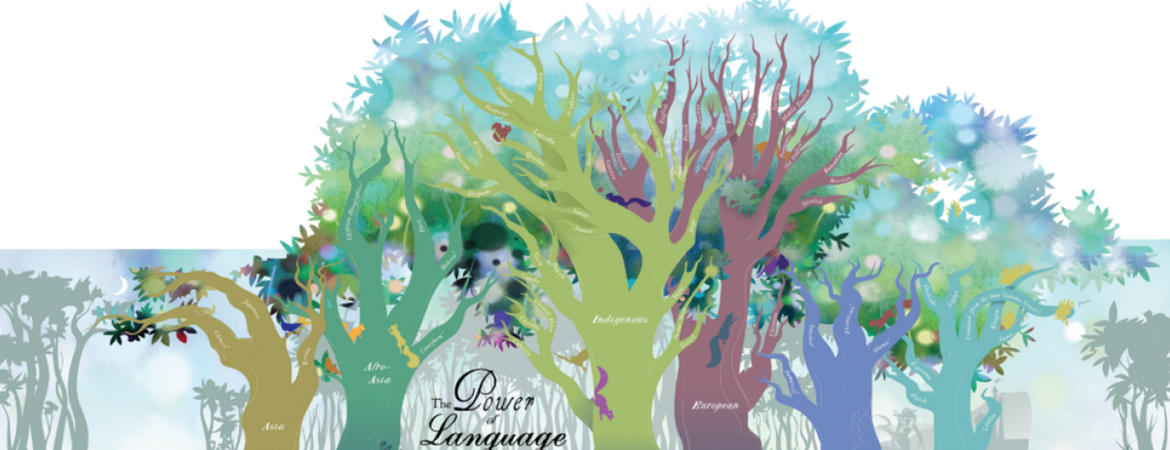
We invite you to view SCUA’s latest exhibition, The Power of Language: From Manuscript to Print, from 10 a.m. – 4 p.m., Monday through Friday on the 4th floor of the Rivera Library in Special Collections & University Archives until March 24, 2023.
This exhibition is the first of a yearlong cycle of four exhibitions, and features texts written in the classical languages of Latin and Greek and highlights some of our oldest materials.
The spring exhibition will showcase our Indigenous languages, while our summer exhibit will delight you with contemporary languages created by authors of imaginative works of fiction. The fourth, and final exhibition in fall of 2023, presents highlights from our collection of Asian and Western and European languages.
| Event | The Power of Language: From Manuscript to Print |
| Location | Tomás Rivera Library, 4th floor, Special Collections & University Archives |
| Dates | February 23, 2023 - Mar. 24, 2023 |
| Parking | Free Visitor Parking is available on Fridays, starting at 12:00 PM through 6:00 AM Monday morning in the unreserved spaces of the following parking lots/structures:
|
Explore Two New Digital Collections
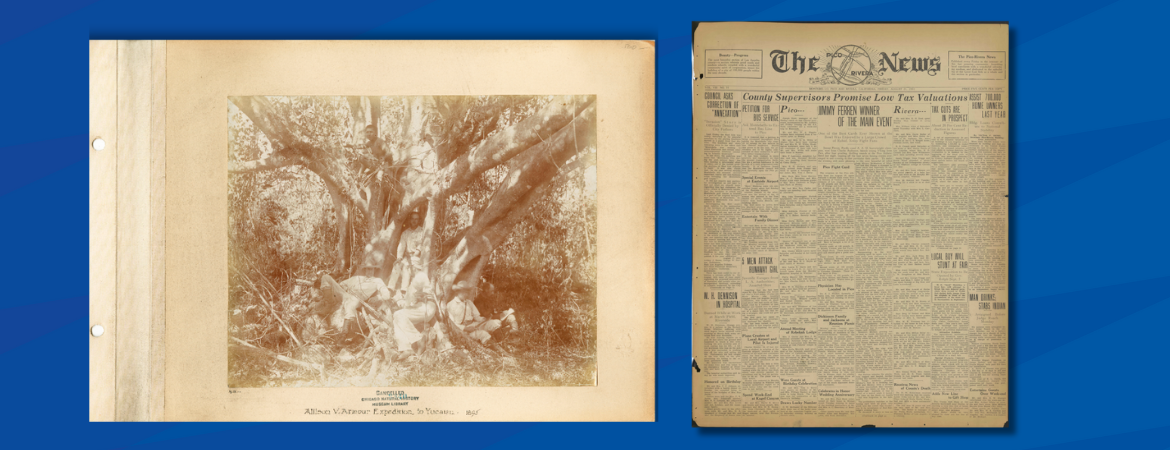
We’re excited to announce the addition of two digital collections available for research and study.
Allison V. Armour Expedition to Yucatán, Mexico Photograph Album
This collection showcases the 1895 research expedition led by curators from the Field Museum of Natural History in Chicago. The photo album captures views of Mayan ruins, with additional photographs of local scenery and the expedition group.
Explore the collection on Calisphere.
Pico Rivera News (UCR Access Only)
Dive into LA County history with the Pico Rivera News, a newspaper chronicling life in Pico Rivera, California and the surrounding area in 1931 and 1932. While mostly in English, some issues do feature a page of news in Spanish. This archive is a valuable resource for members of the UCR community researching journalism, Southern California history, and even Hispanic culture.
Access the collection through UC Library Search.
These new digital collections highlight our commitment to preserving and providing access to historical resources. We invite you to explore these collections and unlock stories from the past!
4 to Explore: October selections from Special Collections
This month in 4 to Explore, your Special Collections librarians and archivists have selected four new items and placed them on hold in the reading room.
Here's what you can see this October in 4 to Explore:
Maneater
A fun-to-use artist's book by Hannah Batsel
Frankenstein
Beautifully designed and illustrated by Barry Moser
Campus Events Flyers
Celebrating Black student life in the 1960s
Illuminated Quran Leaves
Pages from surahs Al-Anam / Al-Araf and An-Najm / Qamar
Why you should try 4 to Explore:
Special Collections materials are kept in closed stacks, which means you can’t see the shelves and browse. You also can’t check things out and take them home. So, 4 to Explore is a great way to experience first-hand some of the collections that truly make UCR Library unique.
4 to Explore will give you the chance to visit a reading room, like the ones that are used for archival research or by rare book scholars, and to get a sampling of our collections without having to submit a request ahead of time.
You’ll be asked to show photo ID and to check your bags – but don’t worry! Our UCR Library staff will explain everything to you when you arrive.
We will also have rotating exhibits of items from the collections on display.
Where to find 4 to Explore:
Department: Special Collections & University Archives
Where: Take elevators to 4th floor of Rivera Library
Hours: 11:00 am - 4:00 pm, Monday - Friday
Bring: Photo ID
Don’t bring: Food or drinks
Who: Everyone is welcome. 4 to Explore is more of an individual experience, but we can usually accommodate up to two people using the same item at the same time, so feel free to bring a friend.
What to expect: Staff will help you sign in and feel comfortable in the reading room. It should take about 5-10 minutes for you to get up to the 4th floor and get settled. Then you can stay and enjoy as long as you like!