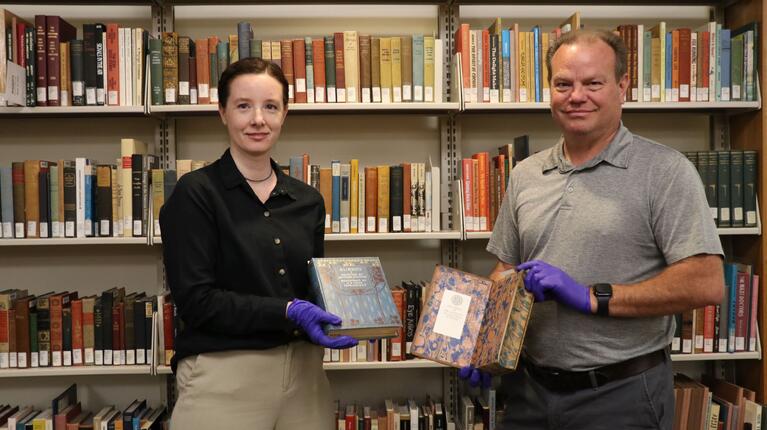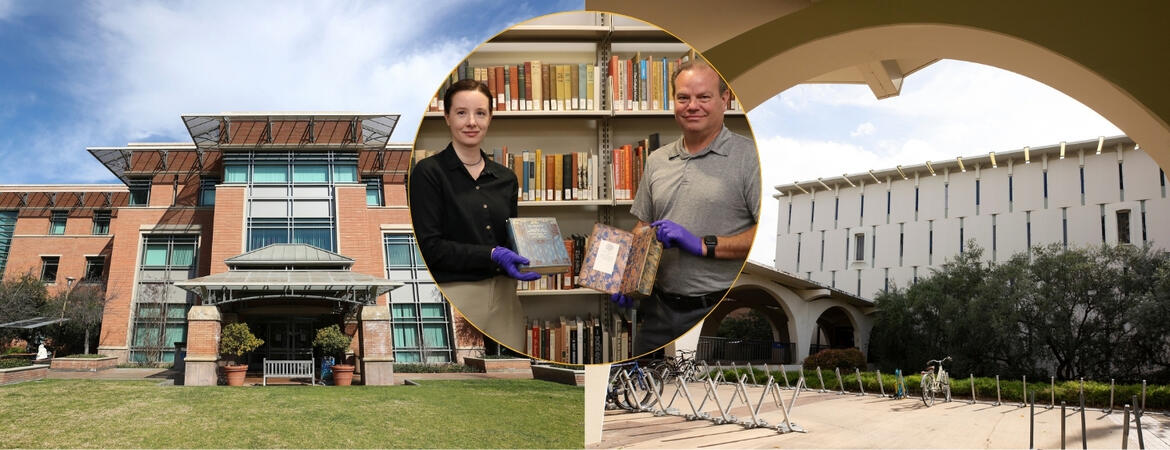
The UCR Library, in partnership with UCR's Environmental Health & Safety (EH&S), has announced a comprehensive safety and awareness initiative to address the presence of historical heavy metal pigments in our book collections.
The project was sparked by growing national awareness from the Winterthur Library's Poison Book Project at the University of Delaware, which identified toxic materials like arsenic and chromium in Victorian-era book collections. Heavy metal pigments were commonly used to achieve vibrant colors in a range of book features, including cloth covers, marbled papers, edge painting, bookmark ribbons, and hand decorated illustrations, with metals such as lead, arsenic, chromium, and mercury sourced to produce the brightest hues.
As all University of California institutions look to address these risks moving forward, the UCR Library began with rigorous testing and data collection conducted by EH&S to understand what is actually happening when patrons interact with our circulating collections. This allowed the UCR Library and EH&S to make decisions based on real, local evidence rather than assumption.
“Our Team is committed to proactively identifying emerging and often overlooked hazards to ensure the health and safety of our campus community. This study reflects both our dedication to protecting our partners and patrons, and our technical expertise in delivering practical, science-based solutions that can benefit institutions well beyond UC Riverside,” said EH&S Director Occupational Safety, Industrial Hygiene, and Environmental Programs Andrea J. Reid.
UCR's testing, which simulated typical use by a novice book handler, found that books published before 1970 may shed lead and arsenic residue onto hands and surfaces. While the overall health risk is low, the primary danger lies in accidental ingestion or absorption, such as eating a sandwich after handling the books or putting your fingers in your eyes.
“Our sampling provided interesting and somewhat unexpected results. Fortunately, they indicated that controlling exposures can be relatively easy with some education and practical controls. Hopefully, this project will bring a better understanding of the hazards associated with these types of books,” said EH&S Senior Industrial Hygienist Mark Atwood.
In response to the test results, the UCR Library and EH&S have established pre-1970 books as a benchmark date for new safety protocols. To ensure the safety of UCR students, staff, and the community while maintaining access to these historical materials, the UCR Library is implementing a series of proactive engineering controls.
These include:
- Encapsulation: The Library is using the CoLibri cover system to start sealing pre-1970 circulating books. This is a long-term initiative that will eventually cover all affected materials, effectively eliminating the risk of contact with heavy metal pigments.
- Specialized Storage: Books in Special Collections & University Archives (SCUA) are being sequestered in anti-static polyethylene bags to preserve the materials while protecting staff and researchers.
- Enhanced Workflows: Library staff handling these materials are now equipped with nitrile gloves, wet wipes, and keyboard covers, with all used personal protective equipment disposed of in hazardous waste bins.
Beyond physical controls, the Library has launched an extensive awareness campaign. In preparation for the initiative's launch, UCR Library Conservator Chirstina Bean conducted multiple staff trainings across the Library so that employees were ready to handle affected materials safely and answer patron questions with confidence. Patrons will notice new safety signage on the end of Library shelf rows, QR codes at self-checkout kiosks, and informative bookmarks included with all pre-1970 book checkouts. These resources provide clear safety recommendations, such as wearing nitrile gloves and washing hands thoroughly after handling older books.
“The conservation community has been engaging with research into these hazards with books for only a short period of time,” said Christina. “We are fortunate here at UCR to be able to focus our testing on the student experience in circulating collections and contribute to the expanding slate of research.”
Through rigorous testing, a long-term plan to effectively eliminate the risks, and an awareness campaign, UCR is ensuring the safety of both students and staff while still preserving access to important resources.
For more information on the UCR Library Heavy Metals Book Project and safe handling tips, please visit the UCR Library's dedicated Heavy Metals Project webpage.