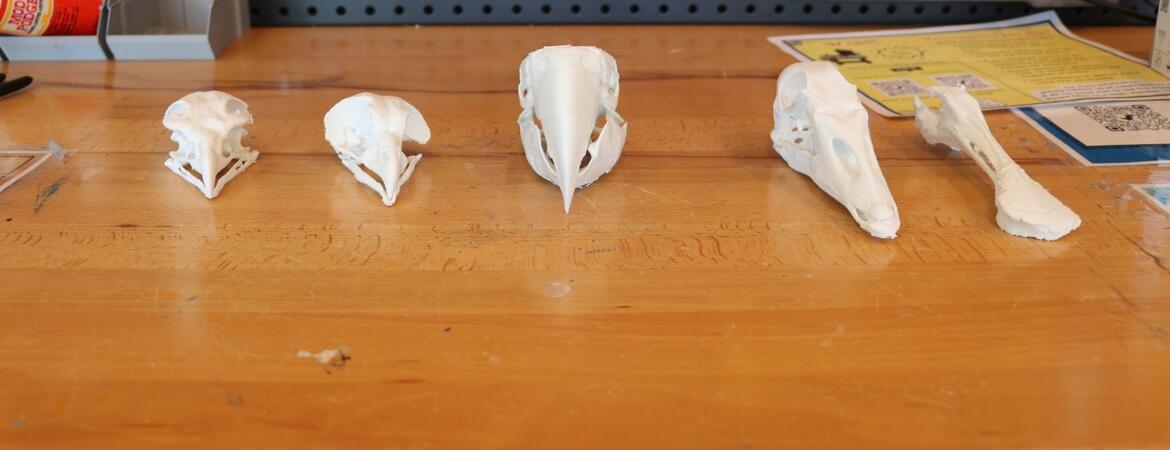
Creat'R Lab Makerspace staff in Orbach Science Library collaborated with campus researchers to create durable, 3D-printed replicas of real bird skulls for faculty and student research.
The Creat’R Lab Makerspace, located in Orbach Library (Room 140), is where Maker Services Coordinator Brendon Wheeler and his student workers help campus researchers from all backgrounds bring complex research and development projects to life. Unlike other makerspaces and labs on campus, the Library's makerspace welcomes all UCR faculty, students, staff, postdocs, and alumni looking to create and innovate.
Brendon shared that the Creat’R Lab’s overall 3D printing capacity has nearly tripled since he arrived in 2023, jumping from around 800 prints a year to around 2,400. Roughly 66% of those requests are now research-based, with Brendon regularly coordinating with professors and students to turn their ideas into a living reality.
A recent success story comes from UCR’s Animal Aeroacoustics Lab, where Principal Investigator Christopher J. Clark and his team study the physics of animal flight, biomechanics, and bioacoustics. The research lab needed a way to showcase bird skulls without putting their primary, delicate learning models (real bird skulls) at risk. They brought their bird skulls into the Creat’R Lab Makerspace to be digitally scanned and replicated using 3D printers.
Creat’R Lab student worker Andrew Murakami, a fourth-year environmental engineering major, took the lead on the technical 3D printing process. He worked closely with the researchers to capture intricate details between the top part of the skull and the bottom jaw using 3D turntable scanners. While the scanning itself was straightforward, the real work came during the refinement phase.
“The part that takes a bit longer is the post-processing part of it,” Andrew explained. “You have to make sure that you remove any outliers, like random specs, and then try to fill in any holes the 3D scanner may have missed.”
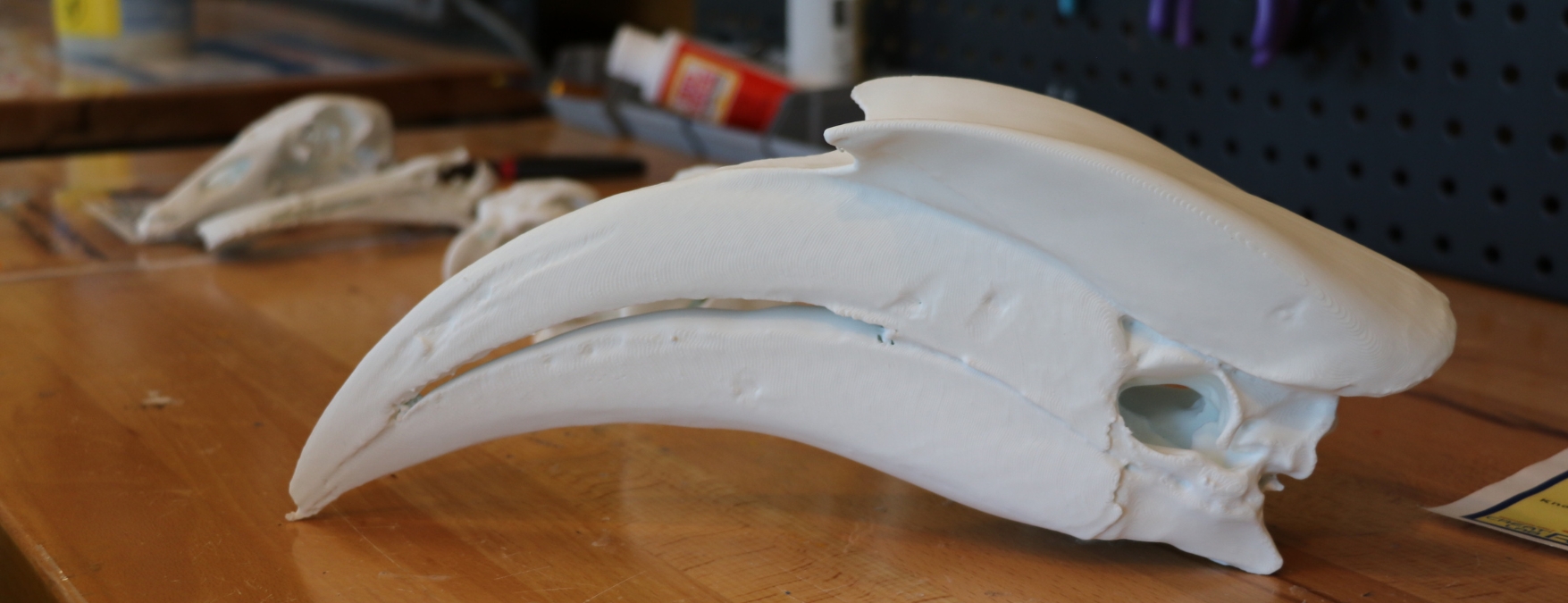
The most challenging piece of the project was replicating a large hornbill skull named Janet. Because of its massive, oblong shape, it required the Makerspace’s largest 3D printer and careful placement. All the models printed are highly durable, allowing people to look at them closely and hold them without the risk of hand oils damaging real bone material.
The bird skull project is just one example of the Creat'R Lab Makerspace's ongoing collaboration with UCR researchers. This past school year alone saw a steady stream of academic requests, including 3D prints of human brain models, specialized housing containers where computer engineering students can store Arduino board electrical components, and a chemical analysis research lab instrument.
The Makerspace operates within Research Services, one of the Library departments focused on working with emerging technology to help campus researchers. "The range of requests is wide," noted Research Services Director Dr. Raymond Uzwyshyn. "What is amazing is that the Makerspace and the other emerging technology Research Services units are also combining 3D printing with other new technologies such as GIS, robotics and AI. They are able to print everything from topographic earthquake models to AI enhanced 3D robotic cats that can tell a red light from a green light. All in the summer's print lists from the lab."
Through this ongoing innovative work, the Creat’R Lab Makerspace continues to show that UCR researchers and community members from any discipline can walk in and get the exact higher end technical support they need to push their research, entrepreneurial ideas and creativity forward.
If you're a UCR student, faculty, or staff member interested in bringing your research to life through 3D printing or other Makerspace resources, email Maker Services Coordinator Brendon Wheeler for lab-related inquiries. For help with specialized 3D software like Blender, Autodesk Fusion, or SolidWorks to design, model, and prototype your projects please email Innovative Media Librarian Alvaro Alvarez.