When a UCR engineering lab needed to turn a dataset into an application the public could explore online, the UCR Library's Research and Technology Division teams built the tool that made it possible.
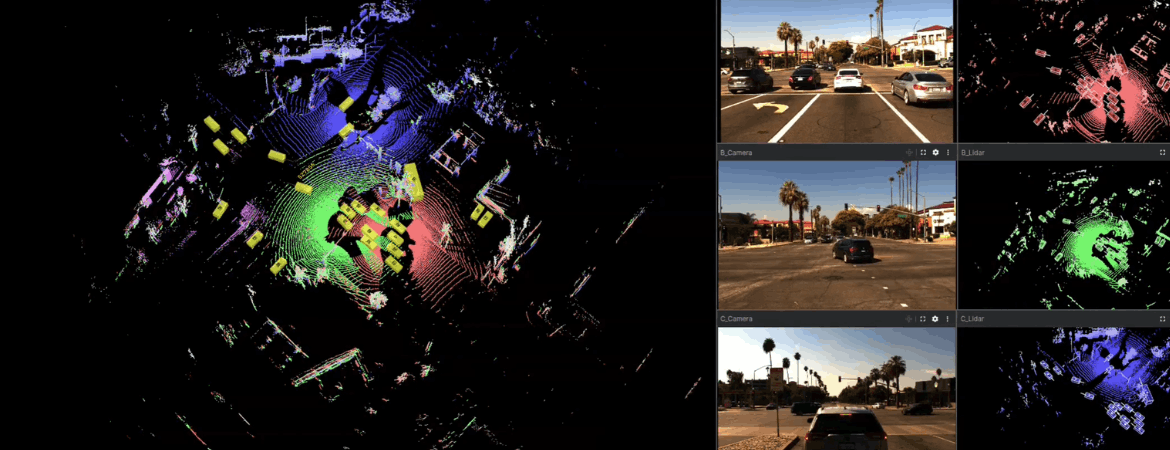
CooperScene is a fascinating auto-related data project from the Collaborative Intelligence Systems Lab (CISL) led by Dr. Hang Qiu, Assistant Professor of the ECE Department in the Bourns College of Engineering. Featuring an interactive visualization portal built in partnership with UCR Library’s Division of Research and Technology Services, the project enables multi-modal data for a global research community to evaluate perception and performance in automobile networks. Dr. Qiu’s lab researches how autonomous systems like vehicles, drones, and robots work together and communicate in real time. CooperScene provides benchmarks for evaluating these multi-agent systems and how they coordinate and perform in real-world scenarios, using an interactive tool (see image above) to view and explore that open benchmark dataset prior to download.
Dr. Barbara Martinez Neda, Research Data Scientist in Research Services, along with Dan Szilagyi, Manager of Cyberinfrastructure, Joel Valdez, Senior Software Developer, and Scott Metoyer, Lead Software Developer, partnered with the CooperScene team. The Library Research and Technology team built a complete data processing pipeline to convert the lab's raw data into a format compatible for 3D visualization. The team then developed an interactive, web-based viewer, giving the application’s users the ability to explore 3D sensor data, play back driving sessions, and navigate through time, no specialized software required.
“Discussing the project with Dr. Qiu, the goal was to allow researchers to interact with the dataset before downloading the enormous files,” said Dr. Martinez Neda. “It was a very rewarding experience, not only helping CISL identify potential solutions, but also to be part of the team bringing this complex data visualization to life.”
CooperScene was accepted for an oral presentation at this year's ECCV, the European Conference on Computer Vision, which is held this September in Malmö, Sweden. ECCV is widely regarded as one of the top computer vision conferences in the world. The dataset itself is a significant contribution to autonomous vehicle research, with nearly 60,000 synchronized LiDAR frames and over 344,000 3D bounding box labels.
“In releasing CooperScene, we aim to bridge network and vision-research communities to advance cooperative autonomy concepts toward scalable, reliable, and deployable real-world systems.” Professor Qiu said. “Rather than just a URL for download, we want to provide a lens for users to view, analyze, and interact with the data. The great support and collaboration with UCR Library Research and Technology Services made this lens feasible and the dataset more accessible.”
This partnership demonstrates how UCR Library’s Division of Research and Technology offers the UCR research community technical expertise to turn complex data into research and learning tools a global audience can review and utilize to improve their own understanding. To see more examples of projects, visit the UCR Library’s Digital Initiatives webpage.
For assistance with data/data science projects, please reach out to Dr. Barbara Martinez Neda directly at barbara.martinezneda@ucr.edu. For all other research support — including digital scholarship, AI, GIS, and makerspace resources — visit our Research Support webpage to see how we can help you.