Search
Search
Library Welcomes New Director of Teaching and Learning
Dani Brecher Cook is our new Director of Teaching and Learning at the UCR Library.
Dani's key responsibility is to lead the development, implementation, and ongoing program for library teaching and learning services and initiatives to support the curricular and research activities of UCR faculty, researchers and students.
The opportunity to establish a new teaching and learning department with a focus on curricular collaboration and learner-centered approaches in a uniquely diverse environment is what excites Dani most about coming to UCR Library. She hopes to build sustainable, ongoing relationships with partners across campus.
“By situating librarians as expert co-educators and sharing our expertise in information resources and pedagogy, UCR Library can materially contribute to the University’s mission to graduate critical thinkers and information-literate citizens,” Dani said. “These skills are especially important in navigating the 21st-century world, where the abundance of information can make it challenging to determine authority, accuracy, and value.”
This newly re-imagined department will also assist faculty and instructors in developing research assignments for students that focus on discovery, exploration, and process.
Previously, Dani served as the Information Literacy and Research Services Coordinator at the Claremont Colleges Library.
Dani has presented nationally at the Association of College and Research Libraries (ACRL), LITA Forum (Library Information Technology Association), LOEX (Library Orientation Exchange), and other instruction- and library technology-focused conferences. Her team at Claremont received the 2015 Library Instruction Round Table (LIRT) Innovation in Instruction Award for their work in curriculum mapping. Dani and Kevin Michael Klipfel’s article, How Do Our Students Learn? An Outline of a Cognitive Psychological Model for Information Literacy Instruction, was recently selected as one of LIRT’s top 20 articles for 2015.
Dani received her MSLS from the University of North Carolina at Chapel Hill, and holds an A.B. in English Literature from the University of Chicago, and a Diversity Advocacy Certificate also from UNC Chapel Hill.
Science Fiction Librarian Contributes to New Book
Our Jay Kay and Doris Klein Librarian for Science Fiction, JJ Jacobson recently contributed a chapter to a book titled, Teaching and Learning in Virtual Environments: Archives, Museums, and Libraries.
JJ’s chapter, Crowdsourcing the Fictive Experience: Virtual-World Emergent Narrative from a Collections Perspective, is about the practice of Immersive Interactive Improvisatory Narrative, or IIIN.
“It’s a very common feature of virtual worlds of all kinds,” JJ explained. “IIIN is a modality of storytelling. There’s role-play, sometimes recreational, sometimes tied to history, as well as re-enactment and historical interpretation. It’s connected to speculative literature because many of these narrative interactions exist in a context that is speculative – alternate history, for instance – or occasions for this kind of narrative are in a context that is related to or is directly the speculative or fantastical imagination.”
IIIN can be traced to modern improvisatory theater forms, JJ explained, such as the Renaissance Faire; and it is often found in Civil War and similar reenactments, which exist to explore history and educate participants as well as audiences. “It’s an interesting question to compare those to the evolution of community theater, too” she continued. “All of these things exist in the real world, but with some specific entertainment or educational mission. One of the questions we barely touched on was: ‘When did IIIN start to become pure recreation?’”
JJ’s chapter is the result of three distinct discussions on the topic of IIIN. JJ spoke with an expert on living history in museums and places like Plimoth Plantation, a special collections librarian from a well-respected institution, and a professional historical interpreter who plays Mildred Cecil, Lady Burleigh, wife of Lord Burleigh, chief advisor to Queen Elizabeth I.
“These conversations opened up some questions worth thinking about, questions that nobody else seems to be writing about, but that people within the reenactment and historical recreation and virtual worlds talk about all the time,” JJ said. “We talked about the phenomenon and why someone might study it, what a research collection might look like.”
To date, JJ has not seen much scholarly writing on this topic, especially not with the same emphasis.
According to JJ, some questions that could inspire scholarly research on the subject of IIIN might include:
- What kind of activity is it, exactly?
- If we trace it back to various kinds of plays or theater, is that sufficient?
- What are we doing in an historical enactment, with its factual constraints?
- If a library were to collect examples of it, what kinds of research might that support?
- What kind of researchers might use them?
- What would a collection surround them with as secondary source material?
“The Eaton Collection is largely a collection of texts and other narrative forms, but stories that are already done and finished are not the only occasion for the fantastical imagination to work,” JJ explained. “So here is a very interesting way of creating something that could easily be subject matter in the Eaton Collection. If people have made up their own country and they act the story together and build it up as they go, that’s still the kind of thing we collect. Those kinds of worlds, those kinds of subjects are intensely interesting to me. Even though you won’t find those exact worlds in the Eaton Collection, you’ll find many like them in motivation, structure, and so on.”
The book was published by Libraries Unlimited in 2016 and is now available on Amazon, Barnes and Noble, and other retailers.
Specialty Labs
Scholarly Technology and Research (STAR) Lab
This computer lab, located in Orbach Library Room 147, has four high-performance Windows PC workstations and one Epson Photo Scanner.
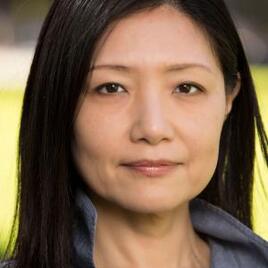
Yoko Kudo
Yoko’s key responsibilities are creating and maintaining metadata for digital collections, and cataloging special collections materials and specialized format resources such as audio visual material, computer programs, and maps. She joined the library in 2011.
Metadata and Media Cataloging Librarian
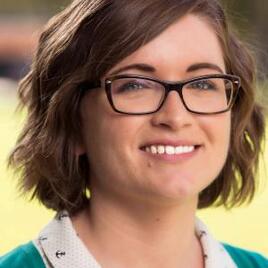
Jessica Geiser
Jessica’s key responsibilities are in the accessioning and collection management of all manuscript, archives, and rare book holdings maintained by Special Collections & University Archives. She holds an M.L.I.S. from the University of California, Los Angeles. Jessica joined the library in 2014.
Collections Management Librarian
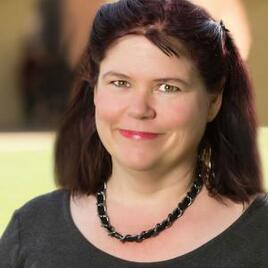
Michele Potter
Michele’s key responsibility is to oversee STEM collection management including assessment and evaluation, transformative collection models, eBook packages, and user engagement.
She holds a B.A. from the University of Oregon, an M.L.S. from the University of Washington, and an M.A. in educational psychology from the University of California, Riverside. Michele joined the library in 1996.
Collection Strategist for Science, Technology, Engineering & Mathematics (STEM)
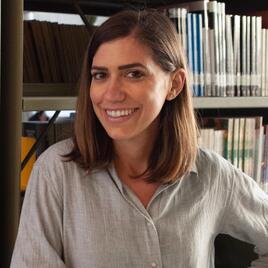
Robin Katz
Robin's key responsibility is to foster primary source literacy for a wide range of audiences. She holds a BA in English & American Literature and European Cultural Studies from Brandeis University and an MLIS with concentration in archives and special collections from Kent State University. Robin joined the library in 2015.
Arts and Humanities Teaching Librarian
Infrastructure Systems Engineer
We are delighted to announce that Mary Anne Eliazo joined the UCR Library as our Infrastructure Systems Engineer, effective November 12, 2019.
Mary Anne will be located in Cyberinfrastructure team office on the first floor of Orbach Library, reporting to Dan Szilagyi, the Manager of Cyberinfrastructure.
Mary Anne earned her BS in Business Administration and Commerce from the University of Santo Tomas.
Most recently, Mary Anne served as a Systems Engineer for the City of Irvine. Prior positions include Senior Systems Engineer at Glidewell Laboratories, and Technical Lead at IBM. She brings significant experience in computer systems engineering.
Please join us in welcoming Mary Anne to the library!
Ann Frenkel Is Now Deputy University Librarian
Effective September 12, 2016, Ann Frenkel will be taking on the title of Deputy University Librarian for the UCR Library.
In this role, Ann will exercise leadership, oversight of operations, and activities associated with promoting and ensuring overall UCR Library effectiveness, which will position the UCR Library for continued success.
Ann will serve as the proxy for the University Librarian, with the requisite authority to address UCR Library issues, and will exercise broad decision-making authority over the Library’s assessment and communications programs as well as oversight of UCR Library policy implementation. She will also routinely represent the UCR Library on UCR and system-wide initiatives in the University Librarian’s absence.
This move is part of a trend that we are seeing at research universities across the country and within the UC system, including at UC Santa Barbara, UC Davis, UC Merced, and UC Los Angeles.
In light of the increased travel requirements of the University Librarian for development and other professional commitments on campus and beyond for the University Librarian, identifying a Deputy University Librarian ensures continuity of operations when the University Librarian is not present.
In addition to the Research and Instructional Services Division, which will continue to report to Ann, Communications has also been moved into Ann’s expanded portfolio.
Library student employees who are “Living the Promise”: Sam Tang
Sam Tang is a class of 2018 Mechanical Engineering major who has worked for the past four years as student employee for the UCR Library’s Cyberinfrastructure department.
This position requires Tang to maintain computers and peripherals for library users and to help staff solve problems connecting to email, printer malfunctions, and other troubleshooting issues.
“It’s taught me a lot about working in an office and communicating with people,” he said. “Be patient, be kind. That was a huge lesson in IT, apart from all the technical stuff about hardware and specific applications that the library uses. I learn so much on the job.”
“Sam is a valued member of our team. He is smart, kind, honest, and reliable,” said Dan Szilagyi, Manager of Cyberinfrastructure. “He’s a hard worker who produces timely, efficient, and effective results.”
Tang grew up as an only child in Irvine, CA. His father is a biomedical engineering professor at UC Irvine. His mother was a piano teacher during his childhood, but she now works as an office manager for a law firm. Before moving to Irvine, Tang’s family lived in Virginia while his father worked on the gyroscope for cruise air missiles for DARPA (Defense Advanced Research Projects Agency).
Tang originally planned to study media and arts at UC Riverside, but changed his major to Mechanical Engineering (ME) during his junior year. At first, he had no plans to study math. “I actually failed pre-calculus in high school, so I thought that math was the opposite of what I wanted to do,” he laughed.
However, he tried a few math classes here at UCR and felt like the work was rewarding. “I wanted to get the most out of learning as possible,” he said. “In high school, I was super lazy about everything. I only cared about not doing schoolwork. But that changes a lot during college when your work actually matters and you’re held responsible for the work that you put in.”
Part of what inspired Tang to become a ME major was his respect for Professor Sundararajan Venkatadriagaram. “He’s one of the nicest guys I know, but the material he gives out is super-hard and it really forces you to learn everything you can about ME,” Tang explained. “You can ask him about anything in ME and he’ll know the answer, and he can also prove it on paper. Having that kind of knowledge in engineering is something I’d aspire to do.”
After graduation, Tang could picture himself in a few different roles. “The skills in IT aren’t at all the same as what you learn in ME, but I could see myself doing research and developing in either field.” However, he has one dream that aims even higher. “If I could do anything, I’d like to be an astronaut,” Tang said. “It’s a good mix of physics, mechanical engineering, and some IT, as well, because you need to know how to operate a lot of electronics.”