Search
Search
Footsteps to You exhibition and Black History in Riverside
Talking with the presenters of Footsteps to You: Chattel Slavery, the visiting exhibition currently in the UC Riverside Special Collections department, revealed some noteworthy facts about Black History and the City of Riverside.
Riverside had many interesting connections to Black history at the turn of the last century, according to Dr. Paulette Brown-Hinds, Publisher of The Black Voice News and Steward of the Gore Collection for the Black Voice Foundation, which was responsible for bringing the exhibition to the UCR Library. One of the most intriguing was the friendship between the American educator, author, and US presidential advisor Booker T. Washington and the Mission Inn’s founder Frank Miller.
Miller grew up in an environment sympathetic to the anti-slavery movement, Brown-Hinds explained. Frank Miller’s parents Christopher Columbus Miller and Maryanne Miller attended Oberlin College and lived in Oberlin, Ohio, a town known for its strong stance and equally aggressive actions against the peculiar institution of slavery. The Millers relocated to Riverside and founded a tavern that Frank eventually grew into the Historic Mission Inn Hotel and Spa.
“During our Footsteps to Freedom Underground Railroad study tour, we annually travel to Oberlin and that’s how we learned about Frank Miller’s connection to abolitionist activity,” added Hardy Brown II, chairman of the Black Voice Foundation. “We’ve always been aware of Booker T. Washington’s connection to Frank Miller, but didn’t realize Miller’s early influences in the cause of African-American freedom.”
Washington visited Miller at the Mission Inn in March 1914, and he also gave several presentations at various locations in the City of Riverside during his stay.
“Our mother former Assemblymember Cheryl Brown was friends with Washington’s granddaughter Edith, and she introduced us to other members of her family including Kenneth Morris, who is also a direct descendant of abolitionist and statesman Frederick Douglass,” Brown commented. “Kenny is now a docent on our tour.”
In 2004 the Brown family spearheaded the effort to raise money to commission the bust of Washington that was unveiled at the Mission Inn. “We wanted to commemorate their friendship and the spirit of cooperation it represented,” Dr. Brown-Hinds said.
Dr. Brown-Hinds believes that the connection between Miller and Washington was strengthened by coming from a community like Oberlin. “Christopher Columbus Miller was very much influenced by the president of the college at the time,” she said. “He was very progressive in his thinking when it came to slavery.”

These unique connections to local history and to Black history are just two among the many reasons for the UCR community to visit the exhibition in Special Collections & University Archives on the fourth floor of Tomás Rivera Library. “Each one of these pieces are ones that people would not see at a normal Black History program,” said Brown.
To enrich the experience of visiting the exhibition, Brown plans to bring in different speakers on the events and history surrounding the abolitionist period, which are represented in many of the exhibition’s primary sources. Information about the speakers and the event schedule are available by request.
Additionally, Brown plans to be on-site when local schools bring their students for scheduled tours of the exhibition, to answer questions about the items featured. He has also created interactive display cards with QR codes throughout the exhibition to provide a more dynamic experience for unscheduled visitors.

Footsteps to You: Chattel Slavery, focuses on highlights of Underground Railroad materials from the private collection of Jerry Gore, which has been entrusted to the Black Voice Foundation. The exhibition is available for viewing in the UC Riverside Special Collections Department on the fourth floor of Tomás Rivera Library on weekdays from 11:00 am until 4:00 pm until Friday, March 30. Those interested in scheduling a guided tour of the exhibition should contact Hardy Brown II by email at Hardy@bvfoundation.org or by calling (909) 682-7070.
Go Behind the Scenes of Research at UCR with "The Reference Desk" Podcast
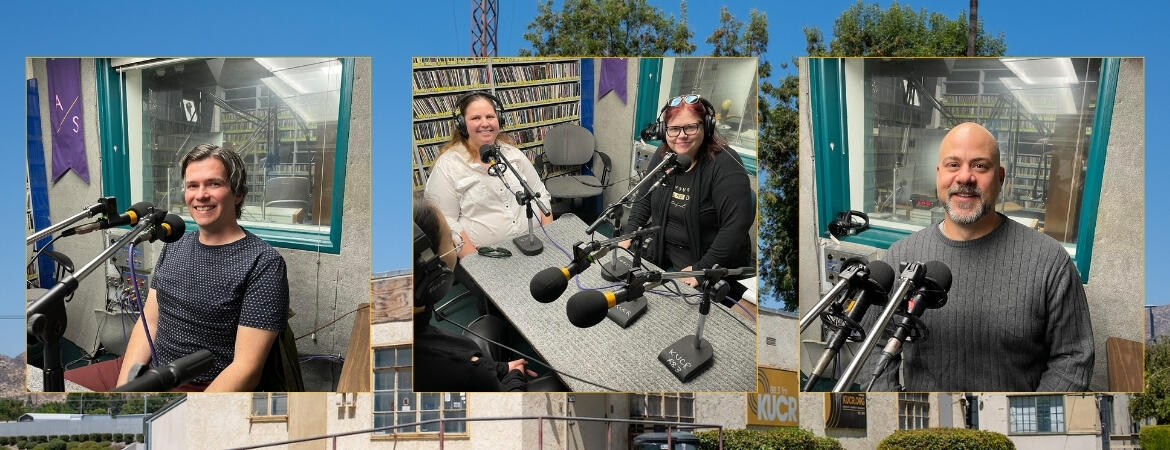
If your New Year’s resolution involved learning something new, diving deeper into the world of research at UCR, or learning about UCR Library resources, we have the perfect podcast for you.
After a successful launch and a busy season of recording in the KUCR 88.3 FM studios, The Reference Desk podcast is ready for your playlists. Hosted by Digital Scholarship Librarian Dr. Jing Han, the series moves UCR research out of the academic journal and into a conversational format that is accessible to everyone.
The project began as an organic collaboration with KUCR Associate Director Elliot Fong. According to Jing, the two quickly realized "how well audio storytelling could highlight research and library work in a more accessible way."
By choosing a podcast format, the library is effectively lowering the barriers to complex information. "The podcast is intentionally conversational," Jing explains. "I spotlight each researcher’s story while asking questions that many listeners are probably already curious about. That approach helps demystify research and makes complex work feel more approachable."
While the library is often associated with its digital and physical collections, The Reference Desk highlights the human expertise and assistance at the UCR Library that fuels academic research success. After interviewing faculty and researchers ranging from music and history to engineering and business, Han noticed a powerful common thread.
"One consistent theme is how much researchers value both the library’s resources, such as databases and collections, and the people behind those services," she says. "Regardless of discipline, nearly everyone highlights the role librarians and library support have played in shaping their research."
For students looking to find their own footing in the world of academia, the podcast serves as a practical roadmap. Each episode is structured to guide listeners through a researcher’s background, the specific library resources or services utilized, and their personal recommendations.
Looking ahead, Jing’s goal is to ensure the podcast is as diverse as the campus itself.
"My hope is for every department, school, and college at UCR to eventually be represented," she says. "I’d like the podcast to continue growing as a platform that reflects the full diversity of research happening on campus while strengthening connections between researchers, students, and the library."
Leadership in Action at the UCR Library
Change is in the air as UCR Library leaders work to transform the Library into a library of the future.
Since University Librarian Steve Mandeville-Gamble started at UCR in 2013, he has focused on developing strategies to support and accelerate the research and teaching programs on campus. One of the objectives in the Library’s Strategic Plan is to develop library leaders to anticipate and meet the rapidly changing campus environment within a culture of innovative thinking and calculated risk-taking.
Starting in 2014, Deputy University Librarian Ann Frenkel (above, center) has been exploring with the librarians the best staffing structures to most effectively support teaching, learning, and research. As typical for many research institutions, the majority of librarians were grouped in parallel departments in discipline-focused libraries (Rivera or Orbach), with each librarian expected to have broad responsibilities and expertise in teaching, research support, and collection building.
After much discussion, in FY2017 the Library recruited two new leaders to work collaboratively to create two departments that would provide more focus specifically for teaching and research: Dani Brecher Cook, Director of Teaching and Learning (above, left), and Brianna Marshall, Director of Research Services (above, right).
During the summer Cook and Marshall worked together with the librarians to develop the mission, vision, and positions needed for their two new departments. “This collaborative leadership structure is not seen in a lot of other libraries,” Marshall said.
“Our administrative team is really open to new ideas and trying out things in an experimental way,” Cook said of the library’s workplace culture.
Marshall echoed her sentiment. “I’m really excited to be in this role. I was drawn to it because of the focus on creativity, innovation, and trying new things.”
Supporting new researcher workflows in the ever-evolving era of digital learning presents unique challenges, according to Marshall. “There are pressures on new faculty that weren’t on their predecessors,” she reflected.
Cook added that the library is exploring technology-enriched models. “We’ve been very empowered to think about new ways of doing teaching and learning and research services at this university that’s growing at an incredible pace.”
Cook and Marshall both came to UCR with forward-thinking ideas about doing things differently – and perhaps better – than other campuses. “What’s getting most libraries stuck is their fear of failing,” Marshall explained, adding that the culture she aspires to is one that embraces vulnerability and builds a community of practice. “We want to figure out an aspirational view of what our department can provide to the campus community.”
Another goal is breaking down silos. Cook explained the library’s approach to solving this challenge, “We’re helping faculty and instructors to support students in accomplishing research-related learning goals. There are a lot of great partners on campus that we’ve identified already. We’re looking forward to deepening and evolving those collaborations.”
“This campus has an incredible energy to it,” Marshall observed. “People are open and optimistic.”
Frenkel added, “This is very much a living process, with adjustments and refinements along the way, and we look forward to constructive conversations with faculty and researchers regarding their experience with this new model over the coming months.”
UCR Library at the California Libraries Association Annual Conference
On Nov. 2-4, several UCR Library staff members contributed programs and poster sessions for the California Libraries Association (CLA) Annual Conference in Riverside, CA. The 2017 conference theme was, “New Worlds Emerge.”
Maker Services Librarian Krista Ivy, Open Research Librarian Michele Potter, and Data Librarian Kat Koziar gave a presentation session called From Zero to Makerspace: The UC Riverside Creat’R Lab Story. “It was well attended, and the audience was engaged with what we presented,” Koziar said.
Data Librarian Kat Koziar, Special Collections Public Services Assistant Zayda Delgado, Head of Preservation Services Patricia Smith-Hunt, Preservation Assistant Sara Stilley, and Director of Distinctive Collections Cherry Williams collaborated on a poster presentation titled, New Technologies, New Worlds. The poster showed the evolution of books across a timeline from 2500 BCE to present day, highlighting the most significant inventions used to create, package, disseminate, and access information.
“We took several items from our teaching collection and people who stopped by got to see and touch the transformative technologies our poster highlighted,” Delgado said. “Conference attendees really enjoyed the hands-on experience.”
Social Sciences Teaching Librarian Christina Cicchetti gave a poster presentation called Promoting School Readiness Through Diverse Children’s Books, which she prepared in collaboration with Dr. Ashaunta Anderson, Assistant Professor of Pediatrics at the UCR School of Medicine and Principal Investigator for the Cultural Pride Reinforcement for Early School Readiness research project; Sharon Rushing, PhD candidate in the UCR Department of Anthropology; and Dr. Annette Goldsmith, Lecturer at the University of Washington Information School.
“The study will distribute books to children during well-child visits to their pediatrician,” explained Cicchetti, who serves with Goldsmith on a community advisory board that helped to select books used in the study and prepared an informational handout for parents.
University Programs Teaching Librarian Judy Lee organized and led a Riverside Asian American Walking Tour on Sunday, Nov. 5, after the CLA Conference concluded.
Carla Arbagey, Collection Strategist for Science, Technology, Engineering, and Mathematics (STEM) led a tour of the UCR Library for attendees from the CLA conference.
“I had a lot of fun showing off our libraries and our campus,” Arbagey said. “Of course, the highlight of the tour was our visit to Special Collections and University Archives, and everyone was excited to see the home of the Eaton Collection.” Katz shared program goals and findings for 4 to Explore, along with the featured items from the current and prior months.
When showing Project Bi Nary by Steven McCarthy (nicknamed the “pillow book” by library staff), a recent acquisition from the September road show with Vamp & Tramp Artists Booksellers, Arbagey had an a-ha! moment: “I saw how one item from our collection can show how the seemingly disparate departments in our library are actually very connected.” The tour group first encountered it when they met with Patricia Smith-Hunt in Preservation, who explained how Preservation creates custom-made, acid free boxes to store special collections items.
Then in Special Collections, Katz explained that she had suggested the book as a purchase because it could be featured as part of a Creat'R Lab event on crafting and artists' books.
“So, you can see how our tour, which went from the Creat'R Lab to Preservation to SCUA, could be connected by this single (and very cool) book!” Arbagey concluded.
Librarians are Here to Help at the Rivera Help Desk
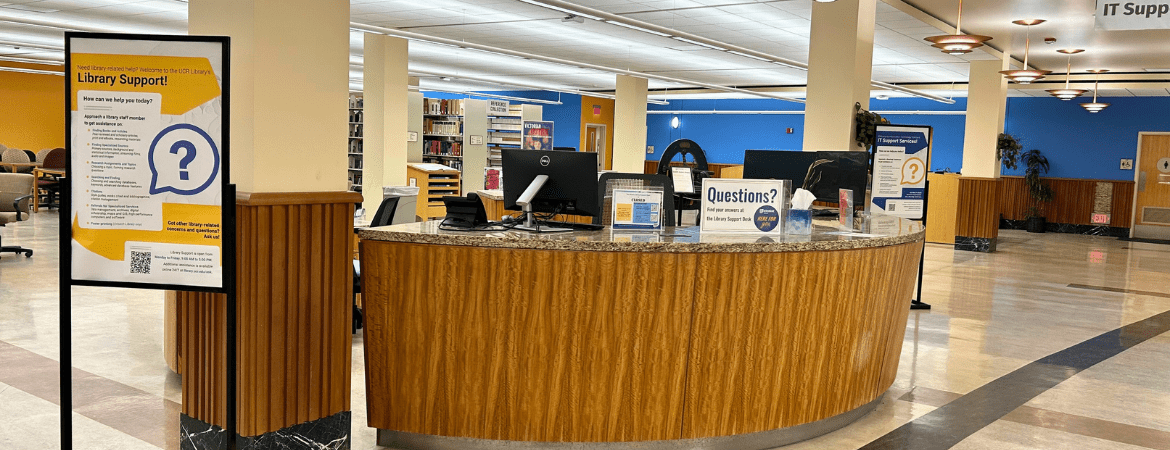
UCR students looking for support with their coursework, research, or general library questions have another valuable resource at their disposal: librarians are now available at the Help Desk in Rivera Library.
Located at the combined Library Support/IT Support Desk, this service offers in-person help for a wide range of needs. Since the start of the academic year, the number of students seeking in-person help has increased by 32% compared to the same period last year, demonstrating that more students are turning to the library for guidance.
Bringing librarians back to the Help Desk is part of the library’s efforts to support students in their academic success. According to Britt Foster, Director of Teaching and Learning, this change helps ensure students have access to the guidance they need when navigating their research and assignments. “Student success research has demonstrated that relationships with university faculty and staff have a positive impact on student engagement and sense of belonging: by having librarians very visible and available to our students, the hope is the Help Desk is a place where these relationships can form,” Britt said.
Today’s information landscape is increasingly complex, and students often need support not only in finding sources but also in evaluating them. Britt explained that “now it’s less about finding information, and more about efficiently navigating the flood to find high quality, relevant resources.” Librarians can help students develop these skills, offering practical strategies for identifying credible materials and managing research challenges.
Students are encouraged to visit the Help Desk for a wide variety of questions, from finding books and e-books to developing effective search strategies. Librarians are also equipped to help students verify citations, particularly as issues with inaccurate references generated by AI tools have become more common.
“We can help with almost anything”, Britt says. “Probably the unofficial model of reference is, I might not know the answer, but I know how to find it.”
Britt emphasized that students should feel comfortable seeking help at any stage of their research process. “Wherever you are in your research process, we’re excited to join you there,” she said. “Librarians want research help to feel like a warm conversation where we focus on getting you to your goals.”
Trained student assistants are also available at the Help Desk in both libraries. Their work not only supports patrons but contributes to their own professional growth. One student assistant researched technology to improve accessibility at the Help Desk, while another is developing a guide for evaluating social media posts. These projects reflect the library’s commitment to both quality service and meaningful mentorship experiences.
For students looking to get the most out of their visit to the Help Desk, Britt recommends bringing assignment details, if possible, as this can help librarians connect students with the most relevant resources. Most importantly, she encourages students to visit sooner rather than later. “The only thing that kills us at the desk is when our upper division or grad students say, I wish I had known I could get this kind of help from the library sooner! ”
Librarians are available at the Rivera Library Help Desk, located at the combined Library Support/IT Support Desk, from 10 a.m. to 2 p.m., Monday through Thursday. Students are encouraged to stop by, ask questions, and take full advantage of this valuable support system.
Former library student employee publishes first children’s book
When Class of 2019 alumnus Matthew Diep first enrolled at UC Riverside to double-major in accounting and public policy, becoming a children's book author was not on his to-do list.
However, a missed opportunity in another campus department led him to apply for a student employee position at the UCR Library, which became the catalyst for a huge shift in Diep’s career and life plans.
“My whole life would have been different if I had gotten that first job,” Diep reflected. “When I was a senior at UCR, my dad passed away. The library was always there for me. They were so supportive. Books were always there for me. You know, books get me through everything.”
In January 2021, Diep self-published his first children’s book (under the pseudonym Matthew Dee) titled, “There’s a Book on That,” which is currently sold through Amazon, Barnes and Noble, and Book Depository. In his book, Diep wanted to show his young readers all the wonders that books in libraries have to offer.
“When I was a kid, I despised reading,” he admitted. “But the one thing that I did like to read was books that rhymed.” Diep eventually learned to love reading and began writing poems during high school, so he knew that he could rhyme, but he had never written anything like this.
After writing the manuscript last year, Diep saved it in his Google docs and promptly forgot about it. “Then this winter break, I got bored,” he said, which is why he decided to self-publish.
Throughout all 4 years of his undergraduate studies, Diep found himself feeling “miserable but practical” about his decision to focus on accounting. “Toward the end of senior year, I reflected on what would make me happy and what would I enjoy, and I knew I enjoyed working at the library. So I decided to totally switch my career path.” He applied for a Masters program in Library and Information Sciences (MLIS) at San Jose State, and hopes to complete his degree within two years.
He is currently employed part-time with the City of Ontario Library and full-time with the University of Redlands Library, where he supervises student employees in the Access Services department. This reminds him of his former supervisor: “Leslie [Settle] is someone I always think about because she was a great supervisor and she was always there for her students, and that’s what I aspire to be for my students.”
Upon completion of his MLIS, Diep hopes to work in an academic library, perhaps at his alma mater. He has ideas for more children’s books, as well. In the meantime, he is focused on marketing his first book and getting it onto the shelves of as many libraries as possible. “I do want to see it with the little call number and everything,” he said.
Diep's endeavors have been met with overwhelming support from his family and friends on social media, though interested libraries should move quickly, he said. “The hard copy is already out-of-stock on Amazon.”
Fortunately, the UCR Library has already ordered a copy of “There’s a Book on That,” which will soon sit proudly alongside its counterparts in the library's juvenile collection.
Supportive Highlanders can follow their classmate at matthewdeebooks.com.
A flag – and a story – for every hero
Volunteers at Riverside National Cemetery’s annual “A Flag for Every Hero” event on Memorial Day weekend 2019 can now read biographies for many of the Veterans whose graves they adorn with flags, thanks in part to the work of two UCR Library employees.
When UC Riverside partnered with the U.S. Department of Veterans Affairs National Cemetery Administration’s Veterans Legacy Program on a multi-year, federally-commissioned project called Along the Chaparral: Memorializing the Enshrined, Principal Investigator Allison Hedge Coke asked Data Librarian Kat Koziar to build the foundation for the project’s data management, and Special Research Projects Director David Rios to assist with local history and archival genealogical research.
Project funding comes from contracts totaling nearly $700,000 over three years, beginning on Feb. 27, 2018.
“It’s important that we recognize that people who served in the military who are interred in RNC – that they had a life beyond the military – and that’s what we’re trying to capture,” Koziar said.
“It was a project that mattered to me,” Hedge Coke explained, because it blends creative writing, local history, archival research, digital media, geospatial resources, and more. “You don’t create a project to push your agenda into the community. You fashion a project to fit what already exists there.”
According to the U.S. Department of Veterans Affairs, the Veteran population in California in 2016 was 1.74 million, the highest of all 50 states; and 131,000 Veterans resided in Riverside County. Those are among the reasons why Hedge Coke believed that the project’s aim and impact would be deeply meaningful to this community.
Hedge Coke’s project proposal intended to create an interactive GIS (geospatial information systems) application so that visitors or researchers could discover the life stories of the Veterans interred at RNC, which would be written by participating K-12 students. GIS consultant Mike Cohen developed the GIS application, which launched at the Closing Celebration on Nov. 29, 2018. The project also generated nine documentary films.
When Hedge Coke visited the RNC site with Koziar she was convinced that, with Koziar’s expertise and with UCR’s on-campus research libraries, they would be able to accomplish this colossal task.
“A lot of people have done work on this – but the base is the base, to give credit where it’s due,” Hedge Coke said. “Everything could not operate without the work that Kat put into it.”
Koziar created and runs the foundational hub of the project, on which everything else continues to expand, Hedge Coke explained. “Everything is semi-reliant – if not completely reliant – on that hub. We absolutely have to have that base to make a project of this breadth successful. It’s quite a bit of exemplary work from this brilliant woman.”
Koziar designed a filing and labeling system to allow the graduate fellows to claim particular people so they could divide up the work while avoiding duplicate efforts, and then to give K-12 students access to basic information about the interred for their research while writing the memorials. “The majority of the students working on this – they’re not data scientists, they’re in humanities,” she said. “I was able to teach some of these other skills because, even if they don’t think about it explicitly, they still have to use it. I enjoyed that.”
To assist with the project, Koziar recruited Rios for his expertise in local history, genealogical research, and his work with Inland Empire Memories -- a fledgling local cultural heritage collaboration; and Brian Geiger from the CHASS Center for Bibliographical Studies and Research.
Geiger helped tremendously because of his connection to the California Digital Newspaper Collection, which the students relied upon significantly while researching, Koziar said.
Hedge Coke acknowledged that Rios and Geiger have done a phenomenal job teaching the graduate fellows and K-12 students about local history, historical research, and where to find archives to learn more about the lives of the interred.
“The children are learning about some of the people who were little-known soldiers,” Rios said. “It gives them an idea of the sacrifices that people have made, and that it’s not just one particular group of people – it’s a wide variety. It’s great because this is Inland Empire Memories and that’s what our responsibilities are: to share resources about the history of people in Riverside and San Bernardino counties.”
The team dedicated to Along the Chaparral has included 75 adults and 2700 K-12 students to write the biographies – from Riverside Unified School District, Sherman Indian High School, Highland Academy in Beaumont, and other schools in Anza and Temecula. At times, up to one-third of the students in a class have discovered they were related to the person they were assigned to research, Hedge Coke said.
The Veterans Legacy program has created partnerships with nine universities across the country. “Our partnership with UC Riverside is one of our largest and our most dynamic,” said Bryce Carpenter, Program Manager for the Veterans Legacy Program. “I think it’s going to raise the bar for all future Veterans Legacy program partnerships.”
The Along the Chaparral team is developing a curriculum so that this project can be duplicated for other Veterans’ cemeteries with K-12 students nationwide, Koziar said.
To date, the students have published more than 500 life stories on the app. Considering the involvement with research, with story craft, with innovative digital platforms, and with K-12 students creating publishable work that heightens memorialization of these lives, the future impact of the project with K-12 students and teachers, UCR students and community, the city, county, Riverside National Cemetery and the greater region is truly immeasurable.
Finding yourself in the archives
Christopher Queen and Brandy Lewis were the first two SCUA graduate student interns and both of their experiences provide excellent examples of how these internships can benefit students and enhance their academic and professional goals.
The UCR Library’s Special Collections & University Archives (SCUA) is known for its vast collections of books, manuscripts, photographs, and other rare research material. UCR students pursuing graduate studies were provided a unique opportunity to explore these treasures up close and gain valuable experience through SCUA’s first graduate student internship program.
Christopher is a Ph.D. candidate in the Department of English whose research focuses on 14th and 15th-century Middle English literature.
“When your work involves rare materials or delicate materials, it's not easy to gain access to those items,” Christopher explained. “It's not something that you necessarily see or get to interact with every day.”
The beginning of Christopher’s internship was exploratory. He spent time learning how archives work, how items are documented and stored, and spent time walking around the stacks discovering what was in the collection.
Christopher appreciated the time familiarizing himself with the space and the collection and was happy to have the opportunity to fine-tune the proposal he submitted for the internship based on his discoveries in the archive.
Once settled into the space, Christopher was able to find items he never expected.
“SCUA has really wonderful, idiosyncratic examples of The Canterbury Tales," Christopher said. “One of them is a collection of prints by an artist named Ron King. That wasn’t what I was looking for originally, but that was the wonderful thing about the internship, finding things I wouldn’t have necessarily found otherwise.”
One of the biggest things Christopher took away from the internship was a bigger sense of confidence.
“I went to England this past summer to work with some materials in libraries there. Having this experience made me more confident about interacting with other libraries' materials, interacting with librarians and staff, and not being afraid to ask questions.”
Christopher has some advice for graduate students who may be interested in applying the next time applications are open but aren’t sure if SCUA has the right material for them.
“Even if you don't think that what you're doing is related to what special collections has, you should still apply,” Christopher said. “At first, I was actually hesitant to apply myself, because we don't have a large collection of Middle English literature, but once I was able to start actually looking through what we did have, I knew there was value for me there.”
Brandy Lewis is also a Ph.D. candidate in the Department of English, but her research focuses on fandom and fanzines.
Brandy was familiar with SCUA and the Eaton Collection of Science Fiction and Fantasy before the internship. She went to UCR as an undergraduate student and had the opportunity to do a book review for the late Fred Patten’s Furry Fandom Conventions and spent time with the Eaton Collection which houses the Fred Patten Papers.
“As an undergrad, I thought this is great, but a little overwhelming,” Brandy said. “But coming back as a graduate student, it gave me a lot more time to sit with the materials and have a little bit more fun.”
Brandy enjoyed the freedom and flexibility that came with the internship and found herself thinking in ways she never had before.
“Originally, I had not been a print and manuscript scholar, I was very much into studying literature and looking at the words on the page,” Brandy said. “Yet handling the materials and getting a chance to sit with the bends of the page, the smudge marks — it’s a completely different experience.”
Brandy continued, “I was able to sit in the space and ask myself, what does the page offer? The experience entirely changed my dissertation because it opened a new frame of thought I never touched on before.”
The internship experience ended up being more emotional than Brandy could have ever imagined.
“As a first-generation student and as a disabled student, years ago I would have never thought that I would get a chance to sit with material considered science fiction history,” Brandy said. “The experience really allowed me to say It's okay to feel geeky, it's okay to feel, what I feel. That's what makes me me. Even though the experience is academic and a learning experience, for me it was also a personal growth experience.”
Che’s Village – Virtual Reality to Stimulate Critical Thinking
UC Riverside’s Associate Professor of History Juliette Levy likes to teach from the edge of the e-learning revolution.
Her latest experiment involved a virtual reality (VR) platform intended to stimulate intellectual learning on an emotional level for the students in her History 20 / World History course. Dr. Levy co-created a VR application called “Che’s Village” and invited students and faculty to test and review the platform in Orbach Science Library on February 15 and 16.
"Juliette felt that the library is precisely where this type of exploration should take place, as our mission is to expand critical thinking skills in studnets," explained JJ Jacobson, UCR Library's Jay Kay and Doris Klein Librarian for Science Fiction. Jacobson and Dr. Levy collaborated for several months on the concept and development in order to bring "Che's Village" to life.
“We serve a population of students who are digitally savvy,” Dr. Levy explained. “We have an amazing student body and an amazing faculty, and we need to teach them to think critically using the tools in their environment.”
Gesturing toward the wall, where a large monitor displayed what the student in the virtual reality goggles was seeing at that moment, Dr. Levy added, “This is the future of public education in here. Technology is a means to activate and render moments of the learning experience more intense.”
The platform was built to amplify students' experience of studying Che Guevara's speech, "Social Ideals of the Rebel Army," which he delivered on January 27, 1959. Guevara along with Raul Castro and others had recently won the rebellion against the existing Batista regime in Cuba, Levy explained. In his speech, Guevara had to balance the nationalistic, pro-Cuba intent of Castro with Guevara's own intent to lead a communist revolution.
The application’s co-creator and head of a VR prototype studio named Shovels and Whiskey, Tawny Schlieski stated, “We built this VR environment for students who have read Che’s speech. It’s meant to provoke them into compelling questions, to connect pieces of text with other pieces of research.”
Once inside the virtual world, exactly as Schlieski had explained, the user could see the text of Che Guevara’s 1959 speech in the setting of a Cuban jungle, with links to other content directly connected to highlighted passages in the speech. Using a pointer, the user could open and view the additional resources – whether text, images, or video – to elaborate on the themes of that particular passage. “It’s like footnotes, but in a virtual reality environment,” one user commented.

Users who tested the VR application saw potential in it. Professor Robert W. Patch from the UCR Department of History commented, “Technology will make certain things easier, certain things better.”
In some ways, the reflection indicated that UCR professors who leverage technology are already doing something right. One of the student testers observed that his best friend, who commutes over 50 miles to attend a different college, does not go to office hours because of the additional time it would require. He added, “He could have a more intimate learning experience if there were online office hours.”
“Good teaching is good teaching, whether that’s 100 years ago or 100 years from now,” Dr. Levy commented. “We owe our students to help them learn better and faster, especially with the amount of debt students are taking on to get an education. We are making it deeper and better with technology.”
“We’re looking to build applications of new technology in humanities that provoke critical thinking for students,” Schlieski stated. Reflecting on her previous work with Intel, she added, “From an industry perspective, problem-solving skills are sorely lacking in recent college graduates. Technology becomes obsolete so fast, but critical thinking skills are always valuable.”
Jacobson added, "After more than 10 years of library and education experience in virtual environments, I think that working with information, ideas, and learning in 3D is something educators and librarians would do well to keep on their radar. VR is in an incunabular age, and we don’t know yet what it will look like as it takes useful forms. However, the possibilities are so compelling that I’m confident VR (or other VE) will develop into important tools for teaching, learning, and information."
No stranger to using digital platforms, Dr. Levy currently employs a variety of digital resources including Podcasting, Zoom, online office hours, and a private virtual discussion forum to maintain a sense of connection with her students throughout the week. As a result, she has received overwhelmingly positive student feedback. For Dr. Levy, this latest endeavor with “Che’s Village” is intended to find new ways to engage her students. “Technology allows us to give students who live off campus and part-time students the same quality of attention and education that a small liberal arts college could,” Levy explained.
“I can teach 300 students and make it feel like a class of 30 students because the entire medium is devised for contact,” Levy added. “The students are all on a screen, and online, everyone is in the front row – so it feels more connected. Students who would usually not raise their hands and participate in a live classroom are more inclined to speak up in an online platform. It’s convenient and an environment in which they feel like they exist, their voice matters.”
“Che’s Village” was a first-step in the iterative design process, and both Dr. Levy and Schlieski are now incorporating the feedback they received from testers to improve the VR platform.
The Finals Countdown at Access Services Conference 2016
On Friday, November 18, UCR Library team members Elisha Hankins and Sahra Missaghieh Klawitter were the closing speakers at the 2016 Access Services Conference.
Their presentation title was: It’s The Finals Countdown – Finals Week Stress Relief Programming at the UCR Library. The 2016 Access Services Conference theme was “Unlocking the 21st Century Library.”
Both Sahra and Elisha wanted to share the idea of Finals Week Stress Relief with fellow Access Services professionals, in hope that more universities would be inspired to add similar programming to serve their campus communities. “We had attendees flock to the front after our time was up to get more information and to thank us for presenting,” Elisha said.
“People said they were empowered, inspired, and excited to try out some of our events. They said that we provided not just variety of ideas, but that we pointed out tangible resources that could be used and explored on their own campuses,” she continued. “I think people could see the passion we have for our students and the programming we provide.”
Finals Week Stress Relief had its humble beginnings back in fall quarter 2012 when the Access Services Department had an idea to start a study break corner to create a place of respite from the stress that students experience during finals week. “Both Sahra and I were students that transitioned to staff,” Elisha explained. “We are UCR alumni and we both know intimately the struggles of students. We both have played the role of ‘student supervisors.’ We want to help our students carry their sometimes unbearable burdens.”
Over time, the program has increased both in popularity and in scale. It’s now greatly anticipated by the UC Riverside community. “It’s been rewarding to watch the FWSR events grow and blossom!” Elisha said. “Over the years, we’ve heard the students rave about our events. It’s even highlighted through UCR Tours – to promote UCR. These type of results are not just tangible but fulfilling on a human level.”
Some events, such as the Therapy Dogs with The Well and Massage Therapy + Stress Busters with Active Minds, have consistently yielded a massive turnout. Events with free food also draw large crowds, such as “Finals Are Nacho Problem” on December 1. Library staff handed out more than 450 servings of nachos at Rivera and Orbach libraries. Last Spring, the “Monday Sundae Funday” event was also quite popular with students.
The inspiration behind the first Finals Week Stress Relief program was to find a creative approach to nurturing UCR students by creating a relaxing and stress-free environment in the library during finals week each quarter. By winter quarter 2013, other departments on campus expressed interest in collaboration, including the Academic Resource Center, which now partners with the library on the Study Jam event. “We stressed that it is not a one-man show,” Elisha said of their presentation. “You need a team committed to excellence and to a shared vision of wanting to help their student population.”
Each quarter, the Finals Week Stress Relief program features a series of activities including Surprise Snack Giveaway with Scotty the Bear, Cookie Break with the Chancellor and University Librarian, and many more, all offered free of charge to UCR students.
View Sahra’s and Elisha’s Presentation (Prezi).
View their “Finals Countdown” Video.