Search
Search
Eaton Collection of Science Fiction and Fantasy
The Eaton Collection of Science Fiction & Fantasy is one of the world's largest, richest, and deepest collections of science fiction, fantasy, horror, utopian literature and related genres. The collection originated with the personal library of Dr. J. Lloyd Eaton, consisting of about 7,500 hardback editions of science fiction, fantasy and horror from the Nineteenth to the mid-Twentieth centuries, which was acquired by the UCR Library in 1969.
Publications Based on Research Conducted in SCUA
This list highlights publications that have used or cited materials held by Special Collections & University Archives.
We hope you find this list to be a valuable resource for your own research. We regularly add new publications to this list, so please check back often.
George Slusser, Co-founder of Renowned Eaton Collection, Dies
The prolific scholar of comparative literature and science fiction helmed the world-renowned Eaton Conference.
RIVERSIDE, Calif. — George Edgar Slusser, whose determination to develop the study of science fiction as an academic discipline led to the growth in size, scope and international reputation of UC Riverside’s Eaton Collection of Science Fiction & Fantasy, died November 4th at his home in Highland, California. He was 75.
Dr. Slusser, curator emeritus of the Eaton Collection and professor emeritus of comparative literature, joined the UCR Library in 1979 and, beginning in 1991, held a joint position as professor of comparative literature until his retirement in 2005. Under his leadership the collection – formally known as the J. Lloyd Eaton Collection of Science Fiction, Fantasy, Horror, and Utopian Literature – grew from 7,500 volumes to the internationally renowned collection it is today, a collection that includes books, journals, fanzines, comic books, authors’ manuscripts, media and memorabilia. He taught the first courses in science fiction studies at UCR and originated the Eaton Conference, which he chaired for more than 20 years. The conference drew — and still draws — scholars from around the world
Rob Latham, professor of English and co-director of UCR’s Science Fiction and Technoculture Studies program, said Professor Slusser’s contribution to SF studies was significant.
“Over three decades, George Slusser built the Eaton Collection up from a small core of titles into the world-class archive that it is today,” Latham said. “The field of science fiction scholarship owes him an incalculable debt.”
Science fiction author and UC Irvine astrophysicist Gregory Benford described Professor Slusser as “a fine man, insightful critic, innovative educator, buoyant spirit. His criticism deeply emerged from his own vast knowledge of science fiction in several languages, uniquely in the field. Without George, Eaton would not remotely approach its present importance in the literary world.”
Howard Hendrix, a Science Fiction author who earned his Ph.D. from UC Riverside, called Slusser a mentor and friend. “George Slusser showed me that science fiction is worthy of serious intellectual study, and his example encouraged my own work as both a science fiction critic and science fiction writer,” he said.
“George was a true and loyal friend of many, a lover of life, and a lover of the life of the mind,” added SciFi author and scholar Eric Rabkin. “All conversations with George shone with his belief that everything had deeper meanings, significance, and the capacity to bring us wonder. Science fiction was a fit genre for him, and a genre whose worth he demonstrated continuously in the collection he guided to preeminence, the people he helped, and the powerful body of criticism he produced. He was a generous and important collaborator in ways small and large for so many of the people in his chosen field. I am honored to be among them.”
Dr. Slusser, a San Francisco native, earned a bachelor’s degree from UC Berkeley, his Diplôme d’Études Françaises from the Université of Poitiers, and his Ph.D. in comparative literature from Harvard University, where he wrote his dissertation on E.T.A. Hoffman, a 19th century German Romantic author of fantasy and horror.
He was widely known for his scholarship in the field of science fiction, writing or editing nearly 40 books and more than 100 articles. In 1986 he received the Pilgrim Award, presented by the Science Fiction Research Association for lifetime achievement in the field of science fiction scholarship. He also was the recipient of the Harvard Traveling Fellowship and Fulbright Awards to Germany and France. He also received the Edward A. Dickson Emeritus/a Professorship Award from UCR to support research by emeritus faculty.
Among the scholarly books he wrote or edited were “Robert A. Heinlein: Stranger in His Own Land,” “The Farthest Shores of Ursula K. LeGuin,” “The Bradbury Chronicles,” “Harlan Ellison: Unrepentant Harlequin,” “The Space Odysseys of Arthur C. Clarke,” and “The Delany Intersection: Samuel R. Delany Considered as a Writer of Semi-Precious Words.”
He and his wife, Danièle Châtelain-Slusser, an associate professor of French at the University of Redlands, co-authored several books, including “Three Science Fiction Novellas: From Prehistory to the End of Mankind,” a 2012 translation of three novellas by Belgian science fiction writer J.H. Rosny aîné (1856-1940). The book included an introductory essay that explains the writer’s place in the science fiction canon and within the context of evolutionary biology. They also published a well-received translation and study of Balzac’s “The Centenarian.”
In a 2000 interview published in UCR’s magazine — then known as Fiat Lux — Professor Slusser described the significance of science fiction literature and the Eaton Collection in particular.
“Science fiction is the natural bridge between things scientific and things artistic,” he said. “On these shelves are treasures for scholars in the ancient sciences, art history, religious mythology. … (Science fiction) is the one real international literary form we have today, and as such has branched out to visual media, interactive media and on to whatever new media the world will invent in the 21st century. Crossover issues between the sciences and the humanities are crucial for the century to come.”
Robert Heath, UCR professor emeritus of plant physiology and biophysics and a longtime friend, co-taught an undergraduate Honors seminar in science fiction with Slusser that focused on both the scientific and literary aspects of time travel, aliens and robotics. “He often was outspoken about the need for SF studies and felt that he was ‘a Stranger in a Strange Land’ in that he was fighting the classical ways of thinking about science and humanities,” Heath said. “He never gave up, however, and today UCR is moving vigorously in the direction where he was pointing for so long.”
Professor Slusser is survived by his wife, Danièle Chatelain-Slusser. No arrangements have been made.
Dr. Phoenix Alexander named new Science Fiction Librarian
The UCR Library is delighted to announce Dr. Phoenix Alexander will serve as the UCR Library’s new Jay Kay Klein and Doris Klein Science Fiction Librarian beginning August 1.
As the Jay Kay Klein and Doris Klein Science Fiction Librarian, Dr. Alexander will be responsible for the development, stewardship, and promotion of the Eaton Collection of Science Fiction and Fantasy — one of the world's largest, richest, and deepest collections of science fiction, fantasy, horror, utopian literature, and related genres.
Dr. Alexander currently serves as the Science Fiction Collections Librarian at the University of Liverpool, Special Collections and Archives where he manages the largest collection of cataloged science fiction in Europe.
Prior to his work at the University of Liverpool, Phoenix completed his Ph.D. in the departments of English and African American Studies at Yale and worked as a curatorial assistant at Yale’s Beinecke Rare Book and Manuscript Library for three years, alongside his studies.
Phoenix also is a scholar and writer of science fiction. His work has been published in The Magazine of Fantasy and Science Fiction, Beneath Ceaseless Skies, Black Static, Safundi: The Journal of South African and American Studies, and Science Fiction Studies. A full member of the Science Fiction Writers of America, his expertise in science fiction writing has allowed him to serve as a judge for the Arthur C. Clarke Award, an award given annually to the best science fiction novel first published in the United Kingdom.
Dr. Alexander’s demonstrated expertise and passion for science fiction, as well as his commitment to social justice and including marginalized communities in his work, complements, and will continue to advance, the UCR Library’s commitment to diversity, equity, and inclusion through the Eaton Collection.
We invite the UCR community to join us in welcoming Phoenix to UCR when he arrives on August 1!
Champion of Science Fiction: Dr. Phoenix Alexander’s Role at UCR and Beyond
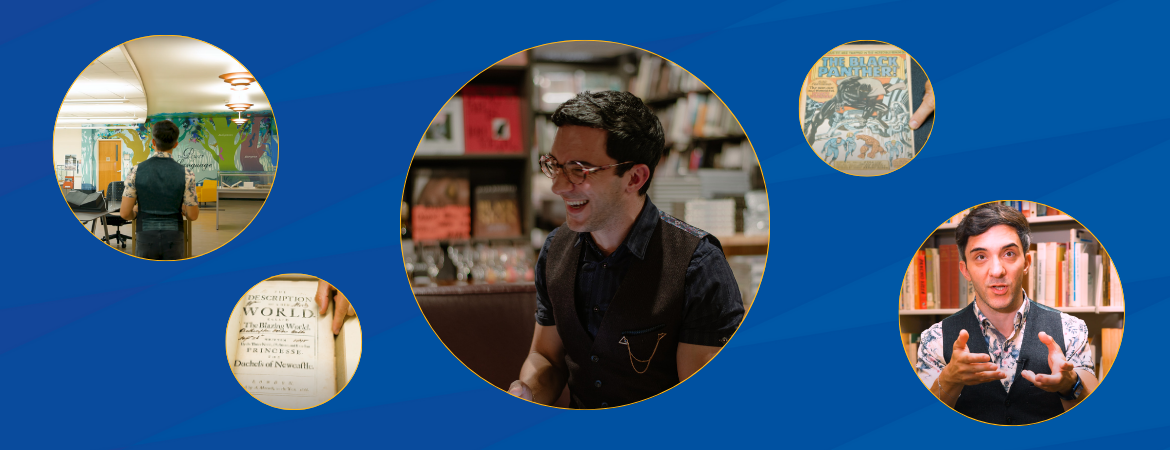
Dr. Phoenix Alexander, the Jay Kay Klein and Doris Klein Science Fiction Librarian at the UCR Library, has had a whirlwind few months.
Between organizing events, managing the Eaton Collection, and engaging with the local community, his schedule has been packed. "The last few months have been a whirlwind. So much exciting stuff is happening," Phoenix says.
One of the activities that has kept Phoenix busy these last few months was his involvement with the Science Fiction and Fantasy Writers Association (SFWA) and the 2024 Nebula Awards, an awards ceremony recognizing published science fiction and fantasy works, voted on and presented by SFWA.
Phoenix played a crucial role as a volunteer organizer at the awards ceremony held on June 8. “I was a liaison to the Grand Master, Susan Cooper. I also was the assistant to the Toastmaster Sarah Gailey," he says. “I had a headset, got instructions from the back, and made sure people were on stage when they needed to be.”
The 2024 SFWA Nebula Conference, which coincided with the awards ceremony, was held June 6-9 and saw Phoenix speak and serve as moderator for the panels, When Clank! Clank! Meets Pew! Pew!: Combining Fantasy and Sci-Fi Elements and Write Well, Stay Well: Self-Care for Authors.
SFWA is an organization for professional science fiction writers and Phoenix has been deeply involved in the organization, even serving as a member of its History Committee for over a year. “The History Committee helps authors, and the institution itself, with things like records management, providing resources to authors, organizing and preparing their papers for donation to different institutions, and keeping track of the history of the award ceremonies.” Phoenix says.
Phoenix sold his first short story in 2018 and describes his own writing as predominantly science fiction/horror. His stories have been published in outlets such as The Magazine of Fantasy and Science Fiction, Escape Pod, and Beneath Ceaseless Skies. He secured his literary agent, Angeline Rodriguez from WME, after a rigorous process of submissions and queries. “Finding the right agent took about 100 applications, but the persistence paid off,” he says.
Despite his busy schedule, Phoenix remains passionate about his work and the Riverside community. His involvement in local events, such as tabling at the Mini Comic Fest Featuring Black Kirby in Downtown Riverside this summer, highlights his commitment to engaging with the local community.
In August, Phoenix presented at Worldcon, the longest-running science fiction convention in the world, in Glasgow and looking ahead, he will be moderating a panel discussion of science fiction authors at USC Fisher Museum of Art at an event titled Radical Imagination: Queer Stories through Sci-Fi Storytelling.
Do you want to learn more about the Eaton Collection of Science Fiction and Fantasy? Learn about the Eaton Collection from Phoenix in the short video below:

Jay Kay Klein Photographs and Papers on Science Fiction Fandom
Located in: Special Collections & University Archives
Jay Kay Klein (1931-2012) began reading Science Fiction at a young age and joined the Philadelphia Science Fiction Society at the age of 14. During his lifetime he was an avid photographer and amassed an extensive photograph collection of Science Fiction & Fantasy conventions and events. Throughout his life Klein lectured on Science Fiction as literature, social commentary, and as a window into the future.
UC Riverside Hosts Science Fiction Research Association Conference
The University of California, Riverside hosted the Science Fiction Research Association (SFRA) 2017 conference from Wednesday, June 28 to Saturday, July 1.
This year's conference theme was "Unknown Pasts / Unseen Futures."
Home to the Eaton Collection of Science Fiction and Fantasy, UCR also runs the Speculative Fictions and Cultures of Science graduate program, and has a robust research community focused on speculative fiction across media.
UC Riverside’s collaboration with SFRA was due to the backing of UCR Library and the College of Humanities, Arts, and Social Sciences (CHASS), with a significant amount of funding and staff support made available by CHASS Dean Milagros Peña. “Without Dean Peña’s support, we wouldn’t even have started down the path of having a conference,” said Dr. Sherryl Vint, Director, Speculative Fiction and Cultures of Science.
“We are absolutely delighted that UCR hosted the SFRA 2017 conference,” said Alison Scott, Associate University Librarian for Collections & Scholarly Communication. “Bringing scholars, students, and creative artists to campus was such a great opportunity for shared learning and engagement. We’re thrilled!”
JJ Jacobson, UCR Library’s inaugural Jay Kay and Doris Klein Librarian for Science Fiction, was one of the panelists at the SFRA conference. Her discussion was about the dialogue between researchers and curators.
“We talked with a UCR graduate student who has done research in the Eaton Collection,” Jacobson explained. “We talked about her experience and how researchers and librarians can work together, what constitutes librarians’ work and what constitutes researchers’ work."
According to SFRA, the “Unknown Pasts / Unseen Future” theme grew out of their 2016 conference, which was centered on the history of science fiction that has yet to be sufficiently addressed in scholarship, including marginalized or otherwise neglected bodies of work. The conference theme also reflected UCR’s commitment to science fiction scholarship that is focused on imagining and creating sustainable and inclusive futures. The focus was equally on new voices in the field and the new kinds of futures that emerge from this broader sense of the field’s membership.
Founded in 1970, SFRA is the oldest professional association dedicated to the scholarly inquiry into science fiction. The association works to improve classroom teaching; encourage and assist scholarship; and to evaluate and publicize new books and magazines dealing with fantastic literature and film, teaching methods and materials, and allied media performances.
"One of the reasons I started having our graduate students co-curate exhibits was to give them another modality through which to speak," Jacobson explained. "They’re really good with words because they’re writing all the time – articles, talks, dissertations – but an exhibit is a very different thing. It’s not just words, it’s not just words and images. An exhibit is a display of works that already exist, so they’re already part of the public conversation, which are put together to tell a story about some aspect of speculative fiction, science fiction, or fantasy. It’s important to me because here are these inquisitive, caring, extremely hard-working young people who are actively committed to using speculative fiction to encourage the world to change. It was important that the Eaton Collection help them find a new kind of voice, to expand how they contribute to the world in terms of public goods.”
As an additional perk, the Eaton Collection granted access to conference attendees only from June 26 to 28, between the hours of 10:00 am and 4:00 pm. The 2017 SFRA conference was held at the Marriott Riverside located at 3400 Market Street, 92501. For the full conference program, panel list, and more, please visit the SFRA conference website.
Renowned Science Fiction and Fantasy artist Michael Whelan speaks at UCR Library
Renowned science fiction artist Michael Whelan came to speak at the UCR Library on the evening of May 18, 2017.
“An Evening with Michael Whelan” was co-sponsored by the Riverside Art Museum (RAM), and ran from 6:00 pm to 7:30 pm in Special Collections & University Archives. Whelan lectured to a standing-room only crowd about his career, his creative inspiration, and more.
Special Collections had also prepared a display of noteworthy books from the Eaton Collection of Science Fiction and Fantasy that feature Whelan’s cover art, which is still available for viewing on the fourth floor of Rivera Library.
The Jay Kay and Doris Klein Librarian for Science Fiction JJ Jacobson said that she was spoiled for choice. “I got 555 results one way, and 568 another,” Jacobson said of her catalog search results.
Jacobson said that she could have approached the display design from a number of different methods, but in the end, she decided to highlight Eaton Collection books by authors that many consider to be the “Grand Masters” of Science Fiction and Fantasy, including Ray Bradbury, Poul Anderson, Marion Zimmer Bradley, Andre Norton, and Samuel Delany.

As the most honored artist in Science Fiction, Whelan has won an unprecedented 15 Hugo Awards (which is the equivalent of an Academy Award in the science fiction art world), three World Fantasy Awards, and 13 Chesleys from the Association of Science Fiction and Fantasy Artists. The readers of Locus Magazine (for SF insiders) have named him “Best Professional Artist” 30 times in their annual poll, most recently in 2014. The Spectrum Annual of the Best in Contemporary Fantastic Art named Whelan a Grand Master in 2004.
Other noteworthy awards include a Gold Medal from the Society of Illustrators, a Vargas Award, a Grumbacher Gold Medal, and the Solstice Award from the Science Fiction Writers of America.
The Riverside Art Museum had an exhibition of Whelan's artwork titled “Beyond Science Fiction: The Alternative Realism of Michael Whelan” on display until May 25, 2017.
To learn more about the artist, please visit: michaelwhelan.com.