Search
Search
Library moves & construction updates: What you need to know
Over the next few months, construction and several moves will be occurring in the Rivera and Orbach Libraries.
Here is the overview. This webpage will be updated as projects are completed, or as timeframes shift.
Rivera Library
Basement
 Completed: Microfilms have been relocated to circulating shelves in the basement to the right of the metal microfiche cases.
- Currently: Construction has started in the former microfilm stacks to create a new secured stack area for Special Collections and University Archives.
First Floor
- Completed: Interlibrary Loan operations has relocated to the Circulation/Reserves service desk in Rivera Library.
Second Floor
- Completed - June 3 - August 9:
- Staff will move items in the Education Services collection to the basement (includes juvenile books, puppets, manipulatives, textbooks), where the microfilm was previously housed. This will allow greater patron accessibility on a non-quiet floor with more open space — conducive for a collection that sometimes is used by parents/caregivers with children.
- Items with K-L call numbers will be moved to the shelves where the Education Services materials were previously housed, on the second floor of Rivera Library.
- Completed - August 12 - September 20:
- Items with ML-MT call numbers will be temporarily moved to mobile carts on the second floor, while new, broader shelving is being installed. During this time, for your convenience, we suggest that patrons submit a hold/request for items in this collection, so that library staff can retrieve the items for you.
Orbach Library
First Floor
- Completed: Poster Printing services has moved from the ground floor to room 121 on the first floor.
- Completed: The Map Collection has moved from the ground floor to first floor. Map cases, GIS workstations, aerial photos, light table, and work tables are adjacent to the Creat'R Lab, now labeled as "Geospatial Resources."
Ground Floor
- June: The UCR School of Medicine will begin construction of their Clinical Skills Simulation Lab in the space formerly occupied by the Map Collection and some adjacent library spaces.
Music Library
The Music Library will close at the end of the day on Friday, September 6, and reopen on Monday, September 16. It will be closed for a week on September 9.
- Completed - September 9 - 13: The Music collection will move to the Rivera Library.
- M call number materials will be moved and shelved after the new location of the L call numbers on the second floor of Rivera Library.
- ML and MT call numbers will then be shelved after the M call numbers.
- Music Study Score will be shelved separately following the MT call numbers.
- Completed - Music Media (CD, VHS, LP, etc.)
- Music media will be interfiled into the current Media Collection on the first floor of Rivera Library. New security cases are being ordered for the collection.
- Rivera Reference will be shifted to the last two ranges behind the reference desk.
- The Media Collection will expand to the first range on the left side—shelves will be added accordingly.
Chicano Latino Studies
Located in: Tomás Rivera Library, Special Collections & University Archives
The Chicano/Latino Studies collections at the UCR Library consist of broad, interdisciplinary coverage in the social sciences and humanities, supporting undergraduate and programs and research.
Harry Potter's World comes to UCR Library
UCR Library is presenting a pop-up exhibition about the historical roots of Harry Potter.
“It is our choices, Harry, that show what we truly are, far more than our abilities.” And, it is with pleasure that the UCR Library Special Collections has chosen to present Harry Potter’s World: Renaissance Science, Magic, and Medicine an exhibition at the Rivera Library from Monday, May 15 to Saturday, June 23.
This traveling exhibition was originally developed and produced by the Exhibition Program at the National Library of Medicine, National Institutes of Health, and curated by Elizabeth J. Bland. The exhibit panels explore Harry Potter’s world, its roots in Renaissance science, and the ethical questions that effected not only the wizards of Harry Potter, but also the historical thinkers featured in the series.
As a complement to the traveling exhibition, also showcased will be selections from the UCR Library’s Special Collections 16th to 19th century original illustrated materials related to magic, witchcraft, herbal medicine, magical creatures and fantastic beasts. Included are some of the foundational works which serve as sources for Harry Potter’s magical world of wonder and wizarding.
“These early illustrated printed materials are crucial in their ability to transmit a wide body of knowledge about science and medicine over a broad geographical expanse. For example, one of the works on display will be Gerard’s Herbal, printed in London in 1597. It’s the first work to record and describe American plants, and it also includes early printed images and descriptions of deadly Nightshade and Mandrake, both of which figure prominently in the Potter novels,” noted Cherry Williams, the UCR Library’s Director of Distinctive Collections. The Special Collections display will also include Ulisse Aldrovandi’s illustrated work on the history of dragons and serpents printed in 1640 in Bologna Italy.
In 1997, British author J. K. Rowling introduced the world to Harry Potter and a literary phenomenon was born. Millions of readers have followed Harry to the Hogwarts School of Witchcraft and Wizardry where he discovers his heritage, encounters new plants and animals, and perfects his magical abilities.
According to the National Library of Medicine, “Although it is a fantasy story, the magic in the Harry Potter books is partially based on Renaissance traditions that played an important role in the development of Western science - including alchemy, astrology, and natural philosophy, …Incorporating the work of several 15th- and 16th-century thinkers, the … series examines important ethical topics such as the desire for knowledge, the effects of prejudice, and the responsibility that comes with power.”
Harry Potter’s World: Renaissance Science, Magic, and Medicine will be located in the Special Collections Department located on the fourth floor of the Rivera Library – which is open Monday through Friday, from 10 a.m. to 5 p.m. For more information about the pop-up exhibition, please visit the UCR Library’s Harry Potter’s World: Renaissance Science, Magic, and Medicine exhibition event website.
Affordable Course Materials Initiative saved UCR students $1.5 million
Where there’s a will, there’s a way – and a team of UC Riverside faculty and staff has devoted the last few years to finding innovative ways to make course materials more affordable for our students.
Survey results indicate that the Affordable Course Materials Initiative (ACMI) program has succeeded so far, having saved students more than $1.5 million over the past two years, according to Instructional Designer Nathaniel Wildes.
Wildes calculated these savings by factoring in the current quarter and recurring courses. “On average, it’s a little over $100 cost savings per student,” he said.
He shared these facts and more on Thursday, April 5 at an event called Democratizing Access to Student Success: Student and Faculty Perspectives on Affordable Course Materials, where attendees learned about the local impact of the ACMI since its 2015 launch. Held in the Center for Teaching and Learning on the first floor of Rivera Library, the event was co-sponsored by the UCR Library, the UC Riverside chapter of CALPIRG, and ITS.
“This is a critical social justice issue and one that is especially important on our campus,” said UCR Library’s Director of Teaching and Learning Dani Brecher Cook, who also coordinates the ACMI program for UC Riverside.
Cook’s welcome remarks included statistics from the UCR Basic Needs Working Group, which reported that six out of 10 students experience food insecurity during their time at UCR and may not have sufficient funds to afford textbooks.
A panel of UCR students also shared their personal experiences with high-cost textbooks compared to open-access resources.
Miguel Ramirez, a second-year anthropology major, Vice Chair of the UC Riverside chapter of CALPIRG, and campaign coordinator for the Higher Education Affordability Campaign, ambitiously bought all his textbooks as a freshman. “But I found myself not having enough money to afford three meals a day,” he said. “The average student is expected to pay $1,200 a year in textbooks and school supplies which, for me, is equivalent to almost 3 months of rent.”
Ramirez appreciated that courses using open-access resources gave all students the same opportunity to succeed. “And in my experience as a student, I can tell that my peers in the classroom like it better, too,” he added.
Fifth-year religious studies major and member of Mujeres Unidas Abigail Garcia tried to cut costs by purchasing earlier editions of textbooks or by using eBooks, but found that those alternatives created other challenges. “With older versions of textbooks, I have to make extra efforts to find where the professor is at in my version. It is a lot cheaper, but it doesn’t allow me to be in sync with the rest of the class,” she said. “With eBooks, it doesn’t give me the opportunity to annotate as freely as I’d like to.”
Huma Khan, a first-year business major and CALPIRG member, appreciates the portability of eBooks. “I’m a commuting student, so I would have to carry like 3 textbooks in my bag every day,” she said. However, certain rules during exams can create obstacles students who rely on eBooks or online-only resources. “Sometimes in midterms, teachers are like, ‘Yeah, you can use a book but you can’t use your computer,’” she added.
Both Garcia and Khan have felt frustrated by spending high dollar amounts but only reading one or two chapters in a textbook as well as with access codes. Khan explained, “For my last math class, I had to buy a textbook for the access code and it was $160, and I never even used the textbook.”
“Like a lot of students, I actually went without,” said Semi Cole, ASUCR Vice President of Internal Affairs and a fourth-year political science & public policy major. “I decided to see what I could do, learn what I could from lecture, and just see how it would work. Ultimately, my academics suffered.”
“We need to continue to move forward on this issue and expand to a larger departmental commitment,” Cole added. “We’ve seen from the students here that allowing open source textbooks in the classroom can be successful.”
“It’s deeply appreciated by our students,” said Cook. “It can also lead to innovative and engaging pedagogies.”
Faculty guest speakers included ACMI grant recipients Ruhi Khan, associate professor in media and cultural studies; and Rachel Wu, assistant professor in psychology.
The ACMI was first spearheaded by Chikako Takeshita, associate professor of gender and sexuality studies, and launched at UCR thanks to an $18,000 grant from Computing and Communications. Due to the success of the initial program, in 2016 an additional $150,000 from the Student Technology Advisory Committee established an endeavor that would span three years. At present, the ACMI is in its second year of this longer-term effort.
Celebrating our Class of 2022 library student employees
The UCR Library’s Student Employee Appreciation Event returns after a two-year pause.
The UCR Library is one of the largest student employers on campus. Each spring, the UCR Library usually holds an in-person appreciation event celebrating our student workers.
However, due to the 2020 and 2021 campuswide closure, the last in-person Student Employee Appreciation Event was in 2019. We are pleased to announce that this event returned on May 25, 2022.
At the safari-themed 2022 Student Employee Appreciation Event, held in the lower courtyard at the Rivera Library, we recognized 14 library student employees who will graduate with UCR’s Class of 2022: Yaneli Alvarado, Cynthia Cruz, Lina Cun, Isabel Fryett, Marlen Gonzalez Duran, Valerie Gonzalez, Hunter Courtney Kern, Romyrl Labuen, Miranda Lara, Jennifer Perez Lara, Michelle Rawlings, Xavier Rodriguez, Karen Rachel Rosales, and Danielle Velarde.
We asked some of our 2022 graduates what they will miss most about working at the UCR Library. Here are their responses:
“I will miss walking around the library and looking for books during my shift. I find this calming. I will also miss talking to my supervisor and my co-workers. They are the best!” — Romyrl Labuen
“What I’ll miss the most is the work culture. I was able to achieve personal and professional growth while simultaneously creating long-lasting friendships. I was never afraid to admit to a mistake, ask questions and I was even given several opportunities to learn and grow. It’s a culture that you cannot find anywhere else and is absolutely valuable for student workers such as myself.” — Miranda Lara
“My coworkers! Especially my supervisor, Margarita. I've worked here at Orbach for four years and while I've seen some of my coworkers come and go, there have been a few constants. We've all shared laughs and troubles, and have had our silly moments. I'll miss that all when I'm gone.” — Valerie Hernandez
“I'm going to miss the employees the most! Everyone is so nice and welcoming and I would always look forward to coming back once the school year would begin. I am also going to miss the flexibility and the laid-back environment that was present at the UCR Library. Overall, the staff make working at the library a great experience.” — Jennifer Perez Lara
Congratulations, class of 2022!
Robotics Camp Emphasizes Critical Thinking and Design
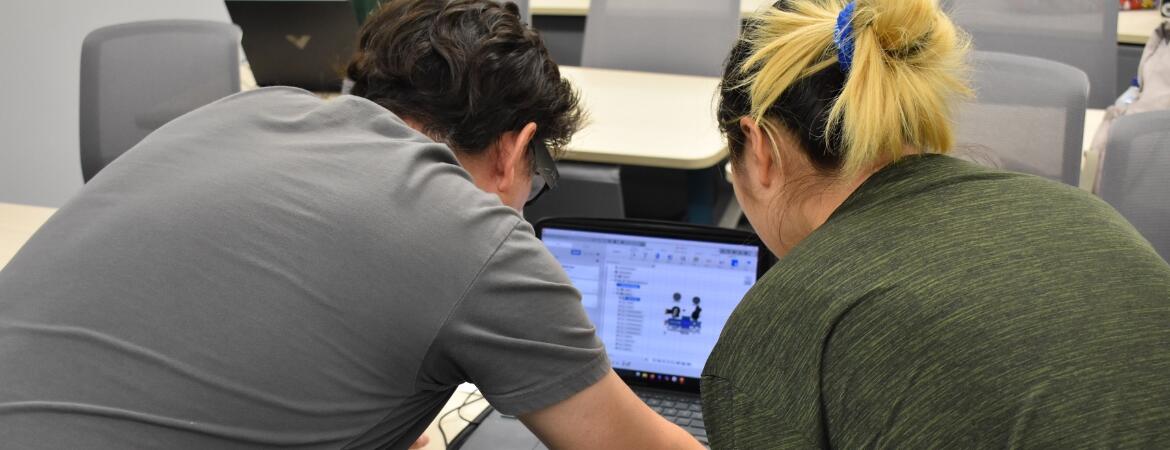
This summer, the UCR Library hosted its second annual summer Robotics Camp, held June 16 to July 18, 2025.
The camp, led by Maker Services Coordinator Brendon Wheeler and Innovative Media Librarian Alvaro Alvarez, brought together undergraduate students from across university disciplines to explore 3D modeling, coding, and robotics in a collaborative, hands-on environment.
Participants at this year’s camp gained hands-on experience with 3D modeling to create prototypes and programmed their robots using Python and C++. As part of the project, they built an Artificial Intelligence Convolutional Neural Network (CNN) capable of identifying red, green, and yellow signals. This in turn activated motors to mimic Mario Kart–inspired power-ups such as banana peels, mushrooms, and shells.
Innovative Media Librarian Alvaro Alvarez supported workshops and presented on Fusion 360 and 3D modeling. Alvaro noted the camp offered a richer curriculum comparatively. “I think overall it had higher quality content compared to last year and very useful for future projects and majors as it combined both robotics with AI,” he said.
Maker Services Coordinator Brendon Wheeler, who acted as the camp’s project manager and guided student participants through the development cycle, emphasized this year’s camp also deepened engagement. “This year our camp featured hands-on coding, robot 3D printer customization, and AI. Unlike last year, where students uploaded pre-written code, this camp emphasized critical thinking and higher levels of design. The curriculum was notably improved, fostering creativity and deeper engagement,” he explained.
A total of 26 students signed up for the camp, with participation highest in the first few weeks with 45% taking part from non-STEM majors, reflecting the camp’s interdisciplinary appeal.
Alvaro and Brendon confirmed that the camp will continue in the future. There are hopes to expand by including a K-12 camp and partnering with our community and a local school next year. The team also plans on designing next year’s summer camp with a more flexible schedule in the hopes of attracting more students.
Through programs like the open interdisciplinary Robotics Camp for wider university audiences, UCR Library continues to inspire curiosity, support creativity, and provide amazing opportunities for students to explore new technologies that will serve them well at UCR and beyond.
UCR Library Awarded $974,259 Grant
Institute of Museum and Library Services funding will provide scholarships for Inland Empire librarians to pursue master’s degrees.
RIVERSIDE, Calif. – The University of California, Riverside Library has been awarded a $974,259 grant from the Institute of Museum and Library Services (IMLS) to recruit 25 non-degreed employees from Inland Empire libraries who want to pursue a Master of Library and Information Science degree.
The Laura Bush 21st Century Librarian Program grant is designed to increase the number of under-represented minorities in the pool of librarians and improve library services in the region, said UCR Librarian Ruth Jackson. UCR will match the grant with $241,587 in library staff time to administer the three-year project.
The UCR grant is one of 38 totaling more than $22.6 million awarded to libraries, library schools, and professional organizations out of a national pool of 110 applicants.
“We’re very excited about this opportunity,” Jackson said. “Diversity of library staff makes a tremendous difference in availability of language skills and understanding the culture and information needs of the population served. It makes a difference to academic and public libraries in the kinds of materials you have in their libraries and the design of programmatic services. It is absolutely critical to have a diverse staff in both academic and public libraries nationally, and in the Inland Empire, which has one of the most diverse and fastest-growing populations in terms of diversity in the nation.”
UCR Library will be the lead institution partnering with eight public and academic libraries in the region to recruit, support and mentor current and future librarians. Those libraries are: San Bernardino County Library system, San Bernardino County Law Library, San Bernardino Public Library, Rancho Cucamonga Public Library, Riverside County Law Library, San Bernardino Valley Community College, Riverside Community College (Moreno Valley) and the University of Redlands Armacost Library. Also collaborating in the grant will be the Graduate Schools of Library and Information Studies at UCLA and San Jose State University.
Funding for the program, titled Inland Empire LEADS (Librarians Educated to Advance Diversity and Service), will provide scholarships up to $24,900, as well as internships, mentoring, and opportunities for program participants to attend professional conferences while working toward their MLIS degrees.
Tuition costs and the time needed to complete a degree – typically two years – make it difficult for working librarians to pursue the advanced degree, said Jackson and Patricia Smith-Hunt, head of Preservation Services for UCR Library and project director for Inland Empire LEADS. The Inland Empire LEADS project will enable working librarians to attend school full or part time, they said. Volunteers from the Librarians Association of the University of California, Riverside (LAUC-R) will serve as mentors.
Smith-Hunt said the grant-writing team – which she led, assisted by library analyst Julie Mason and Jackson – surveyed 25 academic, public and specialty libraries in the Inland Empire to determine interest in and need for the project.
“Administrators at all of the institutions that responded were excited about this possibility,” she said. “They estimated there will be 20 librarians retiring in the next five years. We can help educate the next generation of librarians, and the libraries where they work will benefit from new skills they will be acquiring and implementing before they graduate.”
The project will begin recruiting staff members who are already pursuing a master’s degree or who have been admitted to a program. Upper level undergraduates at UCR who have expressed an interest in pursuing a career as a librarian will be encouraged to apply as well.
Obtaining a Master of Library and Information Science degree is important both to understand the philosophical background of libraries and to respond to rapidly changing technology, services and resources, Jackson said.
“Libraries are complex organizations,” she said. “Librarians need to understand technology, design of services, strategic planning, advocacy, fund-raising, preservation, budgeting and influencing federal information policy, such as copyright law and open access to research paid for with federal dollars. At the same time, we have the challenge of redesigning libraries for easy, effective, and economical access to information in the digital age. Services in such areas as children and young adults, access to health information, economic and job data, and cultural programming will continue to be increasingly important in the public library arena as we make the transition. It’s important to continue to develop skills in critical thinking and reading among children and young adults in the digital age. That’s what libraries do.”
Library services in the Inland Empire have suffered because of language and cultural disparities between library staffs and the communities they serve, Smith-Hunt said.
“Library administrators whom we surveyed said their professional library staffs are racially and culturally disproportionate to the diverse communities they serve,” she said. “They anticipate labor shortages of professionally trained librarians over the next five years, and they need staff with language, cultural and personal experiences that more closely reflect the communities they serve.”
Competition on the national level to recruit and retain librarians from under-represented minority groups is strong, Jackson and Smith-Hunt said. The Inland Empire project will help increase the number of qualified librarians nationally and locally, they said.
The Institute of Museum and Library Services is the primary source of federal support for the nation’s 123,000 libraries and 17,500 museums. The institute’s mission is to create strong libraries and museums that connect people to information and ideas.
For application information contact Patricia Smith-Hunt, project director, at patricia.smith-hunt@ucr.edu or (951) 827-7702.
What If? An evening with Stu Krieger
On Thursday, Oct. 8, the UCR Library will host an online event with special guest, award winning film and television writer and UC Riverside Professor Stu Krieger.
WHAT IF: Professor Stu Krieger and Professor Erith Jaffe-Berg discuss Krieger's counter-factual history novel THAT ONE CIGARETTE is the third installment of the Faculty Profiles in Research, Art & Innovation series. All members of the UC Riverside community and surrounding areas are welcome and encouraged to attend.
Stu Krieger is an acclaimed screen and television writer making his debut as a novelist with That One Cigarette. He is currently a professor of screen and television writing in the University of California, Riverside’s Department of Theatre, Film & Digital Production and in the Creative Writing for the Performing Arts MFA Program at UCR. Each fall, he also teaches the Producing the Screenplay class at USC’s Peter Stark MFA Producing Program.
Krieger co-wrote the Emmy award winning mini-series A Year in the Life and was nominated for a Humanitas Prize for co-writing the Disney Channel original movie, Going to the Mat.
Among his more than 25 produced credits, Krieger wrote the animated classic The Land Before Time for producers Steven Spielberg & George Lucas and ten original movies for the Disney Channel, including Zenon: Girl of the 21st Century and its two sequels, Tru Confessions, Smart House, Phantom of the Megaplex, and Cow Belles.
He has been a story editor and writer on Spielberg’s Amazing Stories and the supervising producer on the ABC Television series Jack’s Place. He served as the head writer and story editor of the animated preschool series Toot & Puddle on Nickelodeon in 2008-2009. Mr. Krieger’s TEDx Talk, “Choose Joy,” can be viewed here.
On April 22, 2017, Stu Krieger received a Lifetime Achievement Award in Screenwriting at the opening night gala of the 2017 Riverside International Film Festival.
That One Cigarette is a counterfactual history novel following four families from November of 1963 to January of 2009. It is a story of ordinary people making extraordinary ripples in the ocean of life.
In November ’63, Ed Callahan is an assistant manager at the Texas School Book Depository in Dallas. His promise to his wife to quit smoking as soon as he finishes the pack in his pocket ends up changing the course of events on November 22. The fallout of this action alters the lives of the Scott family in Rochester, New York, the Kaufman/Goldman family in Los Angeles and the extended Kashat family in Baghdad, Iraq.
It’s not until the final chapters that all of these lives intersect but along the way That One Cigarette explores questions of fate, love, loyalty and the ability of each of us to make defining contributions to our world by simply being present in our own lives.
Please RSVP in order to receive the link to join the livestream broadcast from 4:30 - 5:30 p.m. Pacific Time on Oct. 8.
More dates for the series will be announced soon.
Go Behind the Scenes of Research at UCR with "The Reference Desk" Podcast
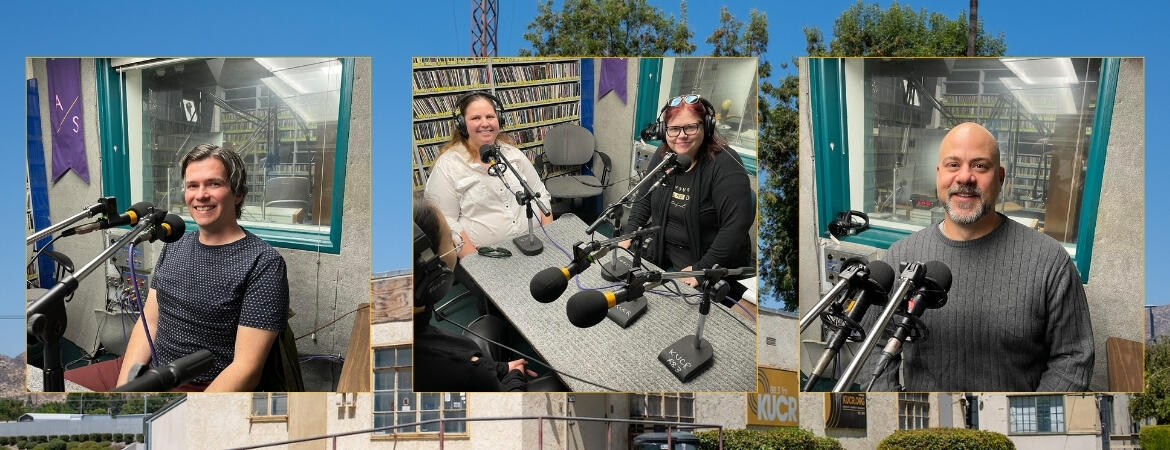
If your New Year’s resolution involved learning something new, diving deeper into the world of research at UCR, or learning about UCR Library resources, we have the perfect podcast for you.
After a successful launch and a busy season of recording in the KUCR 88.3 FM studios, The Reference Desk podcast is ready for your playlists. Hosted by Digital Scholarship Librarian Dr. Jing Han, the series moves UCR research out of the academic journal and into a conversational format that is accessible to everyone.
The project began as an organic collaboration with KUCR Associate Director Elliot Fong. According to Jing, the two quickly realized "how well audio storytelling could highlight research and library work in a more accessible way."
By choosing a podcast format, the library is effectively lowering the barriers to complex information. "The podcast is intentionally conversational," Jing explains. "I spotlight each researcher’s story while asking questions that many listeners are probably already curious about. That approach helps demystify research and makes complex work feel more approachable."
While the library is often associated with its digital and physical collections, The Reference Desk highlights the human expertise and assistance at the UCR Library that fuels academic research success. After interviewing faculty and researchers ranging from music and history to engineering and business, Han noticed a powerful common thread.
"One consistent theme is how much researchers value both the library’s resources, such as databases and collections, and the people behind those services," she says. "Regardless of discipline, nearly everyone highlights the role librarians and library support have played in shaping their research."
For students looking to find their own footing in the world of academia, the podcast serves as a practical roadmap. Each episode is structured to guide listeners through a researcher’s background, the specific library resources or services utilized, and their personal recommendations.
Looking ahead, Jing’s goal is to ensure the podcast is as diverse as the campus itself.
"My hope is for every department, school, and college at UCR to eventually be represented," she says. "I’d like the podcast to continue growing as a platform that reflects the full diversity of research happening on campus while strengthening connections between researchers, students, and the library."
How the UCR Library launched the career of alumna Sara Seltzer '08
Currently an institutional archivist for The J. Paul Getty Trust, the world's largest cultural and philanthropic organization dedicated to the visual arts, class of ’08 alumna Sara Seltzer began her career as a UCR Library student employee in Special Collections and University Archives.
“I’ll never forget when I got that job,” Seltzer said. “I came home that day and told my parents about it and my dad was like, ‘This is the start of your career!’ And I said, ‘I guess it is!’”
From a young age, Seltzer’s family instilled a love of history and literature into her life. “My mom in particular is a huge history buff and culture fiend,” she said. “Growing up we always went to museums, we always did lots of cultural things. I had influential people who exposed me to the kinds of environments where archives live.”
Her grandmother was a Cuban refugee who later worked in the corporate library for Southern California Edison, which also inspired Seltzer’s career goals. “That was her favorite job,” she explained.
Her academic studies at UC Riverside focused on European history and art history, while at the library Seltzer felt most passionate about working with archives tied to British history. “I’m a huge Anglophile, so that was exciting,” she said of working with the Ann Harris correspondence in 2009, among other projects for Special Collections and University Archives.
As a student employee, she appreciated the autonomy that her supervisors gave her, as it helped to build confidence in her own judgment and critical thinking skills. “Since I knew this was the path that I wanted, I was very thankful for that job and I took it very seriously,” she explained. “It was a bit unusual for student workers to be given that responsibility, but when it’s the right student worker, they get a lot out of it.”
Seltzer believes that library student employees can reap more long-term benefits than students at most typical entry-level jobs. “The library is so much more than just people working with books,” she explained. “There’s a huge demand for people with programming skills in this field, people who understand digital technologies, user experience designers. This is an opportunity to gain professional experience and to find a career path. It’s a viable field and it’s growing all the time.”
After graduation, Seltzer remained at the library until 2009 for an internship supervised by Manuel Urrizola, Head of Metadata & Technical Services. “He was very inspiring. He took me under his wing,” she commented. “He taught me all the basics of cataloging before I even started library school.” After graduating from UCLA with a MLIS in Archival Studies, Seltzer eventually moved to her current position where she is responsible for managing the current and historic business records of the J. Paul Getty Museum.
“I’m still working and doing what I always wanted to do,” Seltzer reflected. “I’m really happy with this path that I’ve been put on. It all pretty much began here, so I’m really grateful to UCR Library for giving me my start.”

The UCR Library is committed to enhancing the student learning experience, which includes supporting the professional development and advancement of our student employees. This article is the second in a series of stories following the success of former UCR Library student employees. We are incredibly proud of the alumni talent that was cultivated here, at the UCR Library.