Search
Search
Affordable Course Materials Initiative saved UCR students $1.5 million
Where there’s a will, there’s a way – and a team of UC Riverside faculty and staff has devoted the last few years to finding innovative ways to make course materials more affordable for our students.
Survey results indicate that the Affordable Course Materials Initiative (ACMI) program has succeeded so far, having saved students more than $1.5 million over the past two years, according to Instructional Designer Nathaniel Wildes.
Wildes calculated these savings by factoring in the current quarter and recurring courses. “On average, it’s a little over $100 cost savings per student,” he said.
He shared these facts and more on Thursday, April 5 at an event called Democratizing Access to Student Success: Student and Faculty Perspectives on Affordable Course Materials, where attendees learned about the local impact of the ACMI since its 2015 launch. Held in the Center for Teaching and Learning on the first floor of Rivera Library, the event was co-sponsored by the UCR Library, the UC Riverside chapter of CALPIRG, and ITS.
“This is a critical social justice issue and one that is especially important on our campus,” said UCR Library’s Director of Teaching and Learning Dani Brecher Cook, who also coordinates the ACMI program for UC Riverside.
Cook’s welcome remarks included statistics from the UCR Basic Needs Working Group, which reported that six out of 10 students experience food insecurity during their time at UCR and may not have sufficient funds to afford textbooks.
A panel of UCR students also shared their personal experiences with high-cost textbooks compared to open-access resources.
Miguel Ramirez, a second-year anthropology major, Vice Chair of the UC Riverside chapter of CALPIRG, and campaign coordinator for the Higher Education Affordability Campaign, ambitiously bought all his textbooks as a freshman. “But I found myself not having enough money to afford three meals a day,” he said. “The average student is expected to pay $1,200 a year in textbooks and school supplies which, for me, is equivalent to almost 3 months of rent.”
Ramirez appreciated that courses using open-access resources gave all students the same opportunity to succeed. “And in my experience as a student, I can tell that my peers in the classroom like it better, too,” he added.
Fifth-year religious studies major and member of Mujeres Unidas Abigail Garcia tried to cut costs by purchasing earlier editions of textbooks or by using eBooks, but found that those alternatives created other challenges. “With older versions of textbooks, I have to make extra efforts to find where the professor is at in my version. It is a lot cheaper, but it doesn’t allow me to be in sync with the rest of the class,” she said. “With eBooks, it doesn’t give me the opportunity to annotate as freely as I’d like to.”
Huma Khan, a first-year business major and CALPIRG member, appreciates the portability of eBooks. “I’m a commuting student, so I would have to carry like 3 textbooks in my bag every day,” she said. However, certain rules during exams can create obstacles students who rely on eBooks or online-only resources. “Sometimes in midterms, teachers are like, ‘Yeah, you can use a book but you can’t use your computer,’” she added.
Both Garcia and Khan have felt frustrated by spending high dollar amounts but only reading one or two chapters in a textbook as well as with access codes. Khan explained, “For my last math class, I had to buy a textbook for the access code and it was $160, and I never even used the textbook.”
“Like a lot of students, I actually went without,” said Semi Cole, ASUCR Vice President of Internal Affairs and a fourth-year political science & public policy major. “I decided to see what I could do, learn what I could from lecture, and just see how it would work. Ultimately, my academics suffered.”
“We need to continue to move forward on this issue and expand to a larger departmental commitment,” Cole added. “We’ve seen from the students here that allowing open source textbooks in the classroom can be successful.”
“It’s deeply appreciated by our students,” said Cook. “It can also lead to innovative and engaging pedagogies.”
Faculty guest speakers included ACMI grant recipients Ruhi Khan, associate professor in media and cultural studies; and Rachel Wu, assistant professor in psychology.
The ACMI was first spearheaded by Chikako Takeshita, associate professor of gender and sexuality studies, and launched at UCR thanks to an $18,000 grant from Computing and Communications. Due to the success of the initial program, in 2016 an additional $150,000 from the Student Technology Advisory Committee established an endeavor that would span three years. At present, the ACMI is in its second year of this longer-term effort.
Explore Two New Digital Collections
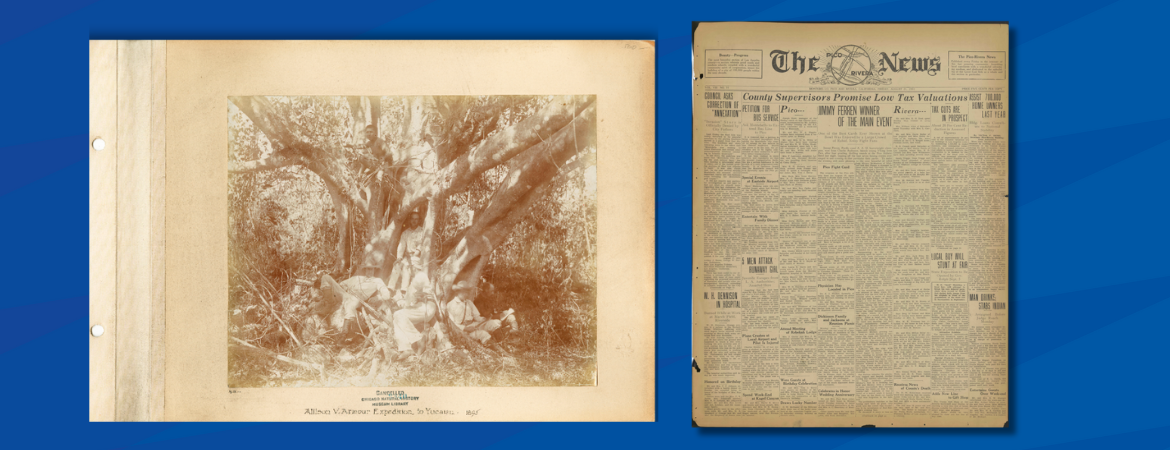
We’re excited to announce the addition of two digital collections available for research and study.
Allison V. Armour Expedition to Yucatán, Mexico Photograph Album
This collection showcases the 1895 research expedition led by curators from the Field Museum of Natural History in Chicago. The photo album captures views of Mayan ruins, with additional photographs of local scenery and the expedition group.
Explore the collection on Calisphere.
Pico Rivera News (UCR Access Only)
Dive into LA County history with the Pico Rivera News, a newspaper chronicling life in Pico Rivera, California and the surrounding area in 1931 and 1932. While mostly in English, some issues do feature a page of news in Spanish. This archive is a valuable resource for members of the UCR community researching journalism, Southern California history, and even Hispanic culture.
Access the collection through UC Library Search.
These new digital collections highlight our commitment to preserving and providing access to historical resources. We invite you to explore these collections and unlock stories from the past!
Spaces that Work: User-Centered Renovations at Orbach Science Library
Last summer, University Librarian Steve Mandeville-Gamble asked Ann Frenkel, Associate University Librarian (AUL) for Research and Instructional Services, to pull together a team of librarians and staff to rethink how space is used in the UCR Library. They were given a budget for purchasing new furniture to enhance research and study interactions. The team analyzed how students use the physical library, studying where students carve out spaces for particular functions.
The team found that students engage in various types of activities, including individual study, group study, individual project work, project collaboration, social interaction and more. They discovered that open areas with tables are conducive to group collaboration, and that students who want to work quietly alone seek out nooks and corners between stacks. Students particularly enjoy the ability to create their own work environment. In the past few months the team has selected furniture to enable these experiences, using bright, bold pieces for open group spaces, creating collaboration stations with shared screens for project work, and installing pieces such as the “egg” chairs and bean bags for individual study. Most of the furniture is moveable and students are using the new mobile white boards as dividers, enclosures, or presentation walls.
We hope you enjoy the 100 new working spaces in Orbach Science Library. Enhancements will continue to be made in both library buildings, so keep an eye out! The Facilities Department is making special effort to maintain a clean, organized, and inviting environment. AUL Ann Frenkel welcomes feedback on the renovations.
Diane Bisom Is Now AUL for the Digital Library
Effective August 9, 2016, Diane Bisom’s title has been changed to Associate University Librarian for the Digital Library.
This development will position the UCR Library for continued success as a major academic research library. Diane will retain her existing departments and units; she will also begin planning and implementing the creation of a Digital Initiatives unit.
Every aspect of contemporary academic research librarianship is intimately tied in with digital technologies and digital strategies, regardless of the formats of the materials acquired or managed. Two-thirds of our acquisition dollars go towards digital content; the tools that libraries use to describe and provide access to materials are digital in nature, regardless of the format of those materials, and academic research libraries manage large and growing quantities of born-digital content in the form of digital archives and research data.
The AUL for the Digital Library role is designed to ensure that the UCR Library employs a coordinated set of digital strategies to manage the life cycle of information resources acquired or managed by the library. Similarly, the AUL for the Digital Library role will emphasize the UCR Library’s commitment to ensuring fast and durable access to high-quality information for the students, faculty, and other researchers at UCR.
We will rely on Diane’s guidance for vision, strategic leadership, and management to help us advance the Library’s digital efforts and innovative technology services.
Reproduction of Library Materials Policy
Self-service scanners, printers and photocopiers are available to library users.
UCR Library and Sherman Indian Museum receive $376,191 Digitizing Hidden Collections Grant from CLIR
On January 4, 2017, the Council on Library and Information Resources (CLIR) announced that the UCR Library and the Sherman Indian Museum would receive a $376,191 Digitizing Hidden Collections grant, generously funded by The Andrew W. Mellon Foundation, for a collaborative project to digitize the museum’s collection.
“Their collection houses thousands of one-of-a-kind documents about the history, education, and culture of The Sherman Institute from 1901 to 1970, and Sherman Indian High School from 1970 to the present day,” explained Dr. Clifford E. Trafzer, UC Riverside’s Distinguished Professor of History and Rupert Costo Chair in American Indian Affairs. “The collections also have all the records of Perris Indian School from 1892 to 1904, when the Bureau of Indian Affairs transferred students to The Sherman Institute, the first off-reservation American Indian boarding school in southern California. These are valuable treasures that cannot be replaced. Documents and photographs represent many aspects of student life at Sherman and focus on the people, curriculum, sports, music, dance, and vocational education.”
“These records hold the history for so many people: Native American people who came to school here, people who have worked here, and their families,” said Lorene Sisquoc, Director of the Sherman Indian Museum. “We get many different research requests, not just from alumni. It’s been quite in-demand for the past 25 years, and the demand has gotten bigger and bigger to access these archives that are well over 100 years old. It was crucial that we got this done somehow.”
The Sherman Indian Museum collection is an invaluable resource documenting the Native American experience in the United States. The collection supports research in a range of disciplines and on a variety of topics including Native American education, the US government’s cultural assimilation efforts of Native Americans, and the history of American Indian off-reservation boarding schools.
“There are only a handful of American Indian boarding school collections out there, and the only other one that has been digitized is in Pennsylvania,” explained Eric Milenkiewicz, Manuscripts Curator and co-principal investigator on the grant. “So this project will provide the public with a glimpse into the boarding school experience from a California, west coast perspective.” Given the granting agency’s guidelines, the Sherman Indian Museum could not apply for the grant on their own; they also didn’t have the resources needed to digitize their collection. That was all the incentive that UCR Library needed to complete the grant application last April.
“Serving this type of community need is exactly why the Inland Empire Memories initiative exists,” Eric explained. Founded in 2013, the mission of Inland Empire Memories is to identify, preserve, interpret, and share the rich cultural legacies of the Inland Empire’s diverse communities. “It’s really about safeguarding these materials, this community treasure for future generations. This is part of Riverside’s history, which UCR is also a part of, and we want to make sure that the collection is preserved and accessible to the community.” The digital collection will be made available through Calisphere, thanks to CLIR and The Andrew W. Mellon Foundation, allowing worldwide online access to this rich resource.
As part of this grant, UCR Library will help build infrastructure for future digitization efforts at the Sherman Indian Museum. The grant will also procure scanning equipment for the Museum, and students from the Sherman Indian High School will receive training so that they can participate in digitization. “This is something that’s been needed for a long time,” said Lorene, “and we’re very fortunate to get this.”
“One of our project’s primary goals is to embed these technical skills in the community that will be carrying this digitization work forward,” Eric explained. “We believe that the skills learned by the students over the course of this project will positively impact the museum and community, promoting a greater understanding of digital initiatives work. And we hope that this grant project will inspire further community support from other interested organizations or individuals who will want to step in, to carry this torch into the future,” Eric added.
Benefits of digitizing the Sherman Museum’s collection are many, but three come to the forefront. As Lorene explains, “It’s going to benefit people all over to be able to access these, and also to protect them so we won’t be using originals as research access.” According to Dr. Trafzer, “Scholars will produce many books and articles from the rich documents found in the collections,” he explained. “Equally important, former Native American students of Sherman and their families will have easy access to documents and photographs, school newspapers and annuals. Native American people and families will be able to learn more about the lives of their loved ones. This will provide contemporary American Indians and scholars with images and voices of past generations of students, faculty, and staff at Sherman.”
“It’s not just great news for UCR’s own graduate students,” Associate University Librarian for Collections & Scholarly Communication, Alison Scott concurred. “This will be great for the world.”
McLeod Collection Aligns with Sikh Studies Award
In early 2011, the UCR Library acquired the McLeod Collection of Sikh Studies from the widow of William Hewat “Hew” McLeod, a New Zealand scholar who wrote many books and essays about Sikh history, theology, and cultural identity.
This collection contains nearly 2,000 volumes devoted to topics including Sikh religion, culture, art, and history. Kuei Chiu, Head of Collection Development Department, oversaw the intake and Manuel Urrizola, Head of Metadata and Technical Services oversaw the cataloging of these items for the Library.
About half of McLeod’s collection is written in English, while the remainder are in Punjabi. UCR Library’s Music Cataloger Diane David and Serials Cataloging Librarian Sharon Scott completed cataloging of the English-language volumes six months after their initial receipt. The English items in the McLeod collection were immediately available for use.
The items in the Punjabi language were cataloged by external vendor Backstage, in collaboration with Librarian and Metadata and Technical Services Department Head Manuel Urrizola and Library Assistants Jim Clark and Cynthia “Kit” Rembert.
The entire collection was available for study and research by 2015.
With the exciting announcement by the College of Humanities, Arts, and Social Sciences (CHASS) of their Harkeerat and Deepta Dhillon Endowed Research Award for Sikh and Punjabi Studies in the Arts and Humanities, the Library looks forward to seeing an influx of visitors to the McLeod collection.
The Dhillon family’s $100,000 gift to CHASS is intended to support dissertation research and writing by doctoral candidates. Students majoring in history, religious studies, and philosophy are certain to benefit from these unique Library resources, as well as from the Dhillon’s generous contribution.
The McLeod Collection of Sikh Studies is housed in the Tomás Rivera Library. To view the full listing of items, use this link: http://bit.ly/ucrsikh
Our Role and Position as a Library Post-Election
Last week, we saw an election unlike anything that any of us alive today could have imagined even a few years ago.
Some have used the rhetoric that emerged during the campaign and afterward as a legitimization for disrespectful speech and violent action towards those that they do not understand and therefore fear. As one colleague put it, we are a nation experiencing a case of road rage, where rage has replaced reasoned, open, and honest discourse.
The UCR Library affirms the campus’ commitment to diversity and inclusion and its role in ensuring that that commitment is fulfilled. We also stand for reasoned, thoughtful, and respectful discourse and the free exchange of high-quality information. We value the multiplicity of viewpoints, insights, and lived experiences that make the academic, professional, and personal experience at UCR so rich for our students, faculty, and staff.
The role of the Library has been and always will be to connect people, ideas, and information. This is a time for us to come together to shine the light of reason and fair play on “information” being shared via social media and other communications platforms that has not faced the test of journalistic or academic integrity and that has not been edited, fact checked, vetted, or otherwise challenged effectively for factual inaccuracies.
The Library can and will play a critical role in preserving and extending our democratic ideals where people of all backgrounds, identities, socioeconomic levels, and places of origin have an equal footing and an equal voice in the democratic processes that have set this country apart from so many others for so long. Libraries in this country have stood from their beginnings as places where democratic ideals are protected, shared, and nurtured. This is not the time for us to stop doing so.
We have an opportunity to be part of the solution to pull this country back from despair, lawlessness, and discord. That doesn’t mean that we have to always agree, far from it. But it does mean that we have to use our skills and abilities to stand for our ideals.
Everyone in the UCR Library community is welcome as a valued member, regardless of race, ethnicity, country of origin, religion, socio-economic status, sexual orientation, gender identity/expression, visible and non-visible disability, or any other characteristic. Please join me in affirming that it is our duty to continue to work together to ensure the safety and well-being -- physically, emotionally, and academically -- of all of the students, faculty, staff, and community members who work, study, or use the UCR Library.
Sincerely,
Steven Mandeville-Gamble, University Librarian
Information for K-12 Class Visits to the UCR Library
Elementary Class Visits (K-5)
Elementary class visits to the UCR Library may be arranged. Library staff will work with you to arrange a visit that aligns with your goals.
Due to space limitations, field trips are limited to groups of 65. For more information, or to arrange a visit, please contact Teaching & Learning Services.
Middle and High School Class Visits (6-12)