Search
Search
African American Life & Culture
Located in: Tomás Rivera Library, Orbach Science Library
The UCR Library provides an extensive collection of resources, in both print and electronic formats, to support the interdisciplinary work of the African American Studies program.
New Arrivals for the Eaton Collection of Science Fiction and Fantasy
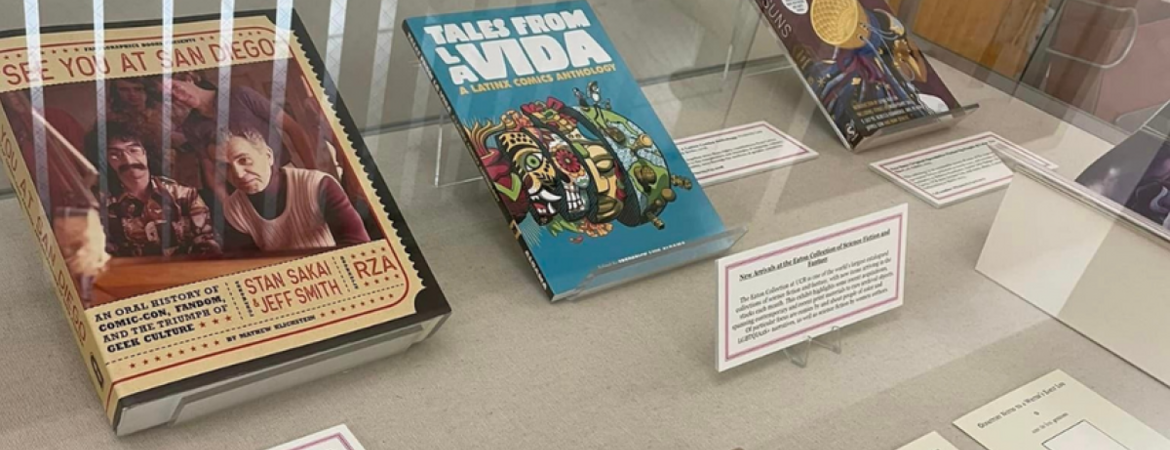
Our new pop-up exhibit features recent acquisitions for the Eaton Collection - including Afrofuturism, Latinx comics, and more! Come visit us during winter quarter on the 4th floor of the Rivera Library from 10 a.m. - 4 p.m. in Special Collections & University Archives.
| Event | New Arrivals for the Eaton Collection of Science Fiction and Fantasy |
| Location | Tomás Rivera Library, 4th floor, Special Collections & University Archives |
| Dates | |
| Parking | Free Visitor Parking is available on Fridays, starting at 12:00 PM through 6:00 AM Monday morning in the unreserved spaces of the following parking lots/structures: Lot 6 Blue Lot 13 Blue Big Springs Parking Structure 2 Lot 26 Gold Lot 30 Gold Lot 50 Gold Paid Visitor Parking information can be found here. |
500 Years of Utopia
This exhibit commemorates the 500th anniversary of Thomas More’s Utopia, a book that led to a proliferation of utopian fiction in the Western world. Utopias usually critique the politics of the author’s time, and imagine what a better society might look like. Many utopias sparked social movements, such as the Utopian Socialism of the 19th century. The vibrancy and diversity of the utopian imagination eludes a simple definition of the term. 500 Years of Utopia explores this subject, and showcases the Eaton Collection’s works on utopias and dystopias. It highlights key texts of the last 500 years, explains their importance, and calls attention to the beauty of the books as artifacts. The exhibit also celebrates the 50th anniversary of the original Star Trek series, which premiered on September 8, 1966, with a display of Star Trek memorabilia for the Eaton Collection.
500 Years of Utopia is the first of a series of exhibit collaborations between the Eaton Collection and UCR’s Science Fiction and Cultures of Science Program (formerly Science Fiction and Technoculture Studies). JJ Jacobson, the Klein Science Fiction Librarian, co-curated it with graduate student Irene Morrison, who works in the field of utopian studies, specifically utopian literature and real-world utopian ideologies.
Research Guides
The following research guides were created by our Librarians and Archivists in order to provide more ready access to the collections and facilitate research with Special Collections and University Archives materials. These guides colocate resources in Special Collections and University Archives according to their subject matter. These are intended to provide an overview on their subjects and help navigate the collections.
Sheila Finch Papers
Located in: Special Collections & University Archives
This collection contains press clippings, correspondence, and other material regarding Sheila Finch, a science fiction author and professor of creative writing. Includes correspondence regarding her science fiction stories with Valerie Smith, Jonathan Matson, David Brin, and Roger MacBride Allen as well as material pertaining to her teaching career.
Science Fiction Librarian Contributes to New Book
Our Jay Kay and Doris Klein Librarian for Science Fiction, JJ Jacobson recently contributed a chapter to a book titled, Teaching and Learning in Virtual Environments: Archives, Museums, and Libraries.
JJ’s chapter, Crowdsourcing the Fictive Experience: Virtual-World Emergent Narrative from a Collections Perspective, is about the practice of Immersive Interactive Improvisatory Narrative, or IIIN.
“It’s a very common feature of virtual worlds of all kinds,” JJ explained. “IIIN is a modality of storytelling. There’s role-play, sometimes recreational, sometimes tied to history, as well as re-enactment and historical interpretation. It’s connected to speculative literature because many of these narrative interactions exist in a context that is speculative – alternate history, for instance – or occasions for this kind of narrative are in a context that is related to or is directly the speculative or fantastical imagination.”
IIIN can be traced to modern improvisatory theater forms, JJ explained, such as the Renaissance Faire; and it is often found in Civil War and similar reenactments, which exist to explore history and educate participants as well as audiences. “It’s an interesting question to compare those to the evolution of community theater, too” she continued. “All of these things exist in the real world, but with some specific entertainment or educational mission. One of the questions we barely touched on was: ‘When did IIIN start to become pure recreation?’”
JJ’s chapter is the result of three distinct discussions on the topic of IIIN. JJ spoke with an expert on living history in museums and places like Plimoth Plantation, a special collections librarian from a well-respected institution, and a professional historical interpreter who plays Mildred Cecil, Lady Burleigh, wife of Lord Burleigh, chief advisor to Queen Elizabeth I.
“These conversations opened up some questions worth thinking about, questions that nobody else seems to be writing about, but that people within the reenactment and historical recreation and virtual worlds talk about all the time,” JJ said. “We talked about the phenomenon and why someone might study it, what a research collection might look like.”
To date, JJ has not seen much scholarly writing on this topic, especially not with the same emphasis.
According to JJ, some questions that could inspire scholarly research on the subject of IIIN might include:
- What kind of activity is it, exactly?
- If we trace it back to various kinds of plays or theater, is that sufficient?
- What are we doing in an historical enactment, with its factual constraints?
- If a library were to collect examples of it, what kinds of research might that support?
- What kind of researchers might use them?
- What would a collection surround them with as secondary source material?
“The Eaton Collection is largely a collection of texts and other narrative forms, but stories that are already done and finished are not the only occasion for the fantastical imagination to work,” JJ explained. “So here is a very interesting way of creating something that could easily be subject matter in the Eaton Collection. If people have made up their own country and they act the story together and build it up as they go, that’s still the kind of thing we collect. Those kinds of worlds, those kinds of subjects are intensely interesting to me. Even though you won’t find those exact worlds in the Eaton Collection, you’ll find many like them in motivation, structure, and so on.”
The book was published by Libraries Unlimited in 2016 and is now available on Amazon, Barnes and Noble, and other retailers.
Poul and Karen Anderson Papers
Located in: Special Collections & University Archives
The collection consists of the personal and authorial papers of science fiction authors Poul and Karen Anderson, including materials related to the publishing process and their involvement in the science fiction community and the Society for Creative Anachronism. Items in the collection include correspondence, memorabilia, manuscript drafts, notes, diaries, artwork, and ephemera from various conventions and events.
Collections
Collecting Areas
The Special Collections & University Archives department at UC Riverside contains a large number of collections across a wide range of interests. Our holdings amount to over 750 archival collections totaling over 8,000 linear feet of materials that includes documents, correspondence, diaries/journals, maps, A/V recordings, and more.
Massive Science Fiction Photo Collection Digitized in Record Time
The California Digital Library and the UCR Library recently partnered to digitize nearly 6,000 photographs from the Jay Kay Klein papers – and completed the task in less than two days.
“If we had done the same project in-house, it would have taken us several months to do,” said University Librarian Steven Mandeville-Gamble.
UC Riverside is the first among the entire UC system to employ this specialized workflow with proprietary object holders designed by Pixel Acuity. The company has used the process with previous clients that include the Smithsonian Institution and Stanford University.
According to Mandeville-Gamble, this project demonstrated that non-book content can be digitized en masse at an affordable price by working with outside vendors.
“The Jay Kay Klein papers were so well cataloged and prepped for digitization, we finished well ahead of schedule,” commented Eric Philcox, owner of Pixel Acuity. “It was a pleasure working with UCR and CDL.”
“A standard has been set here, one that we will strive to meet in our future efforts to digitize comparable collections,” stated Eric Milenkiewicz, Digital Initiatives Program Manager.
This was the first in a series of pilot projects to use Pixel Acuity’s specialized mass digitization process to make more of the UCR Library’s non-book collections available online. For this inaugural project, Milenkiewicz selected 35mm negatives from the Eaton Collection’s Jay Kay Klein papers (MS 381), documenting the World Science Fiction Convention (Worldcon) from 1960-1971.
“We are actively working to make the collection available to researchers worldwide, which I know was one of the goals of the original bequest from Jay Kay Klein,” Mandeville-Gamble added.
The UCR Library plans to make the resulting digital collection available on Calisphere by August 15, 2017.
Although the full project spearheaded by the California Digital Library has not been completed yet, their Technical Lead for UC Mass Digitization Projects Paul Fogel commented, “Overall, I feel like the project is a big success.” Fogel added that CDL was motivated to work with UC Riverside thanks to the library's eagerness and the fact that library staff were already working with some of the systems that CDL wanted to test.
“It is always hard to be the trailblazer and I'm impressed by UCR's willingness to take bold steps in digitization,” Philcox added. “The impressive results of UCR and CDL's first mass digitization pilot will certainly have a positive impact on UC's digitization efforts moving forward.”
Milenkiewicz concluded, “This collaborative project allowed us to witness firsthand the efficiency at which non-book mass digitization can be completed and has provided us with techniques that can be deployed locally to increase our own productivity.”