Search
Search
Camaraderie, Pizza, and 21,000 Comic Books
Many hands make for light work – and when the job is sorting more than 21,000 comic books, you need a lot of hands.
Jim Clark, Head of the Database Management and Authority Control Unit, and Erika Quintana, Acquisitions Unit Supervisor were tagged as team leaders and charged with tackling the project of sorting 142 boxes, each containing approximately 150 comic books.
Jim explained, “We took all the boxes, looked at what we had, and tried to come up with how best to attack it.” He and Erika knew right away that they needed help, and all it took was the lure of free pizza to entice the rest of the team to join. Perhaps library employees are not so different from the students they serve, after all.
“It was a lot of fun,” Jim added. “Erika Quintana and I just organized all the boxes, gathered everybody, and we just went to town.” There were three big sorting ‘parties,’ during which Metadata Cataloger Sompratana Creighton and Asian Languages Cataloger Min Yu came on board as permanent team mates. Other floating team members included Acquisitions Assistants Sean Andress, Christy Brown Anderson, and Deborah Snow, Serials Assistant Andi Newman, Engineering Librarian Michele Potter, Head of Metadata & Technical Services Manuel Urrizola, Digital Assets Metadata Librarian Noah Geraci, Metadata Cataloger Julia Ree, as well as Associate University Librarians Diane Bisom and Alison Scott.
During the first phase of sorting, the team got through about one-third of the boxes when a surprise delivery arrived. “Special collections discovered a bunch more comics that they didn’t know we had, so those got merged into the project,” Manuel explained.
“If Erika and I had been the only ones doing it, we’d still be working on it,” Jim said. “But having that many people work on it, it saved us so much time. It really was a big help.” In whole, the sorting project lasted more than six months, even with several members of the team working on it daily.
“Not only could we work faster and more effectively, but we could also get to know each other more,” Sompratana commented. “When we worked together as a group, I got to know them really well and I liked that.”
Min agreed, “We worked mostly as a team and we had a happy time working together. We had fun and learned a lot.”
Most of the 21,000-plus comic books that the team organized will become part of the Eaton Collection of Science Fiction and Fantasy, adding a wide variety of new and different assets to the UCR Library’s extensive array of materials devoted to this field of scholarly research.
Some of the comics were given to the library by donors who asked for special attribution, so those were kept separate from the rest.
In addition, the team also had to sort out duplicates and process them separately from the comics that the library planned to retain in our collections. According to Min, there were approximately 40 boxes of duplicate issues culled from the collection.
“My favorite part was seeing everyone work together,” Jim stated. “They really got into it! It was really great teamwork.”
Now, the project is moving into its next phase: cataloging, which could take a year or more to complete. “We could use as many people as we can get,” Jim said. “If anyone is interested, if they would enjoy doing that, they should reach out to me or Erika to see how to get involved.”
Children’s & Young Adult Literature
Located in: Tomás Rivera Library
The UCR Library offers a significant collection of children’s and young adult literature. Winning titles from more than fifty annual awards deemed of the most significance to K-12 teachers are featured. Resources also include “big books” for children pre-K through grade 3, sized for sharing with a group of students rather than individual reading.
Class of '68 alumna pledges $489,000 gift to UCR Library
UC Riverside class of 1968 alumna Ann Kelsey recently pledged a $489,000 planned gift to the UCR Library to fund an endowment that supports initiatives in technology advancement.
Born on June 20, 1946 in Kokomo, Indiana, Ann Kelsey’s father served in the Navy, having enlisted after Pearl Harbor was bombed in 1941. At age five, her father’s career brought the family to a Southern California facility.
Very early in life, Kelsey knew that she wanted to become a librarian. She spent much of her adolescent years reading and working in libraries; starting at sixteen, she worked for the Riverside city-county library.
Both of Kelsey’s parents encouraged her to attend college because neither of them nor most of her extended family members had gone to university. By her senior year of high school, she knew that UC Riverside was the natural choice.
At UCR, Kelsey double majored in English and Anthropology; from her anthropology classes, she developed an interest in Asian cultures and Southeast Asia.
After graduating from UCR, Kelsey attended library school at UCLA, where she met Army Special Services recruiters. Kelsey served as a librarian during the Vietnam War, traveling to Vietnam to establish and oversee recreational libraries for soldiers.
Kelsey’s career as a librarian placed her at the helm of introducing new technologies within library spaces to better support the changing needs of the communities they serve.
Her $489,000 planned gift to the UCR Library will provide unrestricted support, allowing the library to strengthen and sustain its programs and services in emerging technology, which directly aligns with Kelsey’s own life and career.
University Librarian Steven Mandeville-Gamble said, “The UCR Library is honored by the generosity and confidence shown by Ann Kelsey in her establishment of this bequest. Ms. Kelsey’s career has spanned the advent of library automation to the evolution of digital scholarship and emerging digital literacies. This gift will allow the UCR Library to continue to evolve to meet the increasingly sophisticated technology needs of our faculty and students for many decades to come.”
Dexter Thomas Jr. Collection of Japanese Hip Hop
Located in: Tomás Rivera Library
The Dexter Thomas Jr. Collection of Japanese Hip Hop is a collection of nearly 600 items, in both Japanese and English, on Hip Hop culture in Japan that Thomas compiled over several years while conducting research in this area. The collection primarily consists of compact disc recordings from Japanese Hip Hop artists, but also includes manga, magazines, and other materials pertaining to Japanese Hip Hop culture.
Rare Books and Other Special Collections
Located in: Special Collections & University Archives
Special Collections demonstrates the full range of the history of the book and book production, from ancient times until today. The holdings represent a wide range of languages; come from various geographic areas; and primarily cover history, religion, geography, art, and literature. Researchers can see examples of paper, vellum, parchment, handwriting, inks, typography, bindings, printing methods, illustration processes, and more.
Diversifying the Digital livestream broadcast
On Friday, Oct. 20, the UCR Library will broadcast Forum Four of Diversifying the Digital series, titled: “Integration: Why and How to Address Integration with National Digital Collections Initiatives.”
The forum will discuss how to integrate community archives into a nationwide digital platform and the importance of including diverse communities’ voices in our recordkeeping while respecting cultural protocols, traditional practices, and local conditions governing the collection, preservation, and access to community archives materials.
Those interested can watch the livestream broadcast in Rivera Library, Room 403 from 7:30 am to 1:00 pm, and join the conversation on Twitter using the hashtag #DDHR4. Forum presenters will include representatives from funding agencies, national digital collections initiatives, traditional libraries and archives, and community archives.
Diversifying the Digital is a collaboration between the Inland Empire Memories project at UC Riverside, the Amistad Research Center at Tulane University, the Shorefront Legacy Center, the South Asian American Digital Archive, and Mukurtu. The project was funded by the Institute of Museum and Library Services’ (IMLS) National Forum Grants program.
The project aims to address the lack of diversity represented in collections; to develop sustainable networks of community archives resources, programming and collections access at local, regional, and national levels; and to design strategies for increased collaboration with inclusion in national digital initiatives, such as the National Digital Platform.
Diversifying the Digital has hosted three prior forums to facilitate public conversations about collaborative community archives and the composition of our cultural heritage, including digital records. Forum Four will be the last in the series.
“Community archives are traditionally independent entities developed to serve specific communities. They grew out of necessity because of exclusion,” explained Bergis Jules, Project Director for Inland Empire Memories. “Diversifying the Digital has been a tremendous opportunity to explore how we can integrate community archives into national digital collections, organizations, and projects while honoring the individuality and independence of those spaces.”
Funding agencies such as IMLS, the National Endowment for the Humanities, and the Andrew W. Mellon Foundation are moving toward more collaborative approaches to providing access to digital records, as are national digital cultural heritage projects like DPLA and the HathiTrust, which makes this an ideal time for community archives to determine how best to integrate their work with these efforts.
Records for the first three forums are posted on the Diversifying the Digital website, and can be found on Twitter using the hashtags #DDHR1, #DDHR2 and #DDHR3, respectively.
Call for Submissions — Ancestral Futures: Speculative Imaginings from the Archive
CALL FOR SUBMISSIONS
Ancestral Futures: Speculative Imaginings from the Archive
An Arts & Literary Magazine from SCUA
What stories can we find in the archives about Black, Indigenous People of Color (BIPOC)? Whose stories are missing, and what new creations can these archives (or the gaps in them) inspire?
UCR Special Collections & University Archives invites everyone, including members of the general public, artists, writers, poets, and creatives, to visit the archives and speculate how these materials can be reimagined, and metaphorically remixed, to tell new stories. We seek submissions that draw from Afrofuturism, Latinx/Chicanx Futurisms, Indigenous Futurisms, Asian Futurity, and related fields to explore how the intersection of art and archives can inspire new ideas, interpretations, and engagement with the past.
Call for Submissions: Due November 22, 2023
Micro-fiction | Poetry | Digitized Art
Compensation: $50 Visa Gift Card for accepted submissions
Find out more information and how to submit
The Power of Language: From Manuscript to Print
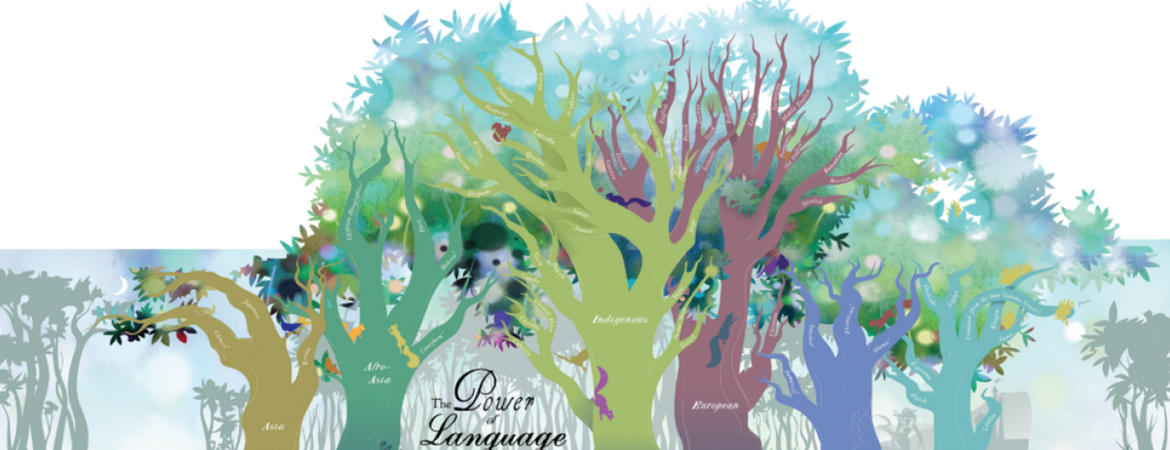
We invite you to view SCUA’s latest exhibition, The Power of Language: From Manuscript to Print, from 10 a.m. – 4 p.m., Monday through Friday on the 4th floor of the Rivera Library in Special Collections & University Archives until March 24, 2023.
This exhibition is the first of a yearlong cycle of four exhibitions, and features texts written in the classical languages of Latin and Greek and highlights some of our oldest materials.
The spring exhibition will showcase our Indigenous languages, while our summer exhibit will delight you with contemporary languages created by authors of imaginative works of fiction. The fourth, and final exhibition in fall of 2023, presents highlights from our collection of Asian and Western and European languages.
| Event | The Power of Language: From Manuscript to Print |
| Location | Tomás Rivera Library, 4th floor, Special Collections & University Archives |
| Dates | February 23, 2023 - Mar. 24, 2023 |
| Parking | Free Visitor Parking is available on Fridays, starting at 12:00 PM through 6:00 AM Monday morning in the unreserved spaces of the following parking lots/structures:
|
Erika Quintana
Erika's key responsibility is to identify, assess, and select resources of all types and in all formats and languages for collections supporting teaching, learning, and research in Area Studies, and to work closely with Special Collections & University Archives and the Collection Strategist for Arts & Humanities to ensure support of interdisciplinary programs. She also oversees US and California Federal Depository collections. She holds a B.A. in history from the University of California, San Diego and an M.L.I.S. from San José State University. Erika joined the library in 2005.
Subject Specialties include:
-
African Studies
-
Asian Studies
-
European Studies
-
Latin American Studies
-
Middle Eastern Studies
-
Latinx/Chicanx Studies
-
Ethnic Studies
Shared (UC) Content Committees include:
-
Shared Print Coordinators
Collection Strategist for Area Studies
Manuscript Collections
Located in: Special Collections & University Archives
The UCR Library holds over 275 manuscript collections of both personal and family papers and organizational records that document a wide range of subject areas. Primary source materials that are contained in the manuscript collections include documents, photographs, diaries, correspondence, maps, sound/video recordings, artifacts, and more.
The major emphases of the library's manuscript collections are: