Search
Search
Library staff recognizes peers for outstanding contributions
At all-staff meetings held on May 15 and 16, Library Human Resources acknowledged one UCR Library employee for her outstanding contributions.
Communications Specialist Melanie Ramiro was included in the second announcement of UCR Library team members who were recognized through the KUDOS program.
Under the KUDOS program, non-probationary staff and academic employees at the UCR Library can be nominated by a peer for actions or contributions related to the library's mission that have a significant, positive impact on colleagues, library users, or others.
Nominations were submitted anonymously by library non-probationary staff and academic employees, and then were reviewed by members of Library Cabinet to determine which staff members would receive the KUDOS awards.
Ramiro's nomination form stated the following:
- "I am nominating Melanie for a KUDOS award because she goes above and beyond in her work as Communication Specialist. Melanie is a design maven. Her work is polished and extremely professional. She has steadily grown the brand of the library, not only in the UCR community but beyond it, too. Beyond her many skills, she is also a pleasure to work with. She remains very organized as she juggles her sizable workload and she consistently shares exceptionally high-quality work despite facing frequent tight timelines. UCR Library is so lucky to have Melanie!"
Please join us in celebrating this library staff member's contributions!
New Director of Teaching and Learning
We are pleased to announce Britt Foster as our new Director of Teaching and Learning!
Britt joined UCR Library staff on September 6 and comes to UCR from California State University, Fresno (Fresno State) where she was most recently a subject specialist in the agricultural sciences, providing instruction and reference to the university's Agricultural Business, Food Science and Nutrition, Plant Science, Viticulture and Enology, and Child and Family Science programs.
Britt studied Creative Writing and English Literature at San Francisco State University. After graduating, she went on to UCLA where she completed her MLIS.
Her library career began as a public children's librarian, but after taking a part-time position at a university, she fell in love with information literacy instruction and decided to stay in higher education. While at Fresno State, she took advantage of the tuition waiver program and completed a Master’s in Education with a Curriculum and Instruction emphasis.
Britt first visited the UCR campus in 2018 as part of a student success fellowship program. She was impressed with the thoughtfulness of the programs at UCR and the supports in place to attend to the whole student, not just their academic needs. Britt also believes in teaching skills that go beyond academic and professional preparation.
“We teach to develop the skill set our students need to be successful in their academic and professional endeavors, but also, to have the information skills they need to self-advocate and navigate within their communities and civic spaces,” Britt explained. “To be able to focus on growing and developing these learning opportunities, with collaborators in and out of the library, is so exciting.”
Class of '68 alumna pledges $489,000 gift to UCR Library
UC Riverside class of 1968 alumna Ann Kelsey recently pledged a $489,000 planned gift to the UCR Library to fund an endowment that supports initiatives in technology advancement.
Born on June 20, 1946 in Kokomo, Indiana, Ann Kelsey’s father served in the Navy, having enlisted after Pearl Harbor was bombed in 1941. At age five, her father’s career brought the family to a Southern California facility.
Very early in life, Kelsey knew that she wanted to become a librarian. She spent much of her adolescent years reading and working in libraries; starting at sixteen, she worked for the Riverside city-county library.
Both of Kelsey’s parents encouraged her to attend college because neither of them nor most of her extended family members had gone to university. By her senior year of high school, she knew that UC Riverside was the natural choice.
At UCR, Kelsey double majored in English and Anthropology; from her anthropology classes, she developed an interest in Asian cultures and Southeast Asia.
After graduating from UCR, Kelsey attended library school at UCLA, where she met Army Special Services recruiters. Kelsey served as a librarian during the Vietnam War, traveling to Vietnam to establish and oversee recreational libraries for soldiers.
Kelsey’s career as a librarian placed her at the helm of introducing new technologies within library spaces to better support the changing needs of the communities they serve.
Her $489,000 planned gift to the UCR Library will provide unrestricted support, allowing the library to strengthen and sustain its programs and services in emerging technology, which directly aligns with Kelsey’s own life and career.
University Librarian Steven Mandeville-Gamble said, “The UCR Library is honored by the generosity and confidence shown by Ann Kelsey in her establishment of this bequest. Ms. Kelsey’s career has spanned the advent of library automation to the evolution of digital scholarship and emerging digital literacies. This gift will allow the UCR Library to continue to evolve to meet the increasingly sophisticated technology needs of our faculty and students for many decades to come.”
From Student Assistant to Princeton University Processing Archivist

As a UCR student majoring in history, Enid Ocegueda’s path to becoming an archivist started unexpectedly — with a class assignment.
While conducting original research for a World War I history course, she explored the archives for the first time and discovered a collection of propaganda posters. This prompted her to write about propaganda methods aimed at women, which was later published in UCR’s Undergraduate Research Journal. The experience further sparked her interest in archival work and set her on a path that would lead her to work in the archives.
During her time at UCR, Enid worked as a student assistant in the library’s administrative office in 2015-2016. Though her role primarily involved administrative tasks, her supervisor, Executive Assistant to the University Librarian Terri Gutierrez, recognized her dedication and encouraged her growing interest in archives and librarianship. Inspired, Enid pursued various internships as a student. Her first internship at the California Museum of Photography gave her her first hands-on experience in archival work.
“I realized then how much I enjoyed working with historical materials,” Enid recalls. “That internship solidified my interest in archives.” She later pursued an internship with the National Archives in Perris, CA, and then ventured to the east coast through the UCDC program and worked as a Collections Intern for the Belmont-Paul Women’s Equality National Monument.
Determined to build her career in the field, Enid completed her master’s degree in Library and Information Science at San Jose State University. From there, she gained experience working at Stanford University’s Hoover Institution, followed by a corporate librarian role at Edwards Lifesciences, before returning to Stanford as a Project Archivist for the University Archives.
Now, Enid is preparing to start her new role at Princeton University as the Processing Archivist for the Latin American Manuscripts Collections — a position that aligns with her passion for preserving diverse voices in archival spaces.
“I’m excited about this role because it’s dedicated to Latin American collections,” she explains. “That’s rare in this field, and it’s a chance to focus on ensuring those voices are preserved and made accessible.”
Enid’s passion for this work stems from her realization that Latin American stories are often missing from archives. “I didn’t see many collections that reflected my background,” she says. “That motivated me to become part of the solution — to bring those voices into the archives.”
Reflecting on her journey, Enid encourages students interested in library or archival careers to embrace every opportunity.
“Put yourself out there,” she advises. “Even if you’re not sure where your path is heading, taking on different roles and being open to new experiences can help you find what you’re passionate about.”
As she prepares for this next chapter at Princeton, Enid is excited to focus on connecting researchers with Latin American collections and ensuring these important materials are preserved for future generations.
A Year of Impact: Sr. Director of Development Strengthens Donor Connections
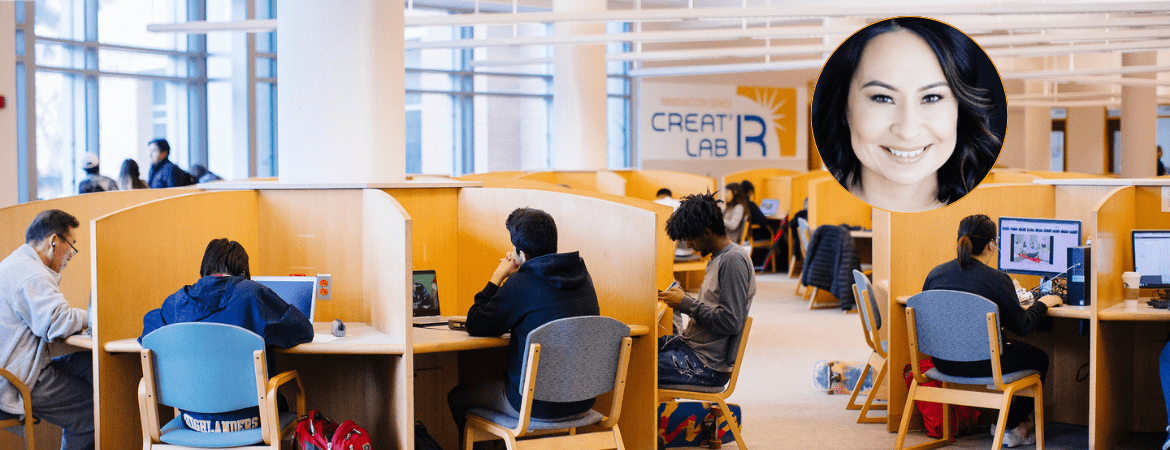
In her first year as Senior Director of Development at the UCR Library, Shannon Castro has worked to expand the UCR Library’s ability to support students and provide a space that meets their academic and personal needs.
With over 900,000 visits in the past year, the library is one of the most-used spaces on campus, offering study areas, access to rare collections, and programs that enrich the student experience.
For Shannon, the UCR Library is central to student life. “I often tell donors that the library is the heart of UCR,” she said. “It’s where students from every discipline come to study, collaborate, and find a space they can call their own. Supporting the library means impacting the most students and helping them succeed.”
Shannon has spent the past year growing the library’s donor base, reengaging past donors, updating the library’s giving website, and building awareness of the library’s critical role on campus. She has collaborated with campus partners, participated in UCR’s Give Day, and developed new marketing materials to make supporting the library easier than ever. “Every donation makes a difference,” she said. “Whether it’s enhancing library programs, creating welcoming spaces, or supporting access to unique resources, every contribution helps students thrive.”
One of Shannon’s favorite moments this year came during a conversation with a long-time donor. “She shared how much the library meant to her as a student,” Shannon recalled. “She called it her safe haven and told me it would always hold a special place in her heart. It’s stories like these that show how much the library means to our students, both past and present.”
Looking ahead, Shannon sees incredible opportunities to grow the library’s impact. “The potential for development is limitless,” she said. “Every gift helps us create opportunities for learning, discovery, and community.”
If you’d like to support the UCR Library and make a lasting impact on the lives of students, please contact Shannon Castro to learn more about giving opportunities or visit library.ucr.edu/giving.
Library staff recognizes peers for outstanding contributions
At all-staff meetings held on February 21 and 22, Library Human Resources acknowledged two UCR Library employees for their outstanding contributions.
Director of Teaching and Learning Dani Cook and Geospatial Information Librarian Janet Reyes became the first two UCR Library team members to be recognized through the KUDOS program.
Under the KUDOS program, non-probationary staff and academic employees at the UCR Library can be nominated by a peer for actions or contributions related to the library's mission that have a significant, positive impact on colleagues, library users, or others.
Nominations were submitted anonymously by library non-probationary staff and academic employees, and then were reviewed by members of Library Cabinet to determine which staff members would receive the KUDOS awards.
Cook’s nomination form stated the following:
“Through Dani's leadership, the Teaching and Learning Services Department has undergone some great changes. She has worked hard to revise and restructure the department in a very compassionate and conscientious manner; and she has continued to make us an even more cohesive team than we already were. Most of all, she leads, but alongside – and not over – us, which is the mark of a great leader. She has been doing amazing things, and I am sure she will continue to do so in the years to come.”
Reyes’ recommendation had the following comments:
“Janet has had a positive impact on the Library department and the UCR community. Her willingness to learn and participate when and where needed is invaluable. Janet has done an amazing job to connect GIS users on campus, giving them a way to communicate and share ideas and information.”
Please join us in celebrating Dani’s and Janet’s achievements!
Professor Paul Chou Collection
Located in: Tomás Rivera Library
Paul Chou (1914-2000), chemist, teacher, and book collector, was born in Qingdao, educated at Peking University, and had a life-long love of Chinese literature and history. His collection of 2,455 volumes was given to the UCR Library in 2004 by his daughter, Huiping Cheng.
Highlights of the collection:
George Brown Legacy Project Documents Congressman's Career
The service of a Congressional champion of science and civil rights is being documented at the UCR Library.
In what was formerly the Copy Center in the quiet basement of the Tomás Rivera Library, Jessica Geiser and her student workers process the papers and materials of former U.S. Congressman George E. Brown, Jr. who represented Inland Southern California in Congress for 14 terms. Known as a champion for science and a staunch defender of civil liberties and human rights, Congressman Brown's papers document his life and career from the late 1930s to his passing in 1999.
In 2010, Congressman Brown's widow, Marta Brown, donated 600 boxes of documents, photographs, and other materials that detailed the Congressman's 14 terms to UCR. Included were approximately 7,000 photographs, 114 VHS tapes, 89 audio cassettes, nearly 600 color slides, and a multitude of reels, floppy discs, and CDs. With the gift of this collection, a mission for the purpose of the project was developed: to ensure the preservation and accessibility of George Brown’s extensive collection at UCR for future generations of scholars, reporters, and leaders in science, labor, business, and public service.
The processing of this comprehensive project began when Geiser was hired as a project archivist in September 2014. Her first task was to relocate and reorganize the unopened boxes prior to unpacking. Once moved, she opened each box and created a content list. "This step was probably the most important step of the entire project and needed to be as detailed as possible," Geiser writes. This information would inform the arrangement of materials, the supplies and staff needed, and the processing time required to complete the project.
As Geiser combed through each box, she collected information on the subjects and dates of the materials, their physical extent in inches, the estimated amount of folders, and the condition of the enclosed materials. Consulting other congressional archival collections, she devised an arrangement scheme that mirrored the ways in which Brown and other Congressmen created and stored their records while in use. A high level of detail and close attention were vital to this success. Finally, she developed the plan which dictates the goals, and methodology to meet those goals, for the entirety of the two-year project.
She and her team then began re-foldering the materials in acid-free folders and boxes that allow for better preservation in long-term storage. Ms. Geiser also ensures that other basic preservation activities take place, such as removing metal paperclips and rubber bands which cause damage, and photocopying fragile and acidic materials — such as newsprint and fax paper — to prevent further deterioration. Although some material is confidential and restricted and must be redacted, the goal is to keep as much information accessible to researchers as possible.
The George Brown papers hold clues to key advances of today and major innovations of tomorrow, and a blueprint for bipartisan problem-solving spanning four decades of federal decision-making. This unique trove of knowledge will be accessible to current and future entrepreneurs and students of effective public service.
As she works towards opening the collection at the end of this two-year project, Ms. Geiser maintains a blog in order to connect with any potential researchers or other interested parties.
Library Support for the UCR School of Medicine: Focus on Tiffany Moxham
Medical Library Programs Coordinator Tiffany Moxham just marked her three-year anniversary at the UCR Library on July 1, 2017. Her presence has been auspicious for the inaugural class of 40 students who graduated from UC Riverside’s School of Medicine this June.
The UCR Library played an integral part in the formative years of UCR’s School of Medicine (SOM), and Moxham has been involved almost since the beginning. “I was very fortunate to be on the search committee for Tiffany’s position, and she just jumped out right away,” said Dr. Michael Nduati, CEO of UCR Health and Senior Associate Dean of Clinical Affairs. Nduati believes that hiring her was “the best decision we could have made for the library and the medical program.”
While clinical faculty may be the core of the program, Moxham has been their unwavering ally in her role at UCR Library. “We are supporting multiple clinical sites and campus locations because it embraces our community aspect,” Moxham explained. “This allows the library to align as a core piece of the research and educational programs, modeling integrated library services.”
Dr. Nduati credits many achievements by School of Medicine students directly to Moxham’s contributions. “Tiffany has been a godsend to the SOM and our medical education program,” he commented. “She meets one-on-one with the medical students to work with them on how to do literature research. A lot of these students have published and presented nationally, and a large part of their success is due to her.”
Moxham also devotes her time to collaborations with and mentorship of faculty. “A lot of faculty would be lost if they didn’t know how to access the resources they need at the library,” Nduati added. He witnessed her commitment to the faculty: “She would go to their offices to set up their computer and walk them through how to access articles. They can’t meet during regular office hours, so she would meet with them at nights, on weekends.”
Moxham has also presented at conferences nationwide with her School of Medicine colleagues. “You feel part of something bigger even though your piece of it might be small,” she said.
The outcome speaks volumes. “One hundred percent of our inaugural class matched,” said Moxham. “This means they all got into a residency program. This does not regularly happen!” Impressive results for a new medical school, indeed.
“The piece that amazes me about the match is that we tried to do things differently,” Moxham explained. “When you see innovation in practice that allows for such great results in the end, being able to witness that effect on the students, that’s great.”
Retention of high-quality medical practitioners in Riverside and San Bernardino counties is a high priority for the School of Medicine. According to Moxham, “This school was built on the mission of improving the local community and getting more doctors here. We have a huge shortage of doctors here in the Inland Empire. Most of the scholarship money going toward the students was aimed at getting more of them to stay here.” Of the 40 graduates, 33 will complete their residencies in California, and ten of those will remain in the Inland Empire.
View photos from the 2017 School of Medicine Commencement
Library Welcomes New Science Fiction Librarian
First Klein Librarian raising profile of Eaton Collection

Though only in her first month at the UCR Library, JJ Jacobson is already filled with ideas, energy, and ambition. As the inaugural Jay Kay and Doris Klein Science Fiction Librarian, she manages and curates the Eaton Collection of Science Fiction & Fantasy – the largest publicly-accessible collection of science fiction, fantasy, horror, and utopian literature in the world.
Jacobson brings a broad range of experience to the Eaton Collection. Once a restaurant owner, chef, baker, and then sourdough consultant, the California native was drawn to library and information school by her interest in how people talk about and engage with what they cook and eat.
University of Michigan provided Jacobson with her foundational education in library and information science, and sparked a passion in her to make the world a better place by bringing together people, information, and technology.
Growing up at Renaissance Faires, her interest in the “history of everyday life” stimulated Jacobson’s personal passion for living history — similar to historical re-enactment, but with less focus on combat and more on the daily activities of a certain period — and alternate history, a genre of fiction in which history unfolds differently from reality. This led her to experiment with virtual worlds. Specifically, Jacobson became deeply involved in Second Life in a unique way that mirrored, and later reinforced, her career: she became a librarian.
With sponsorship from another Second Life Resident, Jacobson built Caledon Library, pictured above. It has since grown into an entire system of virtual library branches. "Residents moved to Caledon because of the library," she boasted. Jacobson would later develop kits for others to build and manage their own libraries in Second Life. Real-life libraries also established presences in Second Life.
Reading, Jacobson says, is a prevalent hobby in her family. Her father was a fan of science fiction in its golden age, and she and her brother were both avid readers, constantly marveling at the 8-foot shelf of paperbacks in her father’s personal collection.
Jacobson’s goal is to leverage the ever-broadening interest in the “Eatonverse” genres to build a deeper understanding of the collection. By drawing on the UCR community’s enthusiasm for these genres across formats and uses, she aims to maintain Eaton’s international prestige while positioning it as a leader in the developing ecosystem of similar collections across the world.