Search
Search
Transcribing the Imaginary

Science fiction, fantasy, and other fantastical genres frequently incorporate - and sometimes even build from scratch – complex linguistic systems that can help orient readers in an unfamiliar setting. These languages help answer some of the questions of how an imaginary society, even an imaginary species, functions.
This exhibit showcases a broad range of imaginary languages across multiple media: film, television, comic, novel, and short story. Amongst the materials on display here, you’ll come across a reality-warping alien language that alters the human relationship with time; ancient, mythic languages spoken by equally ancient and mythic races; and languages constructed to be ‘universal’, speaking across cultures and geographies.
Visit Special Collections & University Archives to view the exhibit or learn more by downloading the exhibit guide here.
| Event | Transcribing the Imaginary |
| Location | Tomás Rivera Library, 4th floor, Special Collections & University Archives |
| Dates | July 7, 2023 - September 22, 2023 |
| Hours | 10 a.m. - 4 p.m. |
| Parking | Free Visitor Parking is available on Fridays, starting at 12:00 PM through 6:00 AM Monday morning in the unreserved spaces of the following parking lots/structures:
|
LGBTQ+ digital collection

Happy Pride Month, Highlanders! Check out our digital LGBTQ+ collection on OverDrive!
The collection includes popular fiction, graphic novels, Lambda Award winners & nominees, nonfiction, and magazines featuring LGBTQ+ characters, authors, and topics. UCR students, faculty, and staff can access this collection for FREE on OverDrive or using the Libby app.
4 to Explore: January selections from Special Collections
This month in 4 to Explore, your Special Collections librarians and archivists have selected four new items and placed them on hold in the reading room.
Items featured this month will tie in with the UCR Library's celebration of the 50th Anniversary of the Eaton Collection of Science Fiction and Fantasy.
Here's what you can see this January in 4 to Explore:
Girl Genius Volume 8:
Agatha Heterodyne and the Chapel of Bones
The Galaxy Game
Named one of the best books of 2015 by NPR
Redwood and Wildfire
Winner of the 2011 James Tiptree Jr. Award
Binti
Winner of the 2015 Hugo Award and the Nebula Award for Best Novella
Why you should try 4 to Explore:
Special Collections materials are kept in closed stacks, which means you can’t see the shelves and browse. You also can’t check things out and take them home. So, 4 to Explore is a great way to experience first-hand some of the collections that truly make the UCR Library unique.
4 to Explore will give you the chance to visit a reading room, like the ones that are used for archival research or by rare book scholars, and to get a sampling of our collections without having to submit a request ahead of time.
You’ll be asked to show photo ID and to check your bags – but don’t worry! Our UCR Library staff will explain everything to you when you arrive.
We will also have rotating exhibits of items from the collections on display.
Where to find 4 to Explore:
Department: Special Collections & University Archives
Where: Take elevators to 4th floor of Rivera Library
Hours: 11:00 am - 4:00 pm, Monday - Friday
Bring: Photo ID
Don’t bring: Food or drinks
Who: Everyone is welcome. 4 to Explore is more of an individual experience, but we can usually accommodate up to two people using the same item at the same time, so feel free to bring a friend.
What to expect: Staff will help you sign in and feel comfortable in the reading room. It should take about 5-10 minutes for you to get up to the 4th floor and get settled. Then you can stay and enjoy as long as you like!
Want to receive updates each month with more details about our 4 to Explore items? Sign up here.
Artists' Books: A Feast for the Senses
Vamp & Tramp Booksellers Bill and Vicky Stewart put as many miles on their minivan each year touring the country to share their love of artists’ books as the average person racks up in his daily work commute.
Birmingham, Alabama is where Bill and Vicky call home, yet they spend nearly 11 months on the road each year, driving coast to coast to visit Special Collections libraries and show their assortment of artists’ books. “We average about 40,000 to 45,000 miles each year on the minivan,” Bill said.
During their west coast tour, Bill and Vicky brought their traveling “road show” to Rivera Library on the morning of March 2, 2017. Their display featured dozens of artists’ books ranging from colorful pop-ups that showed traditional cultural costumes, to miniature books carved out of wood, to accordion-fold books that depicted stylized creation myths from myriad cultures, and more.
Their passion for artists’ books is the result of “pure dumb luck,” as Bill stated. He first encountered artists’ books while he was selling first editions of literature and mystery fiction at a book fair. “I stumbled across one of these books and thought, ‘Wow! How much more exciting is this?’” he said.
Bill bought his first artists’ book that day and immediately shared it with his wife and business partner, Vicky. “That was nearly 20 years ago,” he explained. “We started small and grew more and more.”
Vamp & Tramp Booksellers began as a brick and mortar bookshop in Birmingham and gradually evolved into the traveling business model that it is today. “When it came time to make a decision about whether to keep the shop open, we decided to get rid of all the first editions,” Bill stated. “The best way to sell artists’ books is to travel around the country and let people see, touch, smell, and sometimes even taste the books.”
Bill and Vicky closed the doors to their physical bookshop in 2003 and started living on the road in 2004.
It was several years ago during one of their cross-country tours that Bill and Vicky first met Cherry Williams, UCR Library’s Director of Distinctive Collections. Like Bill and Vicky had, Cherry fell in love with artists’ books right away.
“People need to have a hands-on experience with artists’ books,” Cherry said. “It’s very different to be able to touch them than it is to see the books inside an exhibit case. It engages all the senses. I think the artistry is really amazing, how they envision and create.”
Bill agrees. “There are things that resist the digital world,” he explained. “We find when we give presentations to students, the physical part of the book becomes part of the esthetic experience – how it opens, how it feels. Artists’ books are sort of the antidote to the digital world.”
Attendees of the Vamp & Tramp event voted on which book that UCR Library would acquire, and the book selected was “Circle or Zero” by Mari Eckstein Gower. “It’s a limited edition of 15, which means there are only 14 others in the world,” Cherry explained.
“Circle or Zero” (pictured above) will soon be available for request in Special Collections on the fourth floor of Rivera Library. Many other artists’ books are currently available, until this one has been cataloged, and we encourage you to come explore our collection.
About
The UCR Library serves as an information commons and intellectual center for the campus and is the nexus for research and study at UCR.
OverDrive expands: read leisure and academic magazines
UCR Library patrons can access leisure and academic magazines on OverDrive!
A year ago, the UCR Library acquired access to the OverDrive platform for UCR students, faculty, and staff. OverDrive offers UCR Library patrons access to popular books and audiobooks using their tablet, computer, smartphone, or the Libby app.
Our OverDrive collection has grown since 2021 to include titles from our Allen Leisure Reading collection, the Eaton Collection of Science Fiction and Fantasy, children’s books, popular science books, and now magazines.
The OverDrive magazine collection is quite large at almost 4,000 titles. Patrons can borrow a variety of magazines ranging from news publications such as The Economist and The New Yorker, science and technology periodicals including New Scientist and Wired, arts magazines such as ARTNews and Rolling Stone, and general interest titles like Variety and Newsweek.
For more information on accessing OverDrive, please review this guide or head straight to ucr.overdrive.com and check out all that OverDrive has to offer.
Have a book or magazine you want on OverDrive that isn’t available? Make a purchase suggestion by emailing Carla Arbagey.
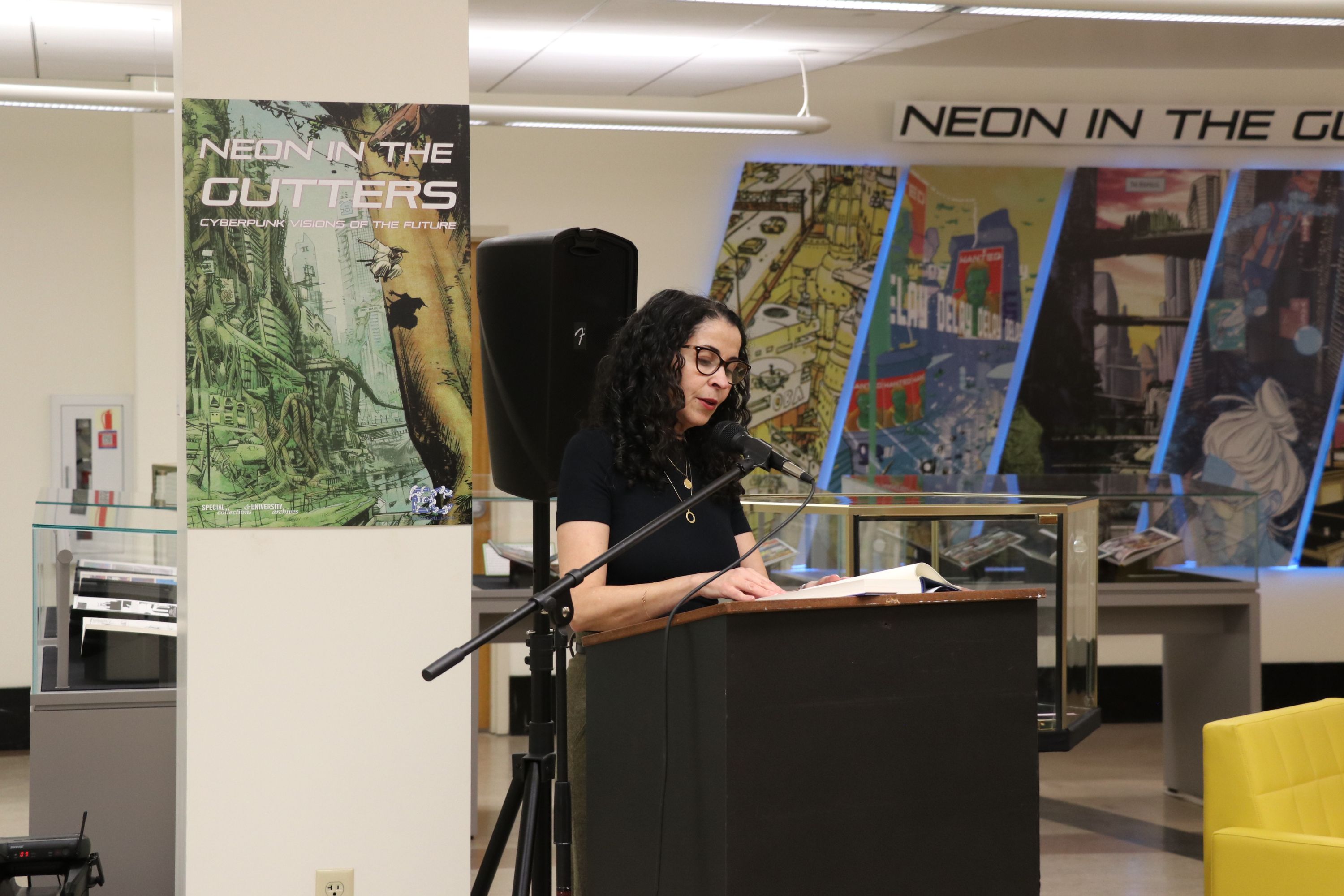
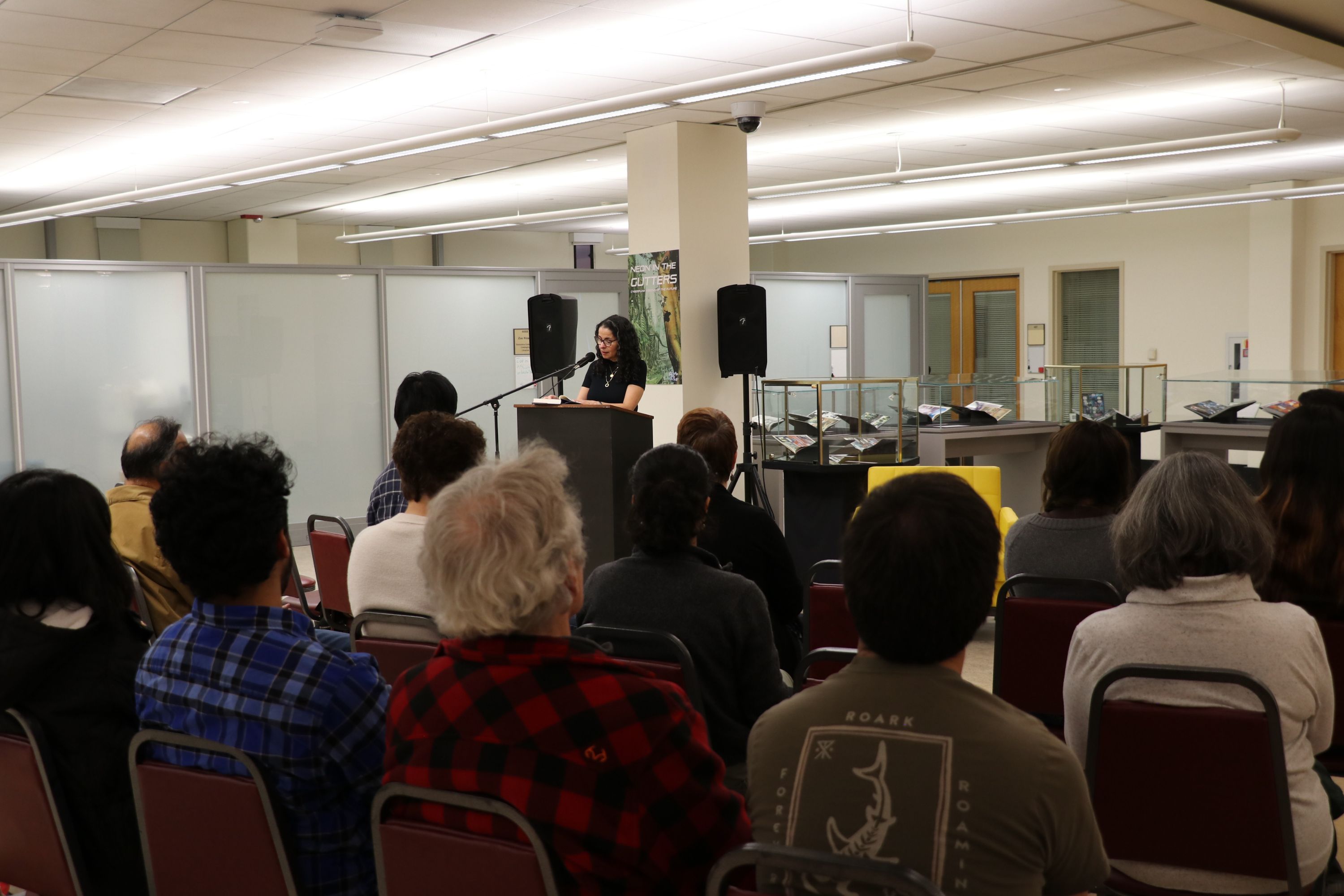
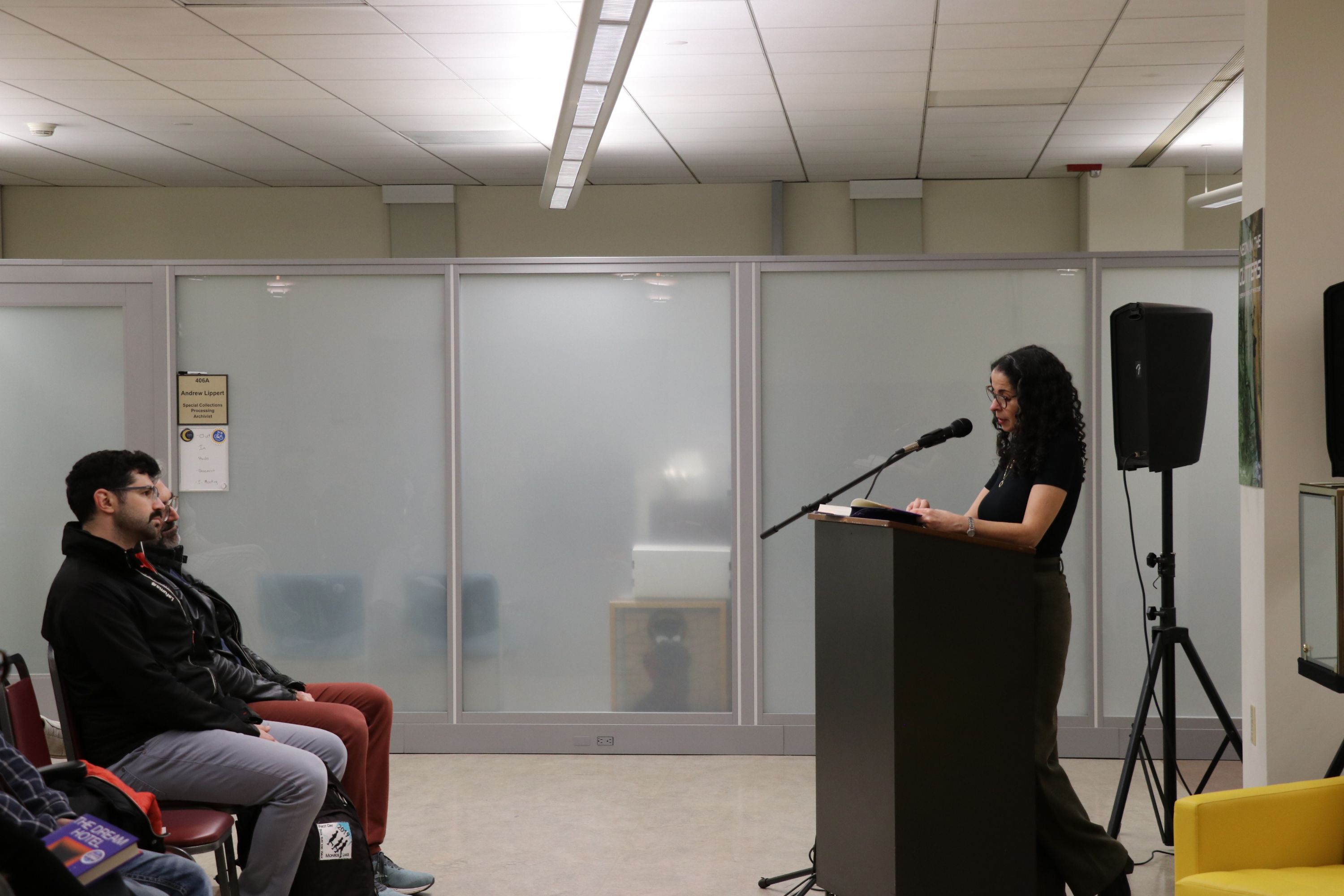
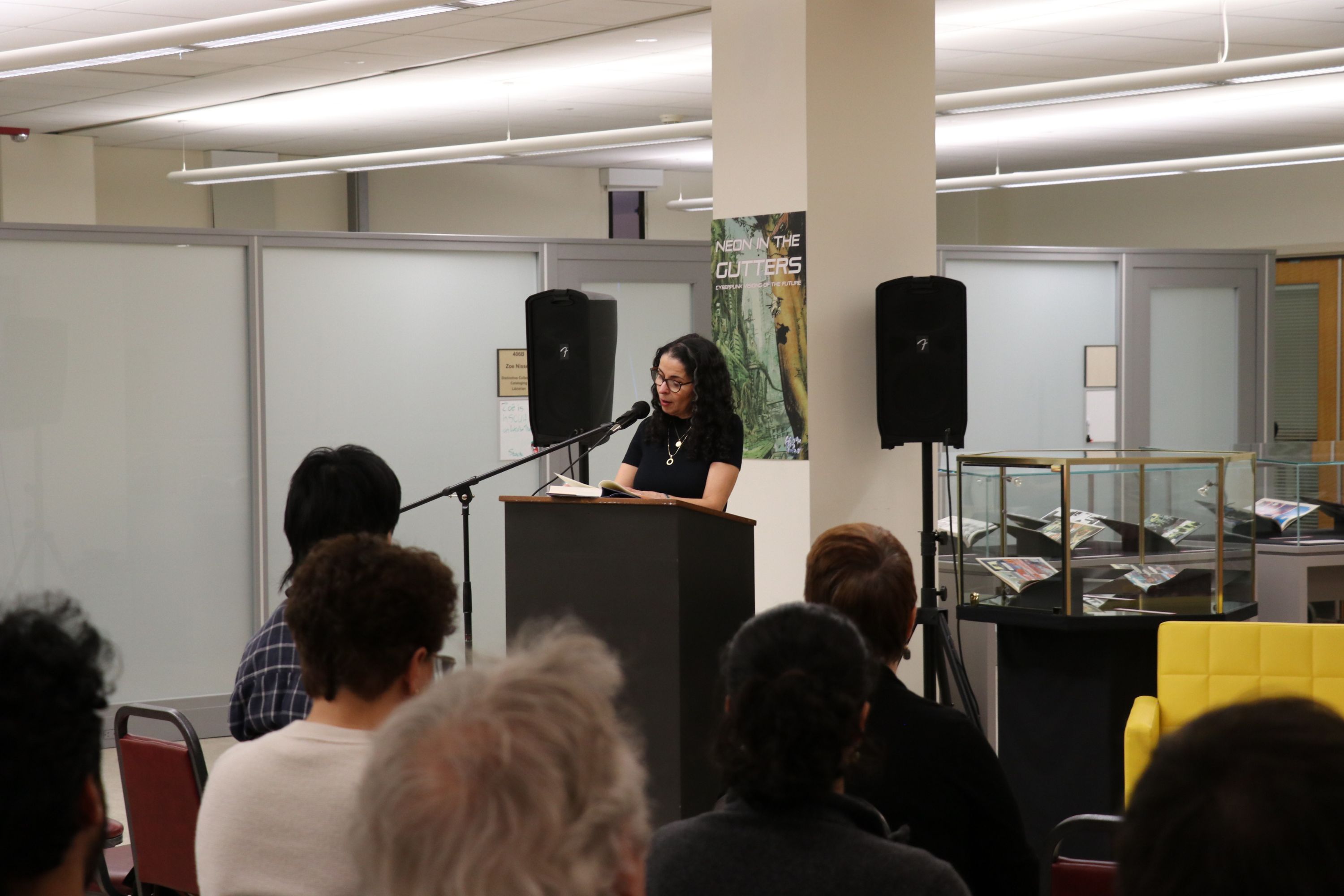
An Evening with Laila Lalami
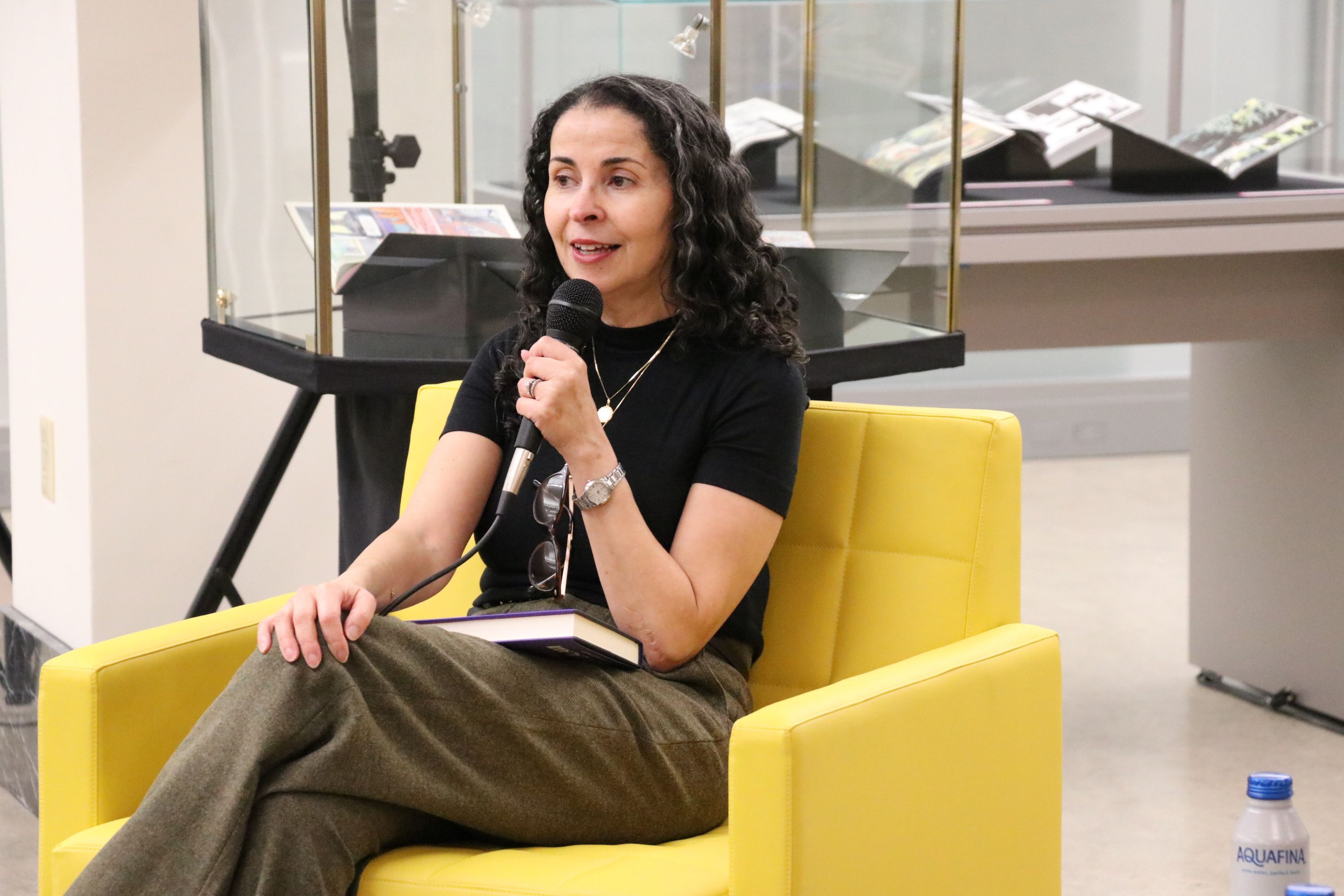
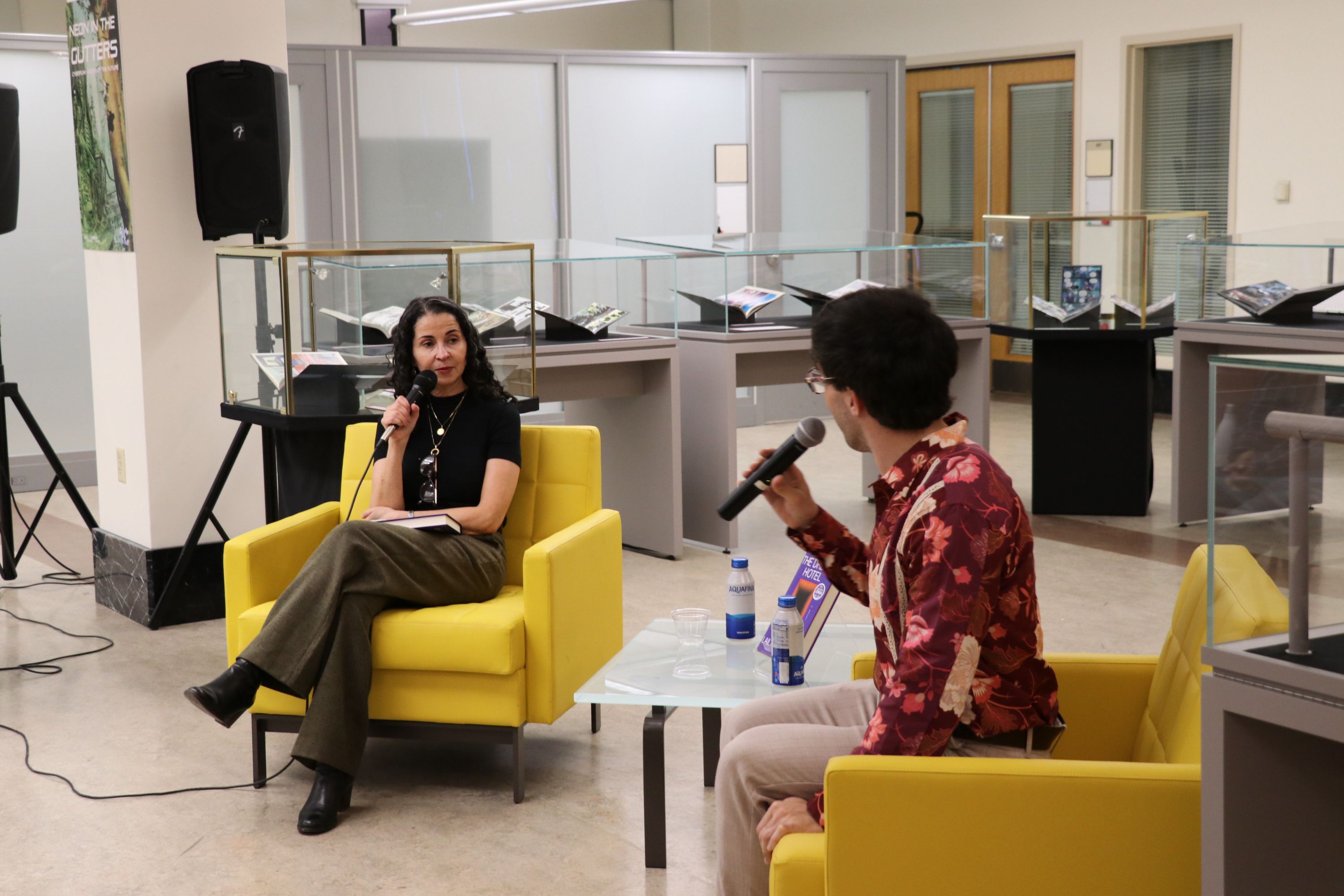
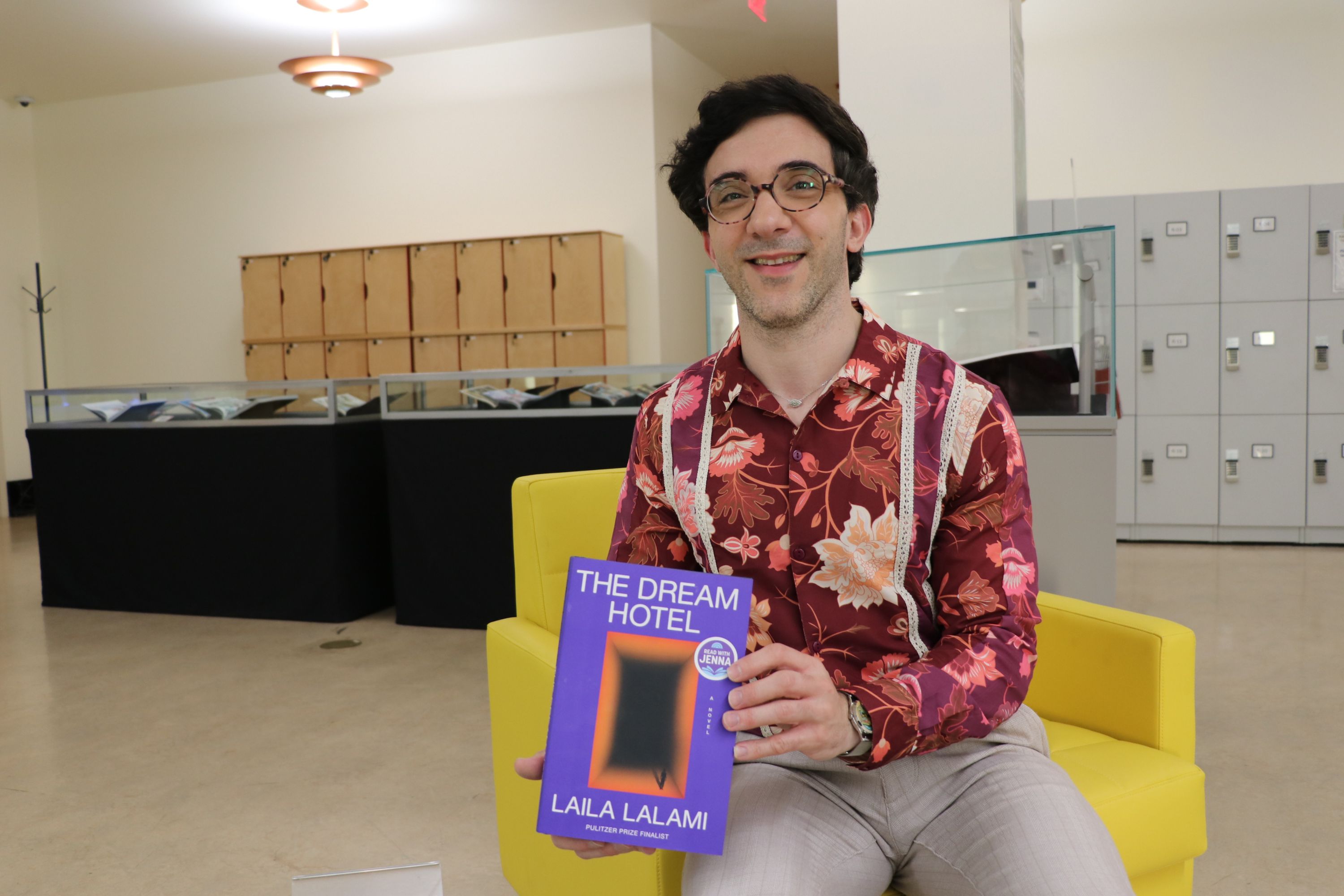
On Tuesday, February 17, 2026, we welcomed Laila Lalami, Pulitzer Prize and National Book Award finalist and Distinguished Professor in UCR's Department of Creative Writing, to the Tomás Rivera Library Special Collections Reading Room for an evening centered on her latest novel, The Dream Hotel.
Jay Kay and Doris Klein Librarian for Science Fiction and Fantasy Dr. Phoenix Alexander led the conversation. Here are a few photos from the night.
Che’s Village – Virtual Reality to Stimulate Critical Thinking
UC Riverside’s Associate Professor of History Juliette Levy likes to teach from the edge of the e-learning revolution.
Her latest experiment involved a virtual reality (VR) platform intended to stimulate intellectual learning on an emotional level for the students in her History 20 / World History course. Dr. Levy co-created a VR application called “Che’s Village” and invited students and faculty to test and review the platform in Orbach Science Library on February 15 and 16.
"Juliette felt that the library is precisely where this type of exploration should take place, as our mission is to expand critical thinking skills in studnets," explained JJ Jacobson, UCR Library's Jay Kay and Doris Klein Librarian for Science Fiction. Jacobson and Dr. Levy collaborated for several months on the concept and development in order to bring "Che's Village" to life.
“We serve a population of students who are digitally savvy,” Dr. Levy explained. “We have an amazing student body and an amazing faculty, and we need to teach them to think critically using the tools in their environment.”
Gesturing toward the wall, where a large monitor displayed what the student in the virtual reality goggles was seeing at that moment, Dr. Levy added, “This is the future of public education in here. Technology is a means to activate and render moments of the learning experience more intense.”
The platform was built to amplify students' experience of studying Che Guevara's speech, "Social Ideals of the Rebel Army," which he delivered on January 27, 1959. Guevara along with Raul Castro and others had recently won the rebellion against the existing Batista regime in Cuba, Levy explained. In his speech, Guevara had to balance the nationalistic, pro-Cuba intent of Castro with Guevara's own intent to lead a communist revolution.
The application’s co-creator and head of a VR prototype studio named Shovels and Whiskey, Tawny Schlieski stated, “We built this VR environment for students who have read Che’s speech. It’s meant to provoke them into compelling questions, to connect pieces of text with other pieces of research.”
Once inside the virtual world, exactly as Schlieski had explained, the user could see the text of Che Guevara’s 1959 speech in the setting of a Cuban jungle, with links to other content directly connected to highlighted passages in the speech. Using a pointer, the user could open and view the additional resources – whether text, images, or video – to elaborate on the themes of that particular passage. “It’s like footnotes, but in a virtual reality environment,” one user commented.

Users who tested the VR application saw potential in it. Professor Robert W. Patch from the UCR Department of History commented, “Technology will make certain things easier, certain things better.”
In some ways, the reflection indicated that UCR professors who leverage technology are already doing something right. One of the student testers observed that his best friend, who commutes over 50 miles to attend a different college, does not go to office hours because of the additional time it would require. He added, “He could have a more intimate learning experience if there were online office hours.”
“Good teaching is good teaching, whether that’s 100 years ago or 100 years from now,” Dr. Levy commented. “We owe our students to help them learn better and faster, especially with the amount of debt students are taking on to get an education. We are making it deeper and better with technology.”
“We’re looking to build applications of new technology in humanities that provoke critical thinking for students,” Schlieski stated. Reflecting on her previous work with Intel, she added, “From an industry perspective, problem-solving skills are sorely lacking in recent college graduates. Technology becomes obsolete so fast, but critical thinking skills are always valuable.”
Jacobson added, "After more than 10 years of library and education experience in virtual environments, I think that working with information, ideas, and learning in 3D is something educators and librarians would do well to keep on their radar. VR is in an incunabular age, and we don’t know yet what it will look like as it takes useful forms. However, the possibilities are so compelling that I’m confident VR (or other VE) will develop into important tools for teaching, learning, and information."
No stranger to using digital platforms, Dr. Levy currently employs a variety of digital resources including Podcasting, Zoom, online office hours, and a private virtual discussion forum to maintain a sense of connection with her students throughout the week. As a result, she has received overwhelmingly positive student feedback. For Dr. Levy, this latest endeavor with “Che’s Village” is intended to find new ways to engage her students. “Technology allows us to give students who live off campus and part-time students the same quality of attention and education that a small liberal arts college could,” Levy explained.
“I can teach 300 students and make it feel like a class of 30 students because the entire medium is devised for contact,” Levy added. “The students are all on a screen, and online, everyone is in the front row – so it feels more connected. Students who would usually not raise their hands and participate in a live classroom are more inclined to speak up in an online platform. It’s convenient and an environment in which they feel like they exist, their voice matters.”
“Che’s Village” was a first-step in the iterative design process, and both Dr. Levy and Schlieski are now incorporating the feedback they received from testers to improve the VR platform.