Search
Search
Sadakichi Hartmann Papers
Located in: Special Collections & University Archives
Sadakichi Hartmann papers (MS 068)
The papers of Sadakichi Hartmann (1867-1944) document the life, work, and influence of this 20th-century essayist, poet, dramatist, journalist, and critic.
Hartmann was born in Nagasaki to a Japanese mother and a German father and educated in Germany. He immigrated to the United States in 1882 and became a citizen in 1894.
Celebrating the Eaton Collection's 50th anniversary
On Saturday, Oct. 26, supporters of the UCR Library's Eaton Collection of Science Fiction and Fantasy gathered to celebrate the collection's 50th anniversary.
The Eaton Collection of Science Fiction & Fantasy is one of the world's largest, richest, and deepest collections of science fiction, fantasy, horror, utopian literature and related genres. The collection originated with the personal library of Dr. J. Lloyd Eaton, consisting of about 7,500 hardback editions of science fiction, fantasy and horror from the Nineteenth to the mid-Twentieth centuries, which was acquired by the UCR Library in 1969.
“The Library team realized that the 50th anniversary of the Eaton Collection would be an ideal opportunity to reach out to all our Eaton stakeholders and show our appreciation for their support,” Derrick said. “We welcomed distinguished authors whose work resides in this collection, and one noted science fiction scholar came from as far away as the Caribbean to participate.”

University Librarian Steven Mandeville-Gamble greeted guests as they arrived at Rivera Library, along with Assistant University Librarian for Content and Discovery Tiffany Moxham, Director of Distinctive Collections Cherry Williams, Special Collections Processing Archivist Andrew Lippert, Associate Director of Development Jernine McBride, and Senior Director of Development Clyde Derrick.
Mandeville-Gamble gave welcoming remarks, followed by Interim Provost Thomas M. Smith.
The program featured a panel discussion on "Graduate Research and the Eaton Collection at UCR," moderated by Dr. Sherryl Vint, professor of Media and Cultural Studies. Speakers included UC Riverside graduate students Taylor Evans, Brandy Lewis and Josh Pearson.
Pearson noted the fanzines, in particular. “One of the things that really struck me is that the practices and modes of engagement that were fostered in Science Fiction -- the forms of fandom, the forms of community developed in the kinds of fanzines that are enshrined upstairs in the Eaton -- have come to permeate not only American culture in general, but particularly American youth culture,” he explained. “Some of the most important ways that my students are making meaning in the world with Science Fictional images have their origin in some of the things that are collected upstairs. Returning to those and thinking hard about them is a way of thinking hard about some of the most crucial questions that we’re thinking about as educators right now.”

Festivities concluded with Williams and Lippert taking guests on a behind-the-scenes tour of the Eaton Collection in the Special Collections and University Archives department, located on the fourth floor of Rivera Library.
If you are a UCR alumni or community stakeholders who enjoys science fiction, fantasy, horror, and other types of speculative fiction, please consider supporting the Eaton Science Fiction and Fantasy Fund. To learn more, please contact Jernine McBride Williams, Associate Director of Development for the UCR Library.
UCR, CSUSB Sign Agreement to Co-house Water Resources Collections and Archives
Head librarians from both campuses articulate policies to jointly manage valuable collection of historical documents.
SAN BERNARDINO, Calif. — Cal State San Bernardino and the University of California, Riverside will co-house and share a valuable collection of water related-documents and materials.
The chief librarians from both universities, Cesar Caballero, dean of the CSUSB John M. Pfau Library, and Steven Mandeville-Gamble, University Librarian for UC Riverside, signed a memorandum of understanding on Sept. 24 that the two institutions will jointly house and manage the Water Resources Collections and Archives (WRCA).
The agreement, which was signed at the Pfau Library, lays out the policies and procedures on the collection and is an addendum to an MOU the universities signed in 2010, which enabled the collaboration, Caballero said.
The WRCA, which previously was housed at UC Berkeley, is a one-of-a-kind resource. It contains historical and contemporary water-related materials of great value to water agencies, governmental bodies, environmental groups, engineering firms, attorneys, historians and researchers.
The collection will be of great interest to students, faculty and researchers from both campuses and also researchers throughout both the University of California and the California State University systems, Caballero said.
“This is a world-class collection and will offer a lifetime of learning as a resource. It is extremely valuable,” Caballero said.
The WRCA collection will be divided between both libraries and jointly managed by Mandeville-Gamble and Caballero. The joint management of the archives will expand accessibility both in the state and nationwide, Caballero said.
“The agreement underlines the importance of the WRCA, which will complement and strengthen other collections at CSUSB and UCR along with the UC and CSU systems,” Caballero said.
Mandeville-Gamble said the agreement took on even more significance because of the state’s ongoing drought, which is unprecedented in the state’s written history.
He said the two universities are committed to studying issues affecting water in all aspects including environmental, public policy and social issues.
“It’s absolutely essential if we’re going to solve water issues. We’re in this together,” said Mandeville-Gamble, who added that the collection “will serve as a roadmap for greater collaboration between the two universities regarding water issues.”
The co-housing of the collection will work well with both universities as both institutions have strong backgrounds in water resources. UCR has a number of water policy experts in the School of Public Policy. CSUSB is home to the Water Resources Institute, which serves as a regional center for research and public policy analysis and houses the Joseph Andrew Rowe Water Resources Archives.
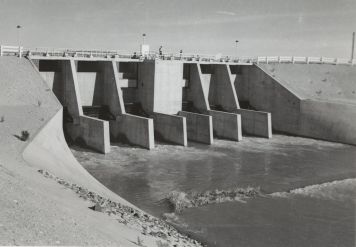
This photo of the junction of the All American Canal and the Coachella Canal was taken by Walter Leroy Huber and is part of a collection of the engineer’s correspondence, documents and photographs in the Water Resources Collections and Archives.
The WRCA collection is comprised of approximately 4,138 linear feet of published circulating materials, and more than 3,000 linear feet of special collections and archives. Approximately 5,545 linear feet of printed circulating materials are also housed in off-site storage facility near the UC Berkeley campus.
The original archive contained approximately 200 archival collections, 200,000 technical reports, 1,500 specialized newsletters, 5,000 maps and videos, 2,200 serials, 25,000 land photographs, 45,000 aerial photographs of coastlines, and digital resources in the form of CDs, DVDs, VHS tapes, and websites.
Since 2011, the archive has gained another 2,500 books, electronic documents, and thousands of hard-to-find publications such as conference proceedings, association publications, technical reports and bulletins, and meeting minutes that deal with water resources in California and the West.
More than 15,000 people visit the WRCA website every year, and another 80,000 visit the California Water Districts & Associations list. UCR librarians scan more than 6,000 pages of material from the collection for researchers and government employees across the state.
The collaboration of the two universities came about in 2010 when the statewide Water Resources Center was to be closed because of budget cuts. The University of California’s Agriculture and Natural Resources Center sought a new location to house the archives, which led CSUSB and UCR to develop an innovative and collaborative plan for joint management of the collection.
The acquisition of the new collection also coincided with the California State University system-wide Water Resources and Policy Initiative, which is centered at Cal State San Bernardino. The WRPI facilitates water-related research capabilities within the 23 CSU campuses.
Water policy experts in the UCR School of Public Policy conduct research on critical issues related to the interactions between water policy, water quality and water scarcity. They also contribute policy-relevant input to dialogues at the local, regional, national and international levels.
Founded in 1999, the Water Resources Institute of Cal State San Bernardino is an academic partnership with the Southern California communities that it serves. The institute is driven by the vision that sustaining water resources rests on sound research, analysis and public policy collaboration. The institute is active in the areas of science, public policy and history, and serves as a regional hub for providing information on water resources.
Time, Life, Ebony magazine archives now available
The UCR Library has recently acquired access to three magazine archives, which will expand UCR Library users’ access to important historical and cultural content covering a wide range of topics.
The three magazines are:
Ebony (1945-2014)
Originally published by John H. Johnson beginning in November 1945, Ebony has served as an influential African-American magazine promoting stories important to the black community and focusing on the achievements of African-American leaders. This archive includes more than 800 issues covering African-American culture, business, civil rights, entertainment, fashion, history, and politics.
Life (1936-2000)
The Life magazine archive presents an extensive collection of the famed photojournalism magazine, spanning its very first issue in November 1936 through December 2000 in a comprehensive cover-to-cover format. Published by Time Inc., the magazine has featured story-telling through documentary photographs and informative captions. Each issue visually and powerfully depicted national and international events and topical stories, providing intimate views of real people and their real-life situations.
Time (1923-2000)
The Time magazine archive includes more than 4,000 issues of the prominent news magazine, dating back to its first issue in March 1923 through December 2000. This weekly magazine contains reports of national and international current events, politics, sports, and entertainment. Capturing the relevant news for a given week, the magazine remains an important resource for researchers studying just about any aspect of Twentieth Century history and life.
The Ebony, Life, and Time magazine archives are available on the EBSCOhost platform and may be searched simultaneously with the UCR Library’s other popular EBSCOhost databases, such as Academic Search Complete. Articles and cover pages are fully indexed and advertisements are individually identified, ensuring researchers and readers can quickly and accurately locate the information they seek.
For more information, contact Carla Arbagey, Arts & Humanities Collection Strategist Librarian at carlar@ucr.edu.
"Orange Roots" Offers a Juicy Slice of UCR History
On the afternoon of Thursday, November 10, 2016, UCR Library celebrated the opening of a new exhibition, titled, “Orange Roots: The Remarkable Story of Two Trees, a Pioneer Town, and the University of California, Riverside.”
The reception featured a presentation by Riverside native and Distinguished Professor of Creative Writing Susan Straight, who shared a magical tale of her youth spent in the orange groves of Riverside, which to her young eyes appeared like an enchanted forest.
To add more zest to the experience, Tracy Kahn, UCR’s Givaudan Citrus Valley Collection Endowed Chair coordinated a citrus tasting station. Guests savored bites of about a dozen different types of citrus fruit grown at UC Riverside, ranging from sweet navel oranges to the more exotic, tart flavor of finger limes.
Special guests and community members attended the exhibition’s welcome reception, including Patricia Ortlieb, who is the great-great granddaughter of Riverside’s citrus pioneer Eliza Tibbets. Tibbets’ introduction of the Washington Navel in 1873 revolutionized the California citrus industry.
Along with fellow pioneers John W. North and Matthew Gage, Tibbets laid the foundation for Riverside’s rapid expansion and success in the citrus business, which created a need for a location research station to support the industry and help to protect crops from frost, pests and disease. In 1906, the University of California selected Riverside for the site for the Citrus Experiment Station, which established the city as the hub of the southern California citrus market.
Forty-eight years later, the University of California, Riverside campus was opened in 1954. The “Orange Roots” exhibition features photographs and other memorabilia that trace the origins of UC Riverside back to its beginnings in the early 20th century.
The exhibition will remain on display until June 2017 on the first floor of Tomás Rivera Library.
Print Materials
Special Collections holds a number of rare books, journals, pamphlets, individual leaves, and other print materials, many of which are related to and complement our archival collecting areas in Special Collections.
In addition to those print materials, Special Collection also holds strong collections of various print materials in the following areas:
Public Services Assistant wins scholarship to Rare Book School
This past quarter, Public Services Assistant Zayda Delgado received word that she had received a scholarship from the National Endowment for the Humanities-Global Book Histories Initiative (NEH-GBHI) to attend Rare Book School at Amherst College during summer 2018.
Rare Book School (RBS) is an independent institute housed at the University of Virginia that provides continuing education and community-building opportunities through hands-on, seminar-style classes taught by distinguished faculty.
At RBS, Delgado will take a course called A History of Native American Books & Indigenous Sovereignty.
Delgado applied to the program for personal and professional development, but also with the purpose of sharing her knowledge here at UCR. “We have a significant collection of Native American books, particularly on California’s first people,” she explained.
“This award presents an opportunity for Zayda to develop her skill sets in culturally diverse book collections,” said Tiffany Moxham, Assistant University Librarian for Collections. “It also ties into our initiatives to support the documentation and research support of our local communities, which are manifested in such initiatives as Inland Empire Memories.”
This will be Delgado’s second time attending Rare Book School. She first received a fellowship in 2016, along with a group of 20 fellows. That year, she took the course History of the Book 200-2000, which was taught jointly by John Buchtel, Director of the Booth Family Center for Special Collections at Georgetown University and Mark Dimunation, the Chief of Rare Books at the Library of Congress. “He gave us a behind-the-scenes tour,” Delgado said. “I got to hold the rarest and most precious materials that they have at the Library of Congress.”
Traditionally, scholarships are reserved for those who have not previously attended Rare Book School. Coordinator of Scholarships Danielle Culpeper encouraged Delgado’s group to apply for the NEH-GBHI fellowship because it was open to people who had attended RBS before.
“It’s just so fun, the opportunity to go back to RBS. It’s like a summer camp for people who really love books,” Delgado explained. “From the time you wake up in the morning until the time you go to bed at night, you’re learning something new every minute. It’s really exciting for me, so I’m really looking forward to that.”