Search
Search
Career retrospective: Deputy University Librarian to retire in June
The UCR Library wishes to congratulate Deputy University Librarian Ann Frenkel on her upcoming retirement in June 2021.
In 2006, Ann Frenkel joined the UCR Library as the Assistant University Librarian for Research and Instructional Services (later promoted to Associate University Librarian), along with her husband, Gwido Zlatkes, who became a librarian first in Special Collections and University Archives, and then in Metadata Services. Ann and Gwido met at Brandeis University outside of Boston, Massachusetts, where Ann worked as a reference librarian and Gwido worked as a graduate student employee at the library information desk.
In 2016, Ann was promoted to the role of Deputy University Librarian. Throughout the years, she has influenced instruction activities, programs, and services that support UC Riverside’s research, education, and service mission. She has also guided the creation of policies and communication strategies for the library. The lasting impact of Ann’s role and work with the UCR Library is extensive.
As her retirement date drew closer, we invited Ann to share some of her UCR memories with us.
What was your favorite part about working at the UCR Library?
Teamwork. Being able to work with staff in all different departments, divisions, units and create things we've never done before, new services, watch people come up with really creative solutions. And then, because of my particular position, I had the ability to give people the tools they needed, whether funding, or the ability to make a decision. I could help people be able to do things, give them what they needed to make things happen. It was fun and rewarding to see people develop and grow in their careers, and personally, as well.
One downside is that I've had several people leave and go on to other positions, bigger positions. But that also is part of the joy of working, even though it's always hard to lose people. It's been a delight for me to see people grow, and I feel like, “Oh, I had a tiny little hand in that!”
What are the biggest “wins” from your time working at UCR?
The reorganization with Research Services and Teaching and Learning is a big win in that I was able to do it together with the directors of the two departments and with the department staff. We worked as collaboratively as we possibly could. It was never perfect, it's always going to be a work in progress, and there are different ways and places for it to go now that I am leaving. We gave ourselves the freedom to imagine what it could look like, and we came up with a plan and we tried it out. Yeah, things changed a lot, but it was really rewarding work.
I think that the furniture and collaborative working space projects in both Rivera and Orbach were also big wins. In my memory it was so much fun because it involved so many people and we definitely had to come up with compromises, especially around colors, I remember! I think, in the end, everybody was satisfied. But we worked together and really envisioned using those spaces in new ways. What's exciting now is that it's going on to phase two or phase three with a new focus, and we'll see where it goes.
The Creat’R Lab is definitely a big win, from its beginnings with a couple librarians creating some Maker Boxes, to saying, “Hey, let's get a 3D printer and see what we can do with it!” and then finally developing a dedicated space that the students took over as their own. That has been really exciting.
There's one more big win from the early days that I remember -- something that seemed like a revelation at the time, and now it's old hat. When I first arrived, we had very rigid policies about what you could do in the libraries. You were supposed to sit in your seat and study and not talk very much, and that was about it. You couldn't eat or drink, and there weren’t places to work collaboratively with others, and the library wasn't seen as a “comfortable” space. I wanted it to be a space where people wanted to be -- and it needed to include all the things that one needs to have to make yourself comfortable, including food and drink. Within the first year I was here, I said to the then-University Librarian, “I think we should revise the food and drink policy to allow it.” She let me come up with a way to do that, and we moved on from there.
I also have a philosophy about rules: that you only should have rules in libraries when you really, really need them. And you shouldn't have rules just for the sake of them. That has always felt very oppressive to me, so I'm always thinking, “How would this make me feel?” and I make decisions accordingly.
What are you going to miss the most?
I know it sounds pat, but the people. I'll really miss the teamwork. I've always been able to work well with my colleagues and form really good working relationships. We truly have enjoyed working together. We've had a special connection. Those relationships are really important.
It's odd retiring when we're still in a remote, Zoom environment. I still see people on Zoom and I'll miss that, as well. I also have missed over this past year the casual contact with people in the office. It's fun, working together with people. That's a huge part of the job. It's why things work. When things work well, it's because you've been doing things together with others.
What's next for you?
I will be, probably the majority of the time, living in Warsaw, Poland with my husband Gwido. We won't be in a long-distance relationship finally, which we're really looking forward to.
Gwido and I have a huge number of translation projects. We translate under several pseudonyms -- Frank L. Vigoda (Polish to English) and Franek Wygoda (English to Polish). We have a book that's coming out in May, a translation to English from Polish of a memoir of one of the most famous Polish dissidents, Karol Modzelewski. It was supposed to come out last year, but got delayed during the pandemic.
One other thing that is coming out soon is a translation from English to Polish of Float by the Canadian poet, Anne Carson. Gwido translated it, but I helped at the very end of the project significantly, and I feel very connected to it. We've always translated from Polish to English together, and he does English to Polish, usually on his own. But working on this project together made us realize how I can be effective as a partner in that process, as well. So we're looking forward to that when we live in Warsaw.
We also hope to travel more. I think being cooped up with the pandemic has made us a little bit more impatient, like, “Oh, we want to go to Rome! Oh, we want to see Paris again! Oh, we want to go here and there.” Our base in the United States will be Portland, Oregon. I have family up there and grew up in Oregon, so I feel quite connected to that region.
What’s your funniest memory from your time at the library?
It’s not really funny, but it is interesting -- we now have a fairly elaborate process that we go through when a student asks to shoot a student film in the library. We ask, “Do you have any fake blood or fake weapons?” That's because there was an incident several years ago when we had a supposed active shooter, and the entire library evacuated, and we were hiding behind bushes for like three hours. What happened was that a student was doing a film in one of the group study rooms and was using an imitation gun. Somebody saw it and reported it, and the rest was history.
So, talking about not having rules for rules sake -- it’s kind of unusual that we ask those questions, but there's a reason why we have to ask those things!
I wish I had something as good as that time in the 50s or 60s when somebody let a flock of chickens loose in Rivera. I don’t have anything as good as that. There is a picture of that somewhere in Special Collections, I believe.
Do you have any parting gems or wisdom to share with your colleagues and community?
One is that I think a key to working in libraries, probably working in general, is to always stay flexible. To not have very rigid ideas. And I say this as somebody who's very opinionated and bossy, at times! But I know that, despite all that, my opinions can be pushed and changed. I think that's important. The second thing… As a leader or as a manager, it’s important to err on the side of giving people more responsibility than you might even think they're ready for because that's how people grow. It’s sometimes hard to find that fine line between delegating and giving someone responsibility, or over-managing / micromanaging them. There's a tension between those two, and I think it's always more rewarding and it's better for you and better for others to err on the side of a more laissez-faire approach because it gives people the freedom and space to develop. It's scary to do this, and sometimes it feels like you're ceding responsibility. But I have had the chance to really see this work, and it’s so rewarding!
***
We at the UCR Library are grateful to have known Ann as a leader, colleague, and friend for the past 15 years. We celebrate and deeply appreciate her many years of excellent service, and we wish both Ann and Gwido all the best in their next adventure. Congratulations, and we will miss you!
Basque Scholar to Read from New Novel
UCR education professor Begoña Echeverria will discuss “The Hammer of Witches” on Jan. 22
RIVERSIDE, Calif. – Noted Basque scholar Begoña Echeverria will read from her novel, “The Hammer of Witches: A Historical Novel,” at UC Riverside at noon on Thursday, Jan. 22, in Orbach Library, Room 240.
The event is sponsored by the Librarians Association of the University of California, Riverside Division, and is free and open to the public. Parking permits may be purchased at the kiosk on West Campus Drive near the University Avenue entrance to the campus.
Echeverria is an associate professor in the UCR Graduate School of Education who is known for her ethnographic and archival research on Basque identity, language and culture.
“The Hammer of Witches” (2014, Center for Basque Studies) takes place in a small Basque town convulsed by accusations of witchcraft in 1610. The novel tells the story of Maria, a girl determined to honor her mother’s memory by learning to read and improving her lot in life; the priest Salvador Zabaleta, who has sworn to protect Maria but whose own identity is beset by struggles; and the mysterious and sophisticated Sabine Elizalde. Based on historical events during the Spanish Inquisition, “The Hammer of Witches” shows that even in the face of tremendous evil, justice can prevail.
For more information contact Christina Cicchetti, education subject specialist in UCR’s Rivera Library, at (951) 827-5138 or christina.cicchetti@ucr.edu.
Former UCR Library employee named Director of the Riverside Public Library
A former UCR Library employee was recently named Library Director for the Riverside Public Library.
From 2005-2007, Erin Christmas worked as a library assistant in collection maintenance at the UCR Science Library (now Orbach Science Library).
“While working at UCR, I was inspired by the work the librarians and other library professionals did and decided I wanted to apply to school to be awarded a MLIS,” Christmas said. “The experiences at UCR were incredibly important to me and give me a fuller understanding of the role library’s play for students in academic settings and the public at large.”
Christmas has worked for the Riverside Public Library since July 2016 and had been serving as its Interim Library Director since December 2017. She previously worked as the Assistant Library Director for Santa Clarita Public Library, Branch Manager of the Old Town Newhall Library, and at the San Bernardino County Public Library.
In her 10 months as Riverside’s Interim Library Director, Christmas led the 2018 Riverside Reads campaign, the Toy Lending Library project and the CENIC upgrade projects, which greatly increased internet speeds at the Riverside Public Library. These projects are part of her effort to increase public offerings and expand the library’s community impact.
A leader with more than 10 years of professional library experience in California, Christmas has extensive knowledge in library management, a positive attitude, and a talent for collaborating with fellow city department heads. These assets will serve her well while working toward the creation of a new Main Library for the City of Riverside and continuing the tradition of excellence at the library branches across the city.
“Erin Christmas has proven herself to be a tireless advocate of how the library system in Riverside can change lives,” said Riverside Mayor Rusty Bailey. “She understands that the library is an incredible resource for young people starting their educations to adults trying to get back into the workforce.”
Christmas holds a Bachelor of Arts in Politics from Occidental College and a Master’s degree in Library Information Science from San Jose State University.
She is also active in the California Library Association and writes book reviews for United for Libraries, a division of the American Library Association.
Library Administration Welcomes New Administrative Assistant
UCR Library is pleased to welcome Rochelle Settle as the Administrative Assistant in Library Administration, effective April 3, 2017.
Rochelle's work station is at the front desk in suite 141 of Rivera Library. She will manage supply orders through the Library’s supply database, as well as scheduling, cash/check deposits, and other library projects and administrative duties.
Rochelle has over nine years of experience working in an educational environment. Most recently, she worked with the Raytown C-2 School District in Kansas City, Missouri.
Rochelle earned her Master of Arts in Theological Studies at the Central Theological Seminary, Shawnee, Kansas. She also has a Bachelor of Science in Biblical Studies from Calvary University, Kansas City, Missouri.
Poster contest for GIS Day 2018
The UCR Library will host a poster contest as part of Geographic Information Systems (GIS) Day 2018 activities at UC Riverside.
The UCR Library presents its GIS Day event series in collaboration with the Center for Geospatial Studies, the School of Public Policy, the Department of Computer Science and Engineering, the Department of Environmental Sciences, the Department of History, GradQuant, and Capital Asset Strategies.
GIS Day, first established in 1999, provides an opportunity for people to learn about geography and the uses of GIS. This year, UCR will observe GIS Day on Thursday, Nov. 15.
Both undergraduate and graduate students are encouraged to enter posters that highlight their use of GIS. All academic disciplines are eligible, including humanities as well as natural and social sciences.
Acceptable formats
Printed posters and a limited number of dynamic displays (such as Story Maps) will be accepted. Students whose abstracts were accepted must submit their posters for printing, or bring their printed poster, to the Map Collection in Orbach Science Library by 5:00 p.m. on Wednesday, Nov. 7. Poster printing fees are waived for the contest.
Collaborations are allowed, as are multiple entries. Please note that for group entries, the first author listed will be eligible for any prizes, should that entry win.
How to enter
Prior to entering, students must submit an abstract before 5:00 p.m. on Thursday, Nov. 1 for review and approval by the GIS Day Planning Committee.
To submit an abstract, please fill out this application form. For questions, you can contact Janet Reyes (janet.reyes@ucr.edu) at the Orbach Science Library’s Map Collection, or call (951) 827-6421.
The committee will notify prospective entrants if their abstract was accepted or declined by Monday, Nov. 5.
Students whose abstracts were accepted must submit their posters by Friday, Nov. 7 to the Map Collection in Orbach Library.
Poster display
Beginning on Tuesday, Nov. 13, the entries will be included in a GIS poster display in the lobby of Tomas Rivera Library.
From 3:00 p.m. to 4:00 p.m. on Thursday, Nov. 15, entrants will have the opportunity to explain their posters and answer questions.
The contest’s first, second, and third-place winners will be announced at 4:00 p.m. on Nov. 15 in Rivera Library, Room 140.
Contest prizes will include a variety of items students will find useful.
Librarian receives coveted diversity fellowship
Sandy Enriquez, Special Collections Public Services, Outreach & Community Engagement Librarian, was awarded a highly competitive fellowship from the Andrew W. Mellon Foundation.
The program will only invite 45 fellows over a six-year period, with aims to advance multicultural collections through innovative and inclusive curatorial practice and leadership among fellows who either identify with diverse racial or ethnic communities and/or who work with collections that document minority, immigrant, and non-Western cultural traditions.
"Participating in the Andrew W. Mellon Fellowship for Diversity, Inclusion & Cultural Heritage is a great honor and opportunity for me as an early-career librarian who is from a traditionally underrepresented background,” said Enriquez, who identifies as first-generation Peruvian-American and Quechua. “This program and training will enhance my ability to serve our UCR community while also providing additional support to highlight our multicultural collections. I especially look forward to collaborating across institutions to develop innovative ways to promote community-oriented, inclusive, and meaningful access to special collections and archives."
In June 2019, Rare Book School received a $1.5 million grant from The Andrew W. Mellon Foundation to support the Andrew W. Mellon Fellowship for Diversity, Inclusion & Cultural Heritage.
“Sandy has been successful in receiving a rare and wonderful Fellowship opportunity. This is a competitive process with only a small cohort being accepted,” added Tiffany Moxham, Associate University Librarian for Content and Discovery.
Harry Potter's World: Renaissance Science, Magic, and Medicine
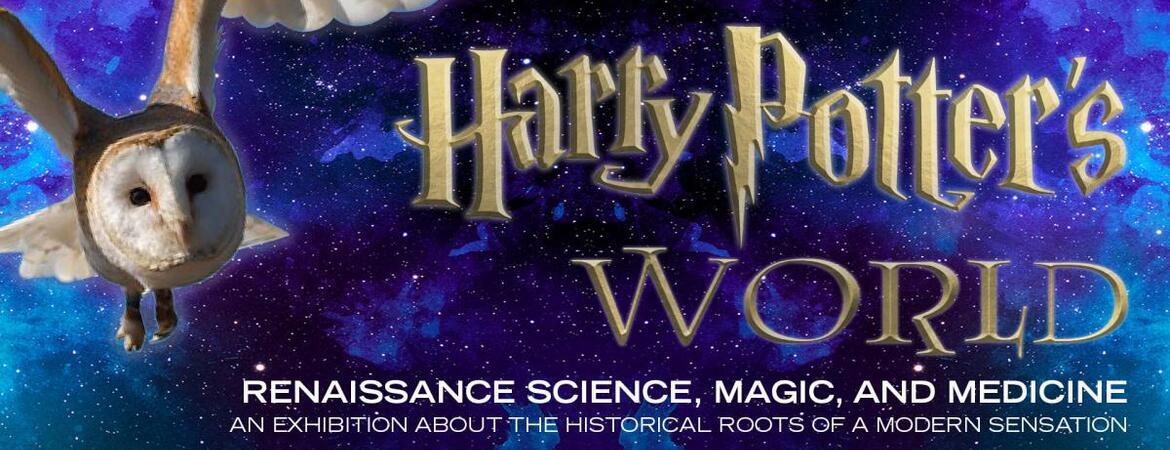
An exhibition developed and produced by the Exhibition Program at the National Library of Medicine.
In 1997, British author J. K. Rowling introduced the world to Harry Potter and a literary phenomenon was born. Millions of readers have followed Harry to the Hogwarts School of Witchcraft and Wizardry where he discovers his heritage, encounters new plants and animals, and perfects his magical abilities. Although a fantasy story, the magic in the Harry Potter books is partially based on Renaissance traditions that played an important role in the development of Western science, including alchemy, astrology, and natural philosophy. Incorporating the work of several 15th- and 16th-century thinkers, the seven-part series examines important ethical topics such as the desire for knowledge, the effects of prejudice, and the responsibility that comes with power.
This exhibition, using materials from the National Library of Medicine, explores Harry Potter’s world, its roots in Renaissance science, and the ethical questions that affected not only the wizards of Harry Potter, but also the historical thinkers featured in the series.
This exhibition is brought to you by the National Library of Medicine, National Institutes of Health. Curated by Elizabeth J. Bland.
Library Celebrates Diversity in Children's Literature
On Friday, May 20, 2016, the UCR Library in partnership with the Graduate School of Education (GSOE) celebrated the importance of diversity in children’s literature at a special event that also honored the 100th birthday and ground-breaking work of author and illustrator Ezra Jack Keats.
The event program featured a presentation by Dr. Claudette McLinn, the Executive Director of the Center for the Study of Multicultural Children's Literature in Inglewood, California.
McLinn addressed more than 100 students, some undergraduates as well as graduate students from the GSOE Teacher Education Program. Her presentation touched on seminal works by Keats and other authors and illustrators who were determined that children’s literature would reflect the diversity of identity and experiences of young readers.
Students engaged in a lively Q & A, many commenting on different books that impacted them as a young reader, and taking note of Dr. McLinn’s “must-read” recommendations.
Director of Teaching and Learning releases her first book
UCR Library’s Director of Teaching and Learning, Dani Brecher Cook recently published her first book, Learner-Centered Pedagogy: Principles and Practice.
Cook co-wrote the book with Kevin Michael Klipfel, who also contributes to their shared blog, Rule Number One. “It was something we’ve talked about doing since library school,” Cook said of their collaboration.
Inspired by the research of the humanistic psychologist and educator Carl Rogers, the book presents an empathic approach to information literacy sessions, reference service, and outreach. It offers concrete, evidence-based practices to implement these ideas and to connect with learners at all levels.
“Most librarians who come out as credentialed MLSs don’t have a background in teaching, but when they come onto their job, a huge amount of their work is in teaching,” Cook explained. “We hope this book will help librarians who don’t necessarily have a background in education to put their students at the center of their work.”
At UCR Library, Cook’s primary responsibility is to provide teaching and learning services that support curricular and research activities of faculty, researchers, and students.
Learner-Centered Pedagogy: Principles and Practice is available for purchase at Amazon.com, the ALA store, and other online retailers.