Search
Search
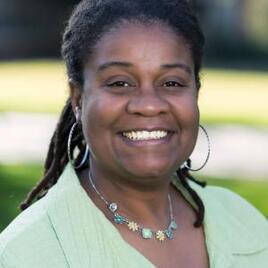
Andrea Newman
Andrea’s key responsibilities are ordering and receiving print serials materials, maintaining serials records, and managing invoices. She joined the library in 2007.
Serials Assistant and Cataloger
Supporting Students When They Need It Most
Finals Week Stress Relief at the UCR Library provides much-needed support to students during the most demanding time of the quarter.
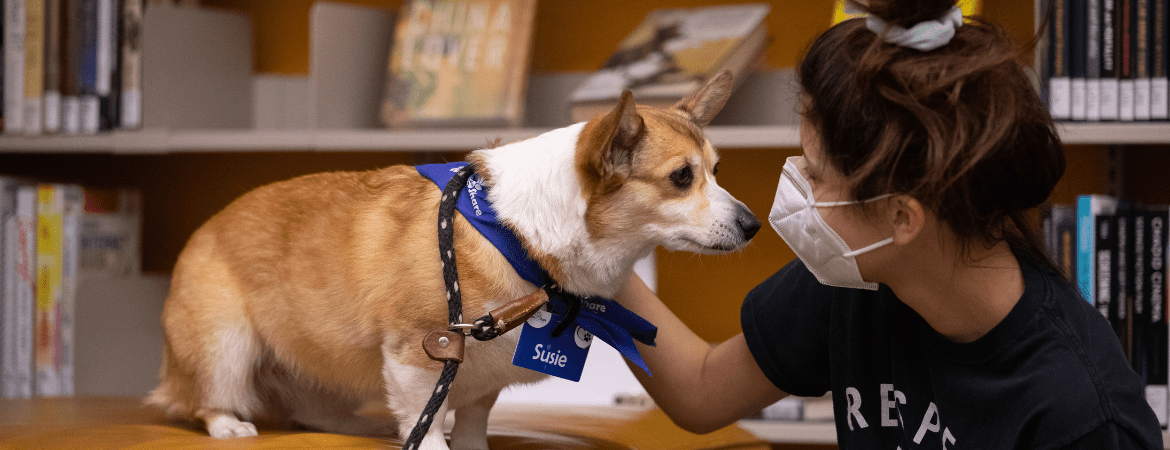
The week before finals and the week of finals, the UCR Library offers free activities to students like arts and craft events, food giveaways, contests, and games to help students take a break, recharge, and refocus. Therapy dog and cat visits, known as Therapy Fluffies, are a special highlight and brought to students with the help of our on campus partner The Well’s Active Minds.
UCR Library Serials Assistant Andrea Newman, a member of the UCR Library's Finals Week Stress Relief Committee, shared how impactful these events are. “The number one comment I’ve heard from students is, ‘Thank you so much… You guys are amazing!’ Whether we’re handing out snacks or boba drinks, the students are always so appreciative,” she said.
Students have shared how these programs help them navigate finals. “I really like the food-related ones because sometimes I forget to make time to eat,” one student said. Arts and crafts are another favorite, providing a creative escape from the pressures of exams. “Students often ask us to put on more arts and crafts events because they find them so calming,” Newman added.
The UCR Library is a space all students use, and programs like Finals Week Stress Relief ensure that it supports students in more ways than one. With over 900,000 visits annually, the library is a cornerstone of campus life, offering students not just academic resources but also a place to find balance during stressful times.
With additional donor support, the UCR Library could expand these offerings, creating even more opportunities to help students de-stress and succeed. If you’d like to support Finals Week Stress Relief at the UCR Library, there are many ways to contribute: you can donate food/snacks, beverages, arts and craft supplies for stress-relief activities, or provide financial support to help us broaden these initiatives. Please contact our Sr. Development Officer Shannon Castro to learn more about how you can make a difference. Your generosity will help us continue to ensure students have a space that supports their well-being and academic success.
Curious to see what we have in store for students for Fall 2024 Finals Week Stress Relief? Click here!
Healthy Campus Initiative grant awarded to library staff
On Feb. 5, a team of library employees received a UCR Healthy Campus Initiative grant for a project proposal, #puppylove: a feasibility study for an on-site, year-round animal therapy program for the UCR campus community.
Their project will conduct a year-long feasibility study to determine whether creating an on-site, year-round therapy dog service at UC Riverside would improve the emotional, mental, physical, and spiritual well-being of the entire UCR campus community.
#puppylove would differ from current Library programming in which therapy dogs visit campus once per quarter as part of the Finals Week Stress Relief events provided for students. However, its enduring popularity makes a great foundation for this research, according to project lead Patricia Smith-Hunt, Head of Preservation Services.
“Institutions like UC Berkeley and Harvard and USC have implemented programs like this,” Smith-Hunt said, who drew inspiration for #pupppylove from the therapeutic benefits she gained by acquiring a dog last year. “We as staff and faculty also have stressful days, so having access to that kind of unconditional love and interaction on a regular basis rather than just once per quarter – and having it open to everyone on campus – that would be the goal of the study.”
She shared this idea with library colleagues Financial and Acquisition Analyst Jacqueline Bates and Serials Assistant Andi Newman, who shared her excitement for the concept and helped to complete the grant application.
The team received notice in December 2017 that the Healthy Campus Initiative grant review committee had decided to green-light their study. Shortly thereafter, Circulation / Reserves Services Manager Sahra Missaghieh Klawitter and Access Services Desk Coordinator Elisha Hankins also joined the project.
After the grant recipients were announced on Feb. 7 in Inside UCR, colleagues from other UCR departments reached out to the team to ask how they could get involved.
Newman observed students interacting with the therapy dogs during Finals Week Stress Relief. “I was really surprised. Even with all these students surrounding them, the dogs remained calm, they were playing with the students, doing tricks, and allowing a number of people to pet them. The dogs loved it!” she said. “I myself was able to spend about 10 minutes holding, petting and just getting unconditional doggie love. After that, I went back to my desk and I truly felt better, all from being with a dog.”
“If I’ve had a really stressful day and I walk in my door and see my three dogs – whether they’re jumping on me or not – I feel better,” Bates commented. “I think everybody should have that opportunity because a lot of people can’t own dogs.”
The feasibility study will conclude in December 2018, and the team hopes that their research data will inspire the Healthy Campus Initiative review committee to implement the #puppylove program on a permanent basis.
Camaraderie, Pizza, and 21,000 Comic Books
Many hands make for light work – and when the job is sorting more than 21,000 comic books, you need a lot of hands.
Jim Clark, Head of the Database Management and Authority Control Unit, and Erika Quintana, Acquisitions Unit Supervisor were tagged as team leaders and charged with tackling the project of sorting 142 boxes, each containing approximately 150 comic books.
Jim explained, “We took all the boxes, looked at what we had, and tried to come up with how best to attack it.” He and Erika knew right away that they needed help, and all it took was the lure of free pizza to entice the rest of the team to join. Perhaps library employees are not so different from the students they serve, after all.
“It was a lot of fun,” Jim added. “Erika Quintana and I just organized all the boxes, gathered everybody, and we just went to town.” There were three big sorting ‘parties,’ during which Metadata Cataloger Sompratana Creighton and Asian Languages Cataloger Min Yu came on board as permanent team mates. Other floating team members included Acquisitions Assistants Sean Andress, Christy Brown Anderson, and Deborah Snow, Serials Assistant Andi Newman, Engineering Librarian Michele Potter, Head of Metadata & Technical Services Manuel Urrizola, Digital Assets Metadata Librarian Noah Geraci, Metadata Cataloger Julia Ree, as well as Associate University Librarians Diane Bisom and Alison Scott.
During the first phase of sorting, the team got through about one-third of the boxes when a surprise delivery arrived. “Special collections discovered a bunch more comics that they didn’t know we had, so those got merged into the project,” Manuel explained.
“If Erika and I had been the only ones doing it, we’d still be working on it,” Jim said. “But having that many people work on it, it saved us so much time. It really was a big help.” In whole, the sorting project lasted more than six months, even with several members of the team working on it daily.
“Not only could we work faster and more effectively, but we could also get to know each other more,” Sompratana commented. “When we worked together as a group, I got to know them really well and I liked that.”
Min agreed, “We worked mostly as a team and we had a happy time working together. We had fun and learned a lot.”
Most of the 21,000-plus comic books that the team organized will become part of the Eaton Collection of Science Fiction and Fantasy, adding a wide variety of new and different assets to the UCR Library’s extensive array of materials devoted to this field of scholarly research.
Some of the comics were given to the library by donors who asked for special attribution, so those were kept separate from the rest.
In addition, the team also had to sort out duplicates and process them separately from the comics that the library planned to retain in our collections. According to Min, there were approximately 40 boxes of duplicate issues culled from the collection.
“My favorite part was seeing everyone work together,” Jim stated. “They really got into it! It was really great teamwork.”
Now, the project is moving into its next phase: cataloging, which could take a year or more to complete. “We could use as many people as we can get,” Jim said. “If anyone is interested, if they would enjoy doing that, they should reach out to me or Erika to see how to get involved.”
#Puppylove study seeks input from UCR community
A team of Healthy Campus Initiative grant recipients is approaching the end of their year-long feasibility study, #puppylove: an on-site, year-round animal therapy program for the UCR campus community.
They are now seeking input from UC Riverside students, faculty, and staff.
The #puppylove study, sponsored by the UCR Healthy Campus Initiative with funding from the UC-wide Healthy Campus Network, seeks to determine faculty, staff, and student interest in an on-site, year-round Campuswide Wellness Dogs (CWD) program.
The proposed CWD program would be in addition to the Therapy Fluffies event that takes place during the quarterly Finals Week Stress Relief event series, sponsored by the UCR Library in collaboration with The WELL and UCR Active Minds.
"A CWD program would be an exciting and innovative method for improving the overall physical, mental and social well-being of the broader UCR community," said project lead Patricia Smith-Hunt, Head of Preservation Services at the UCR Library. "Our team is excited about the research study we are conducting."
There are separate survey forms for UCR faculty and staff and for students. Each survey takes about 5 minutes to complete, and the deadline to participate has been extended to Wednesday, April 10.
Participation is voluntary and answers will remain anonymous.
The #puppylove team included several UCR Library employees: Smith-Hunt was the project lead; Financial and Acquisition Analyst Jacqueline Bates; Serials Assistant Andi Newman; Circulation / Reserves Services Manager Sahra Missaghieh Klawitter; and Access Services Desk Coordinator Elisha Hankins.
Smith-Hunt added, "The #puppylove team thanks the UCR community for participating in the survey."
New archival collections available for winter quarter 2018
Special Collections & University Archives staff are constantly working to process recently acquired collections and make those materials ready for use by students, faculty, and researchers.
Each quarter, we will provide a list of UCR Library's newly processed archival and primary source collections. Check out the list below to see if there are any items that fit your research area, or share with a friend!
Below you'll find brief descriptions and links to the finding aids or collection guides for each new collection. To use any of these materials, simply click the "Request Items" button at the top to submit a request, and log in with our Special Collections Request System. For more on conducting research in Special Collections, see this page.
SCUA is open to the public on weekdays from 11:00 am – 4:00 pm. Check here for closures or other changes to our regular hours.
For questions, email specialcollections@ucr.edu.
Newly Processed Collections – Winter 2018
1.83 linear ft. (3 boxes)
This collection contains role-playing games including Advanced Dungeons & Dragons, Marvel Super Heroes, and DC Heroes. Items in the collection include player and master manuals, as well as maps and character pieces.
1.75 linear ft. (7 boxes)
This collection consists of around 1500 photographs and photographic postcards featuring the people, places, and events significant to the Mexican Revolution (1910-1920) from the studio of Luis Ramirez Pimentel, including many images from the Chihuahua Campaigns (circa 1910-1913).
0.21 linear ft. (1 box)
This collection contains transcripts, MP3 audio files, and digital images related to the Inlandia Institute's oral history project, "'Making Waves: Women's Environmental Movement," which documented the stories of seven Inland Empire area environmentalists. Women interviewed for the project included Jane Block, Liz Cunnison, Melba Dunlap, Beverly Wingate Maloof, Sue Nash, Penny Newman, and Ruth Anderson Wilson.
Seminario International Escenarios Politicos de la Transición a la Democracia records, 1989 (MS 017)
0.42 linear ft. (1 box)
This collection contains newspaper clippings and conference papers related to the "Seminario Internacional Escenarios Politicos de la Transición a la Democracia," a seminar held in July of 1989 that discussed the various political transitions from socialism to democracy occurring in Latin America.
3.33 linear ft. (8 boxes)
This collection consists of photographs and documents related to the Mission Inn, a national historic landmark located in Riverside, California, generally considered to be the largest Mission Revival Style building in the United States. The collection also includes images of Frank Miller, the first owner of the Mission Inn, Riverside's Mount Rubidoux, and other historic buildings in Riverside.
1.67 linear ft. (4 boxes)
The collection consists of items collected by Laura Klure related to the Young Women's Christian Association (YWCA) of Riverside, a women's organization dedicated to empowering women and advocating for civil rights. Materials in the collection mostly consist of interviews, research, notes, and other documents related to the Riverside YWCA History Project, which was an effort by Klure and others undertaken in the early 1990s to document the history of the local branch and create an archive of Riverside YWCA records.
0.42 linear ft. (1 box)
This collection contains schedules and proceedings from the "Seminario Partidos Políticos en los Procesos de Democratización," a seminar on the democratization of political parties in Paraguay held in 1989 and organized by the Grupo de Trabajo de Partidos Politicos (CLACSO) and the Centro Paraguayo de Estudios Sociologicos (CPES).
1.25 linear ft. (1 box)
This collection contains correspondence, documents and other material from Eloise Emerson, an accomplished public health nurse who worked for the Riverside County Department of Health. The majority of materials in the collection focus on her nursing career, and her lobbying effort against the California State mandatory retirement age.
1.5 linear ft. (6 photograph albums)
The collection consists of photographs from the Mexican Revolution (1910-1920) taken by Agustín Victor Casasola, a Mexican photographer and co-founder of the Mexican Association of Press Photographers. Photographs in the collection include depictions of daily life in Mexico, and Mexican presidents in the early 20th century. In addition to photographs taken by Casasola, there are additional photographs on Mexico and its politics taken by Casasola's sons after his death in 1938.
0.83 linear ft. (1 box)
This collection consists of an album of photographs depicting various scenery, people, agriculture, and ruins in Paraguay in the early 1900s. Photographs in the album include views of a fleet from the 1912 Revolution, the Encarnación cyclone disaster of 1926, the Jesuit ruins at Jesus y Trinidad, and of the inauguration of the Salesian Agricultural School at Ypacaraí.
0.5 linear ft. (2 photograph albums)
This collection contains photographs of various people and landscapes of Mexico taken by Hugo Brehme, a German-born photographer that moved to Mexico in 1905.
0.71 linear ft. (2 boxes)
This collection consists of 60 cartes de visite, owned by José Antonio Ulloa of Zacatecas, Mexico. Items in the collection include photographs and portraits of European, South American, and Central American royalty and military members from the 19th century. Many of the cartes de visite depict members of European royalty related to Napoleon I, as well as cartes de visite of figures surrounding the trial and execution of Mexican Emperor Maximilian I in 1867.
1.67 linear ft. (5 boxes)
This collection contains a variety of lantern slides depicting geographical areas, buildings and ruins, famous individuals, and people of various countries.
2.33 linear ft. (3 boxes)
The collection contains black and white photographs taken during the Mexican Revolution in the early 20th century. Photographs in the collection cover various locations, battles, soldiers, and important figures such as Álvaro Obregón, Francisco Madero, Pancho Villa and Pascual Orozco.
2.0 linear ft. (1 photograph album, 1 box)
The collection consists of photographs of Mexican revolutionary and President Venustiano Carranza, including depictions of Carranza on national tours and in areas being attacked by Revolutionaries during his time as Mexico’s president (1917-20). Photographs in the collection also include portraits of Carranza and other prominent Mexican figures, including Isidro Fabela and Álvaro Obregón.
0.54 linear ft. (1 photograph album, 1 box)
The collection consists mainly of photographs of Francisco “Pancho” Villa, a Mexican Revolutionary general and prominent figure during the Mexican Revolution in the early 20th century. Photographs in the collection include portraits of Villa, Villa with his troops and other military figures, Villa's murder in 1923, and photographs of Villa’s family.
0.42 linear ft. (1 box)
This collection contains newspaper clippings, articles, and other material on the history of the Gage Canal, the system built in 1898 to supply water to the city of Riverside, California. Materials in the collection cover the sale of the Gage Canal company, various lawsuits and legal issues, and correspondence and photographs belonging to John M. Mylne, the superintendent and engineer of the Gage Canal System.
0.42 linear ft. (1 box)
The collection consists of 27 stereoscopic photographs depicting various locations in Jerusalem published by Underwood & Underwood at the turn of the 20th century. The majority of the photographs come from the "Jerusalem Tour" set published in 1904.