Search
Search
Library Student Employees Who Are "Living the Promise": Sean Matharoo awarded Fulbright Fellowship
Fourth-year Comparative Literature PhD candidate and library student employee Sean Matharoo has a unique array of talents, experiences, and academic interests that should yield results during his Fulbright fellowship in Belgium later this year.
“The funding to pursue something like this is invaluable to me. It enables me to do something I wouldn’t be able to do otherwise. I’m really honored and I’m excited,” Matharoo said. “I’ve been given the opportunity to work with Dr. Stef Craps in the Department of Literary Studies at Ghent University. His research is focused on the same things that I want to study: memory studies, the Anthropocene, postcolonial literature, and climate change fiction.”
Matharoo added, “The Anthropocene has been theorized by scientists as a geological time period characterized by humankind’s adverse impact on the planet due to the exploitation of land, water, animals, and fossil fuels. I want to problematize the cosmopolitanism of the discourse, which tends to sideline the question of vulnerability.”
Matharoo has been passionate about engaging with environmental issues such as climate change since before he came to UCR. He devoted nearly a year to his Eagle Scout project of building a drought-tolerant garden in his hometown of Inverness, Florida.
After completing his Bachelor’s in English at University of Florida, Matharoo was drawn to UC Riverside for three reasons: the university’s science-fiction program, cultural diversity, and geographic location. “I have always wanted to move out west for social and political reasons, and to be near the Joshua Tree desert and the film cultures of LA.”
Matharoo’s advisor Dr. Sherryl Vint recommended that he apply for the Fulbright grant to study in Belgium, knowing that he feels passionate about bridging cultural and linguistic borders while striving toward solidarity across those gaps.
“What’s really important to me is bringing into the classroom an emphasis on communicating across differences while upholding those differences at the same time,” Matharoo stated. “A lot of students – especially students who don’t come from families that are intimately familiar with the education system in this country – children of immigrants, first generation college students, and so on – they don’t always know that they don’t have to assimilate into one way of doing research.”
Sean credits his collaborative approach to research to his time spent working in Special Collections at Rivera Library with JJ Jacobson, UCR Library’s Jay Kay and Doris Klein Librarian for Science Fiction. “Working in the library taught me that starting with a hypothesis, an idea, a problem or a question, and then thinking about it in a much more improvisational and flexible way, it ends up opening interesting new tangents that are actually really productive for engaging the question,” he explained. “It encouraged me to think of research not in terms of solo-authored projects but instead as collaborative projects.”
When working at Rivera Library, Matharoo cataloged the Jay Kay Klein photograph collection. “There are thousands and thousands of photos and slides in this collection,” he stated. “From the 1940s through the 1990s (Klein) was really active in going to science-fiction conventions and award ceremonies, taking photographs and meticulously documenting where he was, who was in the photograph. I worked on his collection, moving the analog negatives and slides over to digital metadata so that scholars, artists, or anybody who is interested could say, ‘I need a photo of Octavia Butler at this convention in this year,’ for instance, and they could easily find it.”
During his Fulbright fellowship, Sean plans to take classes at Ghent University, conduct research, and write the first few chapters of his PhD dissertation. “There are other PhD students at Ghent working on projects similar to my own. There’s a really incredible, thriving community there that I’ll be able to network with and learn from.”
He hopes to connect his Fulbright research with the Afro-Belgian community in Ghent through interviews and collaborative artistic projects. “I intend to superimpose interviews, field recordings, noise music, text, photography, and video into audiovisual sculptures,” he explained.
After completing his PhD, Matharoo plans to teach at a university. “I don’t want to treat my students as empty vessels to be filled with knowledge,” he said, “but, rather, to create a space where we can do the work of education together, always experimenting to create alternative ways of thinking and being.”
Newly Processed Collections - Winter 2020
Special Collections & University Archives employees are constantly working to process recently acquired collections and make those materials ready for use by students, faculty, and researchers.
Each quarter, we will provide a list of the UCR Library's newly processed archival and primary source collections. Check out this list to see if there are any items that fit your research area, or share with a friend!
Below you'll find brief descriptions and links to the finding aids or collection guides for each new collection. To use any of these materials, simply click the "Request Items" button at the top to submit a request, and log in with our Special Collections Request System. For more on conducting research in Special Collections, see this page.
SCUA will be open to the public during winter quarter 2020 on weekdays from 10:00 am – 4:00 pm. Check here for closures or other changes to our regular hours.
For questions, email specialcollections@ucr.edu.
Newly Processed Collections - Winter 2020
Poul and Karen Anderson papers (MS 040)
This collection consists of the personal and professional papers of science fiction and fantasy authors Poul and Karen Anderson. These materials document the writing and publishing process and their involvement with the science fiction community and other organizations such as the Society for Creative Anachronism and Sherlockiana groups. Items in the collection include correspondence, manuscript drafts, notes, diaries, personal records, artwork, memorabilia and ephemera from various conventions and events.
https://oac.cdlib.org/findaid/ark:/13030/c8sn0gm2/
Lillian Bonham papers (MS 012)
Lillian Bonham was an artist and the second wife of bohemian actor, poet, and social critic Sadakichi Hartmann. Bonham’s papers primarily include her personal diaries, starting as a teenager in rural New Jersey through her adult life with Hartmann in Colorado and southern California, as well as correspondence and art. These materials are a wonderful snapshot into everyday life at the end of the 19th century and a glimpse into the bohemian culture of the early 20th century.
https://oac.cdlib.org/findaid/ark:/13030/c8z03g6t/
African Student Programs (UA 388)
This collection contains press clippings, fliers, and other material documenting the African American student experience at the University of California, Riverside (UCR) and the subsequent role of UCR African Student Programs.
https://oac.cdlib.org/findaid/ark:/13030/c87d2w0b/
Native American Student Programs (UA 011)
This collection contains fliers, pamphlets, and other material regarding Native American Student Programs (NASP) at the University of California, Riverside which serves students of Native American descent and heritage. Primarily contains information about NASP related events.
https://oac.cdlib.org/findaid/ark:/13030/kt0b69r91j/
Associated Students of UCR records (UA 354)
This collection contains documents, publications and other material on the Associated Students of the University of California at Riverside (ASUCR), an undergraduate student government body. The bulk of the collection consists of information on amendments to the ASUCR Election Code and the constitution and bylaws of ASUCR
https://oac.cdlib.org/findaid/ark:/13030/c80z78p3/
Jan Erickson collection of oral history interviews (UA 144)
This collection includes typed transcripts, audiocassettes, and videocassettes from an oral history project conducted betweeen 1992 and 2002 by Jan Erickson, former Administrative Assistant to Chancellor Raymond L. Orbach. The interviews include facts and historical details pertaining to key individuals associated with the campus in an aim to depict the evolution of the University of California, Riverside.
https://oac.cdlib.org/findaid/ark:/13030/c8qv3nb4/
Alumni and former students collection (UA 332)
This collection contains articles, a business card, and other material on alumni and former students of the University of California, Riverside. Mostly contains information on Commander John Kirk Ferguson, USN (Ret.).
https://oac.cdlib.org/findaid/ark:/13030/c81z49s1/
Terry Carr collection on Science Fiction Fandom (MS 359)
This collection contains fliers, correspondence, fanzines, newspaper clippings, ballots, materials related to the Science Fiction Writers of America (SFWA, and other material on Science Fiction fandom collected by Terry Carr.
https://oac.cdlib.org/findaid/ark:/13030/c8mk6k8v/
Jaymee Goh papers (MS 427)
The collection contains drafts, notes and other materials related to works of science fiction and fantasy written by author Jaymee Goh, including drafts from her works created at the 2016 Clarion Science Fiction and Fantasy Writing Workshop.
https://oac.cdlib.org/findaid/ark:/13030/c8sn0gdc/
Science Fiction Poetry Association Records (MS 307)
This collection contains publications, ballots, and other material from the Science Fiction Poetry Association. Includes issues of Star*Line and the Rhysling Anthology.
https://oac.cdlib.org/findaid/ark:/13030/kt15803548/
Charles W. McLaughlin photographs (MS 125)
This collection contains the negatives of Charles W. McLaughlin's photographic work documenting the Inland Empire of Southern California (San Bernardino and Riverside counties). The photographs span more than a sixty year period showing the region's development from a rural/agricultural area to a more urban one. Most of the subject matter is landscapes, architecture, and people within the San Bernardino mountains, but areas and landmarks outside of the Inland Empire are included as well. The collection covers material from about 1850 to 1984.
https://oac.cdlib.org/findaid/ark:/13030/kt8d5nf563/
PDC Promotes Organizational Excellence
UCR Library’s Professional Development Committee (PDC) held its kick-off event on Wednesday, August 17, 2016. More than half of the library’s academic and staff employees came to one of the two sessions, held in Rivera and Orbach libraries.
The PDC comprises Library employees who volunteered to participate in cultivating opportunities for professional development. With members from the various employee groups (represented, non-represented, academic, non-academic, supervisor, non-supervisor), the PDC is positioned to advise Library Administration on an array of diverse professional development needs. This unique endeavor has the full support of Library Administration who looks forward to this feedback from employees.
“I was interested in hearing what type of professional development philosophies might come up,” explained Jacqueline Bates, Financial and Acquisitions Analyst. “Working with people to identify the best programs for them is vital. People are much more likely to engage fully and derive real benefit from any type of training and development program if they understand why the program is valuable and can contribute to their ability to do their job well. I am pleased that the Library envisions an idea that when you energize people to be at their best and make a positive difference, the organization will indeed obtain organizational excellence.”
At the top of the hour, PDC Chair Leslie Settle welcomed the group. Committee members guided employees through a peer-to-peer brainstorming session, with the goal of identifying professional development needs. “The warm-up exercises got our minds thinking and mental states in tune with sharing,” said Christy Brown Anderson, Monographs Receiving Assistant.
The session continued with an interactive, visual facilitation exercise with employees posting their suggestions, by category, onto the wall. Categories included: Customer Service, Leadership, Communication, Teamwork, Technology, and Diversity.
Similar to a silent auction, employees used stickers to select the development opportunities they felt would have the greatest impact. “It was great to see everyone’s ideas up on the wall,” said Carla Arbagey, Electronic Resources Librarian. “And to see which ideas got the most votes.” The PDC also sent out an email survey to solicit input from employees who were unable to attend the kick-off.
Popular recommendations included:
- Cross-training and job shadowing in other units, to better understand workflows
- Communication skills
- Sensitivity training (diversity and microaggressions)
- Conflict management
- Customer service
- Project management
- Grant and proposal writing
“I saw it as an opportunity to interact with staff members that I don’t typically work with, and to hear different ideas and perspectives about what others need to improve their knowledge base and grow professionally,” explained Eric Milenkiewicz, Manuscripts Curator. “I liked the collaborative nature of the event, specifically when the group came together as a collective to surface common professional development needs across the library.”
“I was interested in hearing what colleagues in other departments are looking for out of our organization, and where our goals and desires intersect,” said Alexandra Dolan-Mescal, Web Developer and User-Interface Designer. “I would love to partake in collaborative professional development rather than just individual, as I have so far. I greatly enjoyed the small groups talking through individual cards and grouping them together, as it showed clearly how similar our interests are and how there are categories of professional development interests that could be explored programmatically.”
“I like to be an active member of our library staff,” explained E-Resources Librarian Carla Arbagey. “I’m also interested in continuing my own professional development, so I was eager to see what kind of activities the committee was planning.”
Monographs Receiving Assistant Christy Brown Anderson was also curious about what the session might entail. “I wanted to take the opportunity to see what learning topics others were interested in, as well as be able to contribute to that,” she said. “I had wondered before the event whether there would be a focus on the technical or performance type of skills needed for the efficient and successful operation of the library, or on more visionary topics.”
“The Professional Development Committee is excited that our first peer-to-peer brainstorming session was a success. These sessions proved to be a benefit to everyone involved and allowed us a unique opportunity to suggest to Library HR what training and development we would like to see in this upcoming fiscal year,” stated Leslie Settle, Circulation Services Desk Supervisor and PDC Chair. “The post-it notes we collected represented our voice and we are privileged to draft a proposal that will encompass the voice of the team.”
Library Human Resources looks forward to crafting an implementation plan from the PDC’s proposal. “Library employees are engaged – driving their professional development. And Library leadership actively supports a culture of collaboration, creativity and learning,” said Lisa Dye, Director, Organizational Design and Human Resources. “It’s a win-win. It’s organizational excellence.”
Keeping with the strategic plan, University Librarian Steven Mandeville-Gamble is committed to providing development opportunities to all levels of library employees. His vision, and that of Library Administration, is to empower library employees to continue to build their skill sets and develop into contemporary professionals who contribute to UCR Library’s identity as an Association of Research Libraries organization. The Professional Development Committee will play a vital role by empowering library employees with a voice to propose solutions in a collaborative setting.
Future suggestions for professional development are welcome, and employees are encouraged to submit ideas to the Professional Development Committee via email at: professionaldevelopment@ucr.edu.
Student Research Ignites a ‘Revolutionary’ Poster Exhibit
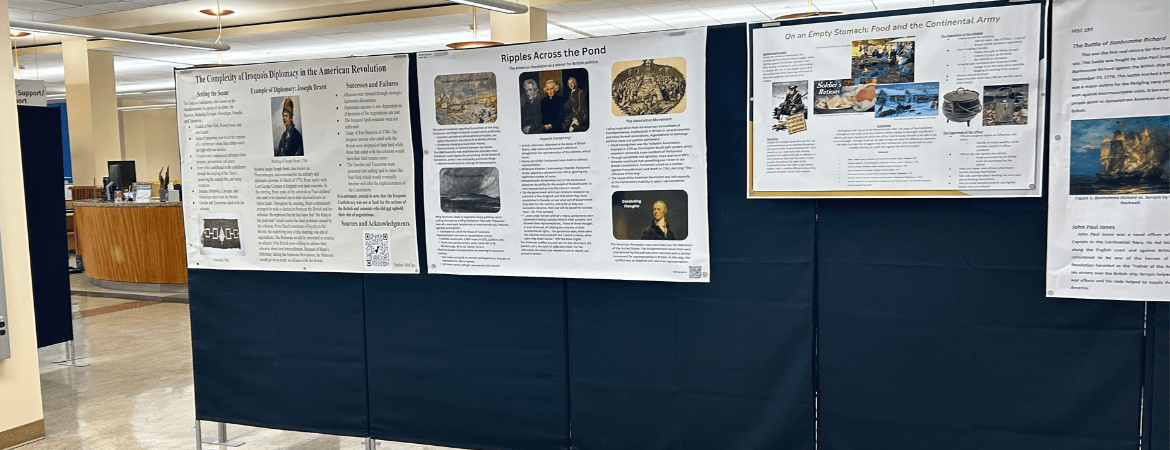
During winter quarter 2024, the UCR Library collaborated with Dr. Alejandra Dubcovsky and her History 197 students on a ‘revolutionary’ project.
From March 15 through March 28, 2024, a poster exhibit near the Information Desk in the Tomás Rivera Library was on display that offered different perspectives on the American Revolution.
Dr. Dubcovsky aimed to deepen students' understanding of the American Revolution by allowing students to explore it from diverse angles, with their research culminating in a poster exhibit.
“There are so many primary materials available and they cover all sorts of topics, from fashion to food, from warfare to everyday life, and from women's experiences to the role of political discourse,” Dr. Dubcovsky explained. “Students can always find something of interest in the American Revolution!”
Key to this exploration were the efforts of Social Sciences Teaching Librarian Michael Yonezawa and Arts and Humanities Teaching Librarian Robin M. Katz. They collaborated with Dr. Dubcovsky to design a library instruction session for the class that not only introduced students to valuable library resources but also helped them engage directly with primary sources.
Dr. Dubcovsky credited this collaboration as critical to the project's success, stating, "The library and librarians were instrumental in the success of the students' research projects. Michael and Robin then went above and beyond (as usual), and held individual meetings with each student; these one-on-one meetings allowed students to ask specific questions and resolve particular research queries."
Student Kasen Milhon-Martin appreciated the one-on-one session. “I met with Michael Yonezawa and he was incredibly helpful and walked me through using the databases…it was also really helpful to talk through my topic while looking for sources to use.”
Another student in the class, Jacob Spencer, expressed how the library’s resources proved invaluable. "The library was the linchpin in my work…giving me free use of internet databases like Gale's Sabin Americana and JSTOR were immensely helpful."
Jacob was unaware of how easy library services like Interlibrary Loan were to use until this project, noting how smooth the process was.
“I needed a book that UCR didn't have, but through the interlibrary loan system, I was able to get it without any problems,” Jacob said. “It's such a wonderfully useful facet of the library that I most definitely will turn to should I need something that I can't pick right off the shelf at Rivera.”
Another History 197 student, Bailey Hellman, shared their enthusiasm for the accessible presentation of historical research through posters: "It's really nice to be able to see something that you have spent so much time working on being displayed. A lot of academic papers are difficult to read, so something like a poster makes historical work more digestible and accessible."
Bailey was surprised by all of the databases accessible to the UCR community for free through the UCR Library, "There are so many sources in those that don't come up with a simple Google search––and I couldn't have written my paper without them. It made everything so much easier," Bailey said.
Haydn Marshall, another student in the class, successfully tracked down the full original text of the Heritable Jurisdictions (Scotland) Act of 1746 in a book in the Rivera Library. There is a free online version from the UK Parliament’s website, but it only goes back to 1991 and not all of the original text is included. Haydn was able to leverage library resources to find the full original text version.
“I gave some advice, but I didn’t point out this specific title,” Robin M. Katz said. “This is just one example of the many students who had a chance to hone and demonstrate tremendous skill and initiative.”
Robin continued, “This story also shows how meaningful it is for us librarians to see students’ final projects – most of the time, we teach a session, or have a research consultation, or answer a question and we don’t know where the research leads. Getting to reconnect with Haydn and see his fantastic work and hear his insightful argument was a real highlight of the quarter for me.”
This exhibition not only showcased students' hard work but also underscored the library's vital role in fostering academic research and information literacy.
“Working with instructors to support students' information literacy development is one of our primary missions,” said Director of Teaching and Learning Britt Foster. “And being active creators of information, as with these posters, is the perfect example of this, as students are bringing together primary and secondary sources to tell these stories in new ways.”
UC Riverside Library Acquires 3 Millionth Volume
Renowned rare book preservationist Terry Belanger will speak at April 18 celebration.
RIVERSIDE, Calif. — UCR Library will celebrate the acquisition of its 3 millionth volume in a ceremony on April 18 at 2:30 p.m. in the lobby of the Tomás Rivera Library on the UC Riverside campus.
The keynote speaker will be Terry Belanger, University Professor emeritus at the University of Virginia and founding director of Rare Book School, a nonprofit institute devoted to the history of books and printing, and to rare books and special collections librarianship. He won a prestigious MacArthur Fellowship in 2005.
Mike Terry, pipe major of the UCR Pipe Band, will perform an original composition, “Literary Notes” (An Ode to the Book). A reception will follow. The event is free and open to the public. Parking costs $5 in Lot 6. To RSVP call (951) 827-4941 or email terrig@ucr.edu.
Achieving a collection size of 3 million volumes is a milestone for UCR, said University Librarian Ruth M. Jackson. The library celebrated its 1 millionth volume in March 1981, and its 2 millionth volume in November 2001. Currently the number of volumes held by the libraries is 3,214,420. Of that total, more than 404,000 are e-books.
With this achievement, UCR ranks 81st for the number of volumes held among the 115 academic research libraries in the United States and Canada that are members of the Association of Research Libraries (ARL). That places UC Riverside just below UC Irvine, which ranks 77th, and just above UC Santa Barbara, which ranks 84th.
“The digital transition is occurring at a steady pace,” Jackson said, and will ultimately transform libraries in much the same way as the printing press revolutionized the process of book-making and distribution in the 15th century.
Printed books will continue to co-exist with e-books and other formats and will remain a staple of university and research libraries for some time, she said. Currently, only 20 percent of all in-copyright scholarly books published in the U.S. and worldwide are fully available in digital form, she said. Electronic books allow multiple users to browse their pages at the same time; can be viewed and accessed on-site in the library, or remotely from home, student residences, and faculty offices using either hard-wired computers, laptops, or hand held mobile devices with proper UCR authentication; and will ultimately offer vast advantages for full-text searching/data mining as the trend continues.
Research libraries, such as the UCR Library, typically purchase books upon the recommendation of library subject-specialists, in collaboration with faculty, based upon the national publication output and the University’s profile, Jackson explained.
In fiscal year 2011, the UCR Library initiated a pilot for testing a demand-driven acquisition (DDA) system that enables all UCR-affiliated library users to access and read licensed e-books loaded into the Scotty catalog by three major vendors. The e-books and the titles for printed books are chosen for loading based upon the university’s academic and research profile. If an e-book or the title for a printed book is accessed or used three times, a purchase is automatically made by the system for the UCR Library, making the electronic title part of the permanent collection. When the title for a print book is accessed for the first time, the system will ask the user if he or she wants to place an automatic order for the title.
The UCR Library will analyze purchasing patterns based upon the pilot at the end of the current fiscal year to determine how the two models of selecting materials for permanent addition to the collections differ and complement each other.
“It’s still very much a print world in many ways and will be so for a while in several key academic disciplines and publishing fields such as the arts, humanities, social sciences, foreign language materials, and selected areas of the sciences ,” Jackson said. “It’s also one of the most exciting times to be a librarian and information scientist because of the mix of information resources we are able to make available to our users.
“The digital transition in publishing is changing the whole information environment. Libraries have a significant role to play in reshaping the campus information environment and developing new ways to manage, deliver, and preserve both print and digital resources, as we continue our role of making easily available the scientific, social and cultural publishing output of the nation and the world in support of research and learning.”
First e-book acquired by UCR Library: “Native American health care: January 1980-January 1993,) Patricia La Caille
10 Most Popular Books in the UCR Library 2011-2012 (based on circulation data)
-
“Outliers: the story of success,” Malcolm Gladwell (2008)
-
“Person and reality; an introduction to metaphysics,” ed. Peter Anthony Bertocci et al (1958)
-
“Eat, pray, love: one woman’s search for everything across Italy, India, and Indonesia,” Elizabeth Gilbert (2006)
-
“God and creation: three interpretations of the universe,” John Elof Boodin (1934)
-
“GRE exam: premier program,” Kaplan Test Prep and Admissions (2008, 2009)
-
“Handbook of fuel cells: fundamentals, technology, and applications,” ed. Wolf Vielstich, et al (2003)
-
“Cracking the GRE,” with DVD, Karen Lurie, et al (2010)
-
“Crisis intervention theory and practice: a clinical handbook,” Ann Wolbert Burgess, et al. (1981)
-
“Catching Fire,” Suzanne Collins (2009)
- “The Hunger Games,” Suzanne Collins (2008)
Career retrospective: Deputy University Librarian to retire in June
The UCR Library wishes to congratulate Deputy University Librarian Ann Frenkel on her upcoming retirement in June 2021.
In 2006, Ann Frenkel joined the UCR Library as the Assistant University Librarian for Research and Instructional Services (later promoted to Associate University Librarian), along with her husband, Gwido Zlatkes, who became a librarian first in Special Collections and University Archives, and then in Metadata Services. Ann and Gwido met at Brandeis University outside of Boston, Massachusetts, where Ann worked as a reference librarian and Gwido worked as a graduate student employee at the library information desk.
In 2016, Ann was promoted to the role of Deputy University Librarian. Throughout the years, she has influenced instruction activities, programs, and services that support UC Riverside’s research, education, and service mission. She has also guided the creation of policies and communication strategies for the library. The lasting impact of Ann’s role and work with the UCR Library is extensive.
As her retirement date drew closer, we invited Ann to share some of her UCR memories with us.
What was your favorite part about working at the UCR Library?
Teamwork. Being able to work with staff in all different departments, divisions, units and create things we've never done before, new services, watch people come up with really creative solutions. And then, because of my particular position, I had the ability to give people the tools they needed, whether funding, or the ability to make a decision. I could help people be able to do things, give them what they needed to make things happen. It was fun and rewarding to see people develop and grow in their careers, and personally, as well.
One downside is that I've had several people leave and go on to other positions, bigger positions. But that also is part of the joy of working, even though it's always hard to lose people. It's been a delight for me to see people grow, and I feel like, “Oh, I had a tiny little hand in that!”
What are the biggest “wins” from your time working at UCR?
The reorganization with Research Services and Teaching and Learning is a big win in that I was able to do it together with the directors of the two departments and with the department staff. We worked as collaboratively as we possibly could. It was never perfect, it's always going to be a work in progress, and there are different ways and places for it to go now that I am leaving. We gave ourselves the freedom to imagine what it could look like, and we came up with a plan and we tried it out. Yeah, things changed a lot, but it was really rewarding work.
I think that the furniture and collaborative working space projects in both Rivera and Orbach were also big wins. In my memory it was so much fun because it involved so many people and we definitely had to come up with compromises, especially around colors, I remember! I think, in the end, everybody was satisfied. But we worked together and really envisioned using those spaces in new ways. What's exciting now is that it's going on to phase two or phase three with a new focus, and we'll see where it goes.
The Creat’R Lab is definitely a big win, from its beginnings with a couple librarians creating some Maker Boxes, to saying, “Hey, let's get a 3D printer and see what we can do with it!” and then finally developing a dedicated space that the students took over as their own. That has been really exciting.
There's one more big win from the early days that I remember -- something that seemed like a revelation at the time, and now it's old hat. When I first arrived, we had very rigid policies about what you could do in the libraries. You were supposed to sit in your seat and study and not talk very much, and that was about it. You couldn't eat or drink, and there weren’t places to work collaboratively with others, and the library wasn't seen as a “comfortable” space. I wanted it to be a space where people wanted to be -- and it needed to include all the things that one needs to have to make yourself comfortable, including food and drink. Within the first year I was here, I said to the then-University Librarian, “I think we should revise the food and drink policy to allow it.” She let me come up with a way to do that, and we moved on from there.
I also have a philosophy about rules: that you only should have rules in libraries when you really, really need them. And you shouldn't have rules just for the sake of them. That has always felt very oppressive to me, so I'm always thinking, “How would this make me feel?” and I make decisions accordingly.
What are you going to miss the most?
I know it sounds pat, but the people. I'll really miss the teamwork. I've always been able to work well with my colleagues and form really good working relationships. We truly have enjoyed working together. We've had a special connection. Those relationships are really important.
It's odd retiring when we're still in a remote, Zoom environment. I still see people on Zoom and I'll miss that, as well. I also have missed over this past year the casual contact with people in the office. It's fun, working together with people. That's a huge part of the job. It's why things work. When things work well, it's because you've been doing things together with others.
What's next for you?
I will be, probably the majority of the time, living in Warsaw, Poland with my husband Gwido. We won't be in a long-distance relationship finally, which we're really looking forward to.
Gwido and I have a huge number of translation projects. We translate under several pseudonyms -- Frank L. Vigoda (Polish to English) and Franek Wygoda (English to Polish). We have a book that's coming out in May, a translation to English from Polish of a memoir of one of the most famous Polish dissidents, Karol Modzelewski. It was supposed to come out last year, but got delayed during the pandemic.
One other thing that is coming out soon is a translation from English to Polish of Float by the Canadian poet, Anne Carson. Gwido translated it, but I helped at the very end of the project significantly, and I feel very connected to it. We've always translated from Polish to English together, and he does English to Polish, usually on his own. But working on this project together made us realize how I can be effective as a partner in that process, as well. So we're looking forward to that when we live in Warsaw.
We also hope to travel more. I think being cooped up with the pandemic has made us a little bit more impatient, like, “Oh, we want to go to Rome! Oh, we want to see Paris again! Oh, we want to go here and there.” Our base in the United States will be Portland, Oregon. I have family up there and grew up in Oregon, so I feel quite connected to that region.
What’s your funniest memory from your time at the library?
It’s not really funny, but it is interesting -- we now have a fairly elaborate process that we go through when a student asks to shoot a student film in the library. We ask, “Do you have any fake blood or fake weapons?” That's because there was an incident several years ago when we had a supposed active shooter, and the entire library evacuated, and we were hiding behind bushes for like three hours. What happened was that a student was doing a film in one of the group study rooms and was using an imitation gun. Somebody saw it and reported it, and the rest was history.
So, talking about not having rules for rules sake -- it’s kind of unusual that we ask those questions, but there's a reason why we have to ask those things!
I wish I had something as good as that time in the 50s or 60s when somebody let a flock of chickens loose in Rivera. I don’t have anything as good as that. There is a picture of that somewhere in Special Collections, I believe.
Do you have any parting gems or wisdom to share with your colleagues and community?
One is that I think a key to working in libraries, probably working in general, is to always stay flexible. To not have very rigid ideas. And I say this as somebody who's very opinionated and bossy, at times! But I know that, despite all that, my opinions can be pushed and changed. I think that's important. The second thing… As a leader or as a manager, it’s important to err on the side of giving people more responsibility than you might even think they're ready for because that's how people grow. It’s sometimes hard to find that fine line between delegating and giving someone responsibility, or over-managing / micromanaging them. There's a tension between those two, and I think it's always more rewarding and it's better for you and better for others to err on the side of a more laissez-faire approach because it gives people the freedom and space to develop. It's scary to do this, and sometimes it feels like you're ceding responsibility. But I have had the chance to really see this work, and it’s so rewarding!
***
We at the UCR Library are grateful to have known Ann as a leader, colleague, and friend for the past 15 years. We celebrate and deeply appreciate her many years of excellent service, and we wish both Ann and Gwido all the best in their next adventure. Congratulations, and we will miss you!
New archival collections available for winter quarter 2018
Special Collections & University Archives staff are constantly working to process recently acquired collections and make those materials ready for use by students, faculty, and researchers.
Each quarter, we will provide a list of UCR Library's newly processed archival and primary source collections. Check out the list below to see if there are any items that fit your research area, or share with a friend!
Below you'll find brief descriptions and links to the finding aids or collection guides for each new collection. To use any of these materials, simply click the "Request Items" button at the top to submit a request, and log in with our Special Collections Request System. For more on conducting research in Special Collections, see this page.
SCUA is open to the public on weekdays from 11:00 am – 4:00 pm. Check here for closures or other changes to our regular hours.
For questions, email specialcollections@ucr.edu.
Newly Processed Collections – Winter 2018
1.83 linear ft. (3 boxes)
This collection contains role-playing games including Advanced Dungeons & Dragons, Marvel Super Heroes, and DC Heroes. Items in the collection include player and master manuals, as well as maps and character pieces.
1.75 linear ft. (7 boxes)
This collection consists of around 1500 photographs and photographic postcards featuring the people, places, and events significant to the Mexican Revolution (1910-1920) from the studio of Luis Ramirez Pimentel, including many images from the Chihuahua Campaigns (circa 1910-1913).
0.21 linear ft. (1 box)
This collection contains transcripts, MP3 audio files, and digital images related to the Inlandia Institute's oral history project, "'Making Waves: Women's Environmental Movement," which documented the stories of seven Inland Empire area environmentalists. Women interviewed for the project included Jane Block, Liz Cunnison, Melba Dunlap, Beverly Wingate Maloof, Sue Nash, Penny Newman, and Ruth Anderson Wilson.
Seminario International Escenarios Politicos de la Transición a la Democracia records, 1989 (MS 017)
0.42 linear ft. (1 box)
This collection contains newspaper clippings and conference papers related to the "Seminario Internacional Escenarios Politicos de la Transición a la Democracia," a seminar held in July of 1989 that discussed the various political transitions from socialism to democracy occurring in Latin America.
3.33 linear ft. (8 boxes)
This collection consists of photographs and documents related to the Mission Inn, a national historic landmark located in Riverside, California, generally considered to be the largest Mission Revival Style building in the United States. The collection also includes images of Frank Miller, the first owner of the Mission Inn, Riverside's Mount Rubidoux, and other historic buildings in Riverside.
1.67 linear ft. (4 boxes)
The collection consists of items collected by Laura Klure related to the Young Women's Christian Association (YWCA) of Riverside, a women's organization dedicated to empowering women and advocating for civil rights. Materials in the collection mostly consist of interviews, research, notes, and other documents related to the Riverside YWCA History Project, which was an effort by Klure and others undertaken in the early 1990s to document the history of the local branch and create an archive of Riverside YWCA records.
0.42 linear ft. (1 box)
This collection contains schedules and proceedings from the "Seminario Partidos Políticos en los Procesos de Democratización," a seminar on the democratization of political parties in Paraguay held in 1989 and organized by the Grupo de Trabajo de Partidos Politicos (CLACSO) and the Centro Paraguayo de Estudios Sociologicos (CPES).
1.25 linear ft. (1 box)
This collection contains correspondence, documents and other material from Eloise Emerson, an accomplished public health nurse who worked for the Riverside County Department of Health. The majority of materials in the collection focus on her nursing career, and her lobbying effort against the California State mandatory retirement age.
1.5 linear ft. (6 photograph albums)
The collection consists of photographs from the Mexican Revolution (1910-1920) taken by Agustín Victor Casasola, a Mexican photographer and co-founder of the Mexican Association of Press Photographers. Photographs in the collection include depictions of daily life in Mexico, and Mexican presidents in the early 20th century. In addition to photographs taken by Casasola, there are additional photographs on Mexico and its politics taken by Casasola's sons after his death in 1938.
0.83 linear ft. (1 box)
This collection consists of an album of photographs depicting various scenery, people, agriculture, and ruins in Paraguay in the early 1900s. Photographs in the album include views of a fleet from the 1912 Revolution, the Encarnación cyclone disaster of 1926, the Jesuit ruins at Jesus y Trinidad, and of the inauguration of the Salesian Agricultural School at Ypacaraí.
0.5 linear ft. (2 photograph albums)
This collection contains photographs of various people and landscapes of Mexico taken by Hugo Brehme, a German-born photographer that moved to Mexico in 1905.
0.71 linear ft. (2 boxes)
This collection consists of 60 cartes de visite, owned by José Antonio Ulloa of Zacatecas, Mexico. Items in the collection include photographs and portraits of European, South American, and Central American royalty and military members from the 19th century. Many of the cartes de visite depict members of European royalty related to Napoleon I, as well as cartes de visite of figures surrounding the trial and execution of Mexican Emperor Maximilian I in 1867.
1.67 linear ft. (5 boxes)
This collection contains a variety of lantern slides depicting geographical areas, buildings and ruins, famous individuals, and people of various countries.
2.33 linear ft. (3 boxes)
The collection contains black and white photographs taken during the Mexican Revolution in the early 20th century. Photographs in the collection cover various locations, battles, soldiers, and important figures such as Álvaro Obregón, Francisco Madero, Pancho Villa and Pascual Orozco.
2.0 linear ft. (1 photograph album, 1 box)
The collection consists of photographs of Mexican revolutionary and President Venustiano Carranza, including depictions of Carranza on national tours and in areas being attacked by Revolutionaries during his time as Mexico’s president (1917-20). Photographs in the collection also include portraits of Carranza and other prominent Mexican figures, including Isidro Fabela and Álvaro Obregón.
0.54 linear ft. (1 photograph album, 1 box)
The collection consists mainly of photographs of Francisco “Pancho” Villa, a Mexican Revolutionary general and prominent figure during the Mexican Revolution in the early 20th century. Photographs in the collection include portraits of Villa, Villa with his troops and other military figures, Villa's murder in 1923, and photographs of Villa’s family.
0.42 linear ft. (1 box)
This collection contains newspaper clippings, articles, and other material on the history of the Gage Canal, the system built in 1898 to supply water to the city of Riverside, California. Materials in the collection cover the sale of the Gage Canal company, various lawsuits and legal issues, and correspondence and photographs belonging to John M. Mylne, the superintendent and engineer of the Gage Canal System.
0.42 linear ft. (1 box)
The collection consists of 27 stereoscopic photographs depicting various locations in Jerusalem published by Underwood & Underwood at the turn of the 20th century. The majority of the photographs come from the "Jerusalem Tour" set published in 1904.