Search
Search
Visiting Scholar in the Eaton Collection
The UCR Library has been host to Pablo Gomez, visiting scholar from the University of Zaragoza, Spain, throughout Spring Quarter, 2016. Gomez found his way to the Eaton Collection of Science Fiction & Fantasy after an international search for a library that could provide access to the largest possible number of works in these genres. He has found titles in the Eaton Collection that are invaluable for his work and very difficult to find in Europe.
Gomez is researching transnationalism in science fiction cinema for his Ph.D., and his research has identified trends in science fiction that reveal the development of a “transnational social conscience” that has come about largely through globalization. “Science fiction has a social imagination that can deal with our real world by suspending reality or pushing the boundaries of reality.”
Gomez will be returning to Spain in June.
500 Years of Utopia Exhibit Opens
A new exhibit opened in Special Collections & University Archives, which commemorates the 500th anniversary of Thomas More’s Utopia.
More's book led to a proliferation of utopian fiction in the Western world. Utopias usually critique the politics of the author’s time and imagine what a better society might look like. Many utopias sparked social movements, such as the Utopian Socialism of the 19th century. The vibrancy and diversity of the utopian imagination allude to a simple definition of the term. 500 Years of Utopia explores this subject and showcases the Eaton Collection’s works on utopias and dystopias. It highlights key texts of the last 500 years, explains their importance, and calls attention to the beauty of the books as artifacts.
The exhibit also celebrates the 50th anniversary of the original Star Trek series, which premiered on September 8, 1966, with a display of Star Trek memorabilia for the Eaton Collection.
500 Years of Utopia is the first of a series of exhibit collaborations between the Eaton Collection and UCR’s Science Fiction and Cultures of Science Program (formerly Science Fiction and Technoculture Studies). JJ Jacobson, the Klein Science Fiction Librarian, co-curated it with graduate student Irene Morrison, who works in the field of utopian studies, specifically utopian literature and real-world utopian ideologies.
The exhibit will remain on display on the fourth floor of Rivera Library until December 15, 2016.
History/Social Sciences Instructional Materials Now Available for Review
California’s textbook adoption process is ready to take its next step forward – but first, the State Department of Education needs your input.
All of the History/Social Science instructional materials currently up for consideration are now available in Room 217, the Learning Resources Display Center (LRDC), on the second floor of Tomás Rivera Library. These materials are intended for use by elementary and middle school students, ranging from kindergarten through eighth grade.
“The LRDC provides a way for all interested parties to have some input into the textbook adoption process,” said Christopher Martone, UCR Library’s Coordinator of Education Services and one of the State Board-appointed reviewers for History/Social Sciences instructional materials.
“If you want to review any of the materials, you can make an appointment to meet Christopher in Education Services,” explained Christina Cicchetti, Education / Reference Librarian. “He will make the materials available for your review.”
This invitation is open not just to educators but also to interested students, faculty, staff, and community members. After reviewing the materials, patrons can submit their comments directly to the California State Department of Education by following these instructions.
“California has a network of Learning Resource Display Centers throughout the state,” Cicchetti added. “We serve Riverside County specifically, but anyone could come from anywhere to use our LRDC.”
Each LRDC can choose whether they want to display the materials while they are being reviewed, or only after the state's adoption has been approved. In the inland southern California region, UCR Library's LRDC is the only one that has instructional materials currently under review. “The next closest LRDCs that have materials under consideration for adoption are in Ventura, Santa Barbara, or San Diego,” Cicchetti said. “San Bernardino County and Cal State Fullerton are post-adoption only.”
In addition to evaluating instructional materials during the review process, school district personnel can also come to the LRDC after the adoption has been finalized. They can review the wide variety of approved textbooks to determine which ones to use in their classrooms.
Lights, Camera, Eaton!
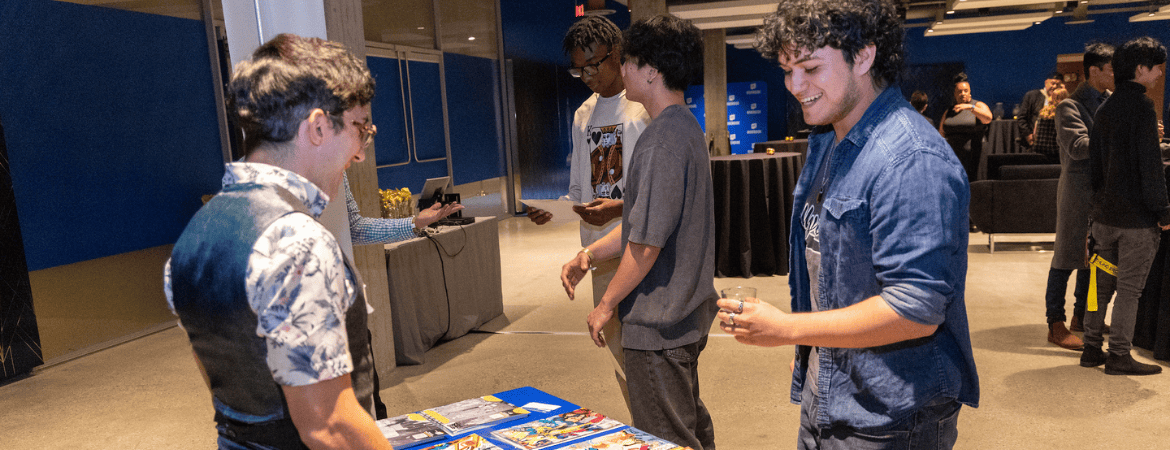
On Friday, September 27, the UCR Alumni Association hosted 'Lights, Camera, Action: A Night at the Academy Museum with UCR', an event that celebrated Highlanders in Hollywood.
Our Jay Kay and Doris Klein Librarian for Science Fiction and Fantasy Phoenix Alexander proudly showcased items from our Eaton Collection of Science Fiction and Fantasy at this event held at the Academy Museum of Motion Pictures in Los Angeles.
Visitors to the Eaton Collection’s table were treated to a unique display featuring comic books, model spaceships from Star Trek, vintage sci-fi magazines, and a UCR University Relations video—Discover the Science Fiction Treasures of the Eaton Collection—featuring Phoenix. The event was a great opportunity to highlight the treasures of the Eaton Collection and connect alumni to one of the world’s richest resources for science fiction and fantasy.
The night also included a panel discussion featuring UCR faculty and alumni thriving in the entertainment industry: Patricia Cardoso, Robin Uriel Russin, Chris Morgan ’95, and Ashley Carr ’09.
A big thank you to everyone who attended and stopped by the Eaton Collection table, and thank you to the UCR Alumni Association for hosting this memorable celebration of Highlanders in Hollywood!
To learn more about the Eaton Collection of Science Fiction and Fantasy, please visit our Eaton Collection of Science Fiction and Fantasy webpage.
To see upcoming UCR Alumni Association events, please visit the Alumni Engagement section of the UCR events calendar.
David Brin Papers
Located in: Special Collections & University Archives
Glen David Brin (born October 6, 1950) is an American scientist and multi-awarding winning author of science fiction and nonfiction. For his science fiction novels, he has won the Hugo, Locus, Campbell and Nebula Awards; his nonfiction book The Transparent Society won the Freedom of Speech Award of the American Library Association and the McGannon Communication Award.
The Human and the Alien: An Exploration of First Contact Stories
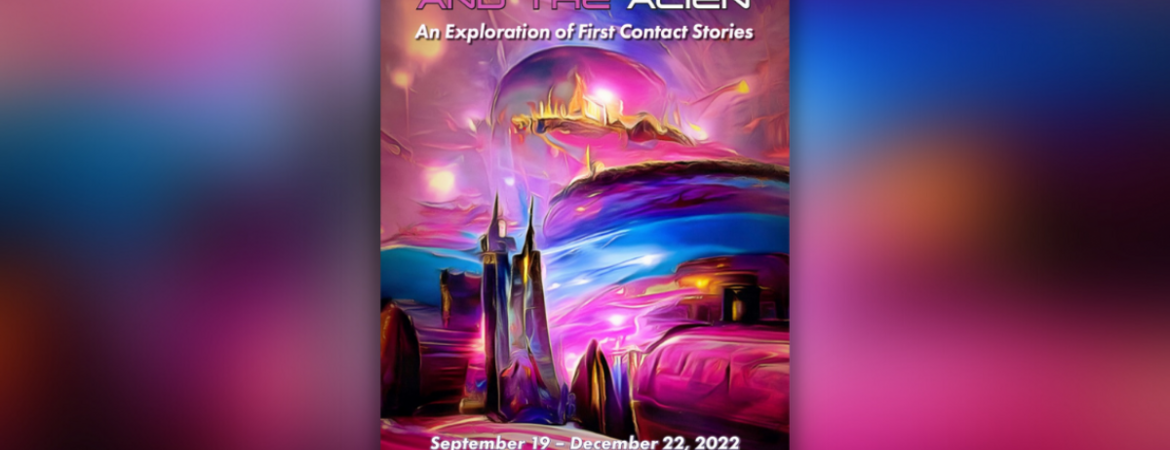
Discovering intelligent life in the cosmos has been a long-anticipated moment for humanity and fertile ground for fantastic stories since the dawn of science fiction. Nineteenth-century speculative fiction writers such as Jules Verne and H. G. Wells envisioned discovering life on the Moon or the invasion of Earth by Martians. From these early stories, encounters between humans and alien species (often described as “first contact” stories) have served as a vehicle for the exploration of possible futures and a reflection upon humanity’s place both on Earth and in the cosmos.
Within the context of science fiction, first contact can be thought of as an event in which two intelligent species encounter each other for the first time. Sometimes this encounter is peaceful or friendly and is about establishing communications or sharing knowledge. Other times the first contact scenario begins with a hostile act, like a war or invasion. Many of the themes found in these stories have parallels with historical examples of European explorers and colonizers encountering indigenous peoples in sub-Saharan Africa, the Americas, or Oceania.
There are many ways in which humans and aliens could engage in first contact. This exhibit will explore some of the forms that these types of stories can take and what messages they may have for us here on Earth. Each display case focuses on a single theme or type of human-alien encounter with examples pulled from the Eaton Collection. However, it is rare that a book is limited to a single theme, so many of the examples in this exhibit will be present in more than one category.
View the exhibit Monday through Friday in Special Collections & University Archives from 10 a.m. - 4 p.m.
DocNow Tool will Chronicle Historically Significant Events
After 18 months in development, the first release of the DocNow tool is expected by fall/winter 2017.
DocNow, short for “Documenting the Now,” is a free, open-source tool designed to support the ethical appraisal, collection, use, and preservation of social media content.
The purpose of DocNow is to help archivists and scholars make sense of large datasets of social media content. DocNow’s developers hope that by providing this free and easy to use tool, users can gather and preserve posts made by everyday people, particularly those of eyewitnesses, which often challenge the accepted narratives presented by the mainstream media on controversial social issues.
UCR Library’s University and Political Papers Archivist Bergis Jules has spoken frequently at public events about his work with DocNow, with a particular focus on the ethical aspects surrounding the curation of social media content into archives.
“Just because things are public doesn’t mean you can take them,” Jules said. “People have a right to privacy, a right to be forgotten on the internet. There are a lot of surveillance concerns with activists who are being monitored by police illegally through their social media accounts.” DocNow will try to honor these ethical principles by respecting the privacy of individual users who do not want their posts to be included in an archive or a research dataset.
Originally spurred by the online discussion surrounding the death of Michael Brown on August 9, 2014 in Ferguson, MO, the creators behind DocNow intend for this platform to serve two purposes moving forward: community-building and scholarly research. They hope that the many archives people will create by using DocNow will influence how history is written for future generations, allowing for the underrepresented voices of people of color to be included in the historical records of significant events.
As Deray McKesson (@deray) posted on Twitter, “We exist in a tradition of erased histories. Twitter has helped us tell our own story. We are sitting in history and making it. #Ferguson”
Jules mused on Medium, “What would have remained today of the public social media record if micro blogging services like Twitter had been around during the aftermath of the Rodney King beating, the acquittal of the officers and the subsequent riots?”
DocNow will help to provide this missing piece of the puzzle for future generations of scholars to ponder.
Funded by a grant from The Andrew W. Mellon Foundation, DocNow was developed through a collaboration between UC Riverside, Washington University in St. Louis, and the Maryland Institute for Technology in the Humanities (MITH) at the University of Maryland.
New archival collections available for summer quarter 2017
Special Collections & University Archives staff are constantly working to process recently acquired collections and make those materials ready for use by students, faculty, and researchers.
Each quarter, we will provide a list of UCR Library's newly processed archival and primary source collections. Check out the list below to see if there are any items that fit your research area, or share with a friend!
Below you'll find brief descriptions and links to the finding aids or collection guides for each new collection. To use any of these materials, simply click the "Request Items" button at the top to submit a request, and log in with our Special Collections Request System. For more on conducting research in Special Collections, see this page.
SCUA is open to the public on weekdays from 11:00 am – 4:00 pm. Check here for closures or other changes to our regular hours.
For questions, email specialcollections@ucr.edu.
Newly Processed Collections – Summer 2017
0.42 linear ft. (1 box)
This collection contains correspondence, science fiction convention programs, and a floppy disk from science fiction author Vernor Vinge. The correspondence mostly concerns other authors and publishers sending Vinge their works for his review or comments.
0.42 linear ft. (1 box)
The Abbie Voorhies De Verges papers contain photographs, newspaper clippings, correspondence, certificates, and other material from Abbie Voorhies DeVerges, a nurse in the Air Force who worked at the Tuskegee Army Air Field during the Second World War.
0.42 linear ft. (1 box)
This collection contains materials related to the publication and distribution of Dreams and Nightmares, a fantasy and science fiction poetry magazine edited by David C. Kopaska-Merkel. Items in the collection include original page proofs for a number of issues, art and poetry submissions, and correspondence and records related to some distributors of the magazine.
0.21 linear ft. (1 box)
This collection contains signatures of British nobility and members of the British royal family and includes some signed letters and government documents. Notable signatures in the collection include those of Queen Victoria, Prince of Wales Albert Edward (later Edward VII), Princess May of Teck (later Queen Mary), and multiple Dukes and Duchesses.
0.21 linear ft. (1 box)
This collection consists of correspondence from 19th century British politician Charles Philip Yorke to various family members and fellow politicians. The collection also contains letters from Yorke's brother, Sir Joseph Sydney Yorke, to Charles. Most of the correspondence concerns British political events of the early 1800s, most notably the ministries of Henry Addington and William Pitt the Younger.
0.21 linear ft. (1 box)
This collection contains correspondence written by clergy members from the Church of England during the 19th and early 20th centuries, primarily from bishops of various dioceses. Correspondence in the collection concerns mostly regular church business.
18.35 linear ft. (45 boxes)
This collection consists of notes, proofs, manuscripts, and other material related to the written works of Patricia Beatty, an award-winning author of children's books including Lupita Manana and Charley Skedaddle. The collection also includes materials on books Beatty co-authored with her husband John Beatty.
2.5 linear ft. (2 boxes)
This collection contains administrative records, press clippings, and other material from the Riverside Youth Concert Series, an organization in Riverside, California that provided affordable fine arts performances to local children from 1962-1978.
2.25 linear ft. (2 boxes)
The Collection on Philip K. Dick consists of press clippings, publications, short stories and manuscripts regarding Philip K. Dick, an American novelist who has published almost entirely in the science fiction genre. His works have been published in numerous literary magazines, such as Galaxy, Amazing Stories, and Fantasy and Science Fiction. The collection also consists of newsletters from the Philip K. Dick Society, and photographs and press booklets from the film Blade Runner.
9.67 linear ft. (9 boxes, 2 flat folders)
This collection consists of the professional and personal papers of actor and science fiction writer George Nader, including manuscript drafts, photographs, financial information, audio cassettes, and a film poster. Notable manuscripts in the collection include Nader's unpublished work The Perils of Paul, and Trio of Forever Friends, an autobiographical work written by Nader's partner Mark Miller about their friendship with actor Rock Hudson.
0.42 linear ft. (1 box)
This collection consists of documents, programs, and fliers from conferences and events on turfgrass management held mostly in California in the 1950s and early 1960s.
0.21 linear ft. (1 box)
This collection contains publications written and co-written by Walton B. Sinclair, a pioneer plant biochemist who worked at the Citrus Experiment Station in Riverside beginning in 1932 and was a professor emeritus of biochemistry at the University of California, Riverside. Publications in the collection focus on Sinclair's research regarding the biochemistry of various citrus fruits, as well as an article Sinclair wrote regarding the state of higher education in the Southern United States.
0.21 linear ft. (1 box)
The George A. Zentmyer papers is a collection of newsletters, monographs, and magazines related to UC Riverside professor emeritus George A. Zentmyer’s research on phytophthoras, which are a genus of plant-damaging molds that can cause damage to crops and natural ecosystems. The collection also includes obituaries for Zentmyer, and a booklet from his funeral service in 2003.
0.42 linear ft. (1 box)
This collection includes documents, correspondence, photographs, and other material regarding Christena L. Schlundt, Professor Emerita of Dance and founding faculty member at the University of California, Riverside (UCR). Materials in the collection include items pertaining to the UCR Department of Dance, the study of dance, and modern dancers and choreographers like Ted Shawn and Barton Mumaw.
0.21 linear ft. (1 box)
This collection contains documents regarding Boysie E. Day, a former professor of Plant Physiology at UC Riverside. Items in the collection include a biography of Day, as well as an unpublished manuscript written by Day about a sailing expedition he took in the Pacific.
1.25 linear ft. (3 boxes)
The Riverside School Study collection is a collection of reports and newsletters that document the joint research performed in the late 1960s by the Riverside Unified School District and the University of California, Riverside on the relationship between the desegregation of public schools and emotional adjustment and academic achievements of children. The collection also includes publications and guidelines for educators placed in newly desegregated school environments.
2.5 linear ft. (4 boxes, 1 flat folder)
The George Boyce papers consists of the professional papers and manuscripts of George Arthur Boyce, a Native American historian and former Director of Navajo Education for the United States Bureau of Indian Affairs. This collection documents his work with Navajo education and includes materials from his research and photographs depicting Navajo schools and students. Additionally, the collection includes oversize posters of day school budgets and Navajo translated newsletters.
2.92 linear ft. (8 boxes)
The John DeChancie papers is a collection of documents consisting of manuscripts, page proofs, and correspondence relating to the literary works of American comic fantasy and science fiction writer, John DeChancie.
0.42 linear ft. (1 box)
The collection contains press clippings, letters, and other material related to the research of historian John Hunt, focusing on the people and landmarks of Desert Hot Springs, California.
1.58 linear ft. (1 box)
The collection consists of an album of photographs depicting the Allison V. Armour expedition to the Yucatán peninsula in Mexico, a research expedition undertaken in 1895 by curators from the Field Museum of Natural History in Chicago. Photographs in the album focus mainly on the Mayan ruins visited by members of the expedition, with additional photographs of local scenery and the expedition group.
0.42 linear ft. (1 box)
The collection consists of a photograph album of nearly 200 black and white images taken by photojournalist Enrique Díaz Reyna of the festivities relating to the 1920 inauguration of Mexican President Álvaro Obregón.
0.5 linear ft. (2 boxes)
This collection contains lantern slides published by the London Missionary Society regarding David Livingstone, the noted explorer and medical missionary who traveled to Africa in the 19th century. The lantern slides in this collection depict Livingstone’s life in color illustrations and are accompanied by a pamphlet that provides descriptions of the slides. The collection also includes a handwritten piece on David Livingstone by an unknown author.
0.42 linear ft. (1 box)
This collection contains several items related to composer William Berwald, including photocopies of several of his compositions, performance programs, articles, and a copy of a manuscript remembrance of Berwald written by his daughter.
4.67 linear ft. (4 boxes)
The collection consists of television scripts from Seasons 1-5 of the Canadian-American science fiction television series, Gene Roddenberry's Andromeda (2000-2005), also known as Andromeda, which was based on unused material from screenwriter Gene Roddenberry. The collection also includes a script of an unaired episode from Season Two. The majority of the scripts are rough drafts and written before their air date.
0.42 linear ft. (1 box)
This collection contains programs, newspaper clippings, fliers, posters, and other materials related to minority issues both on and off the UC Riverside campus in the late 1960s. Topics addressed in the collection include information on ethnic studies, African American students, Mexican American students, protests, and related campus events. The collection also includes items related to civil and labor rights issues happening off campus affecting students, on topics such as housing discrimination, farm worker strikes, and politics.
New resources from Gale and AM
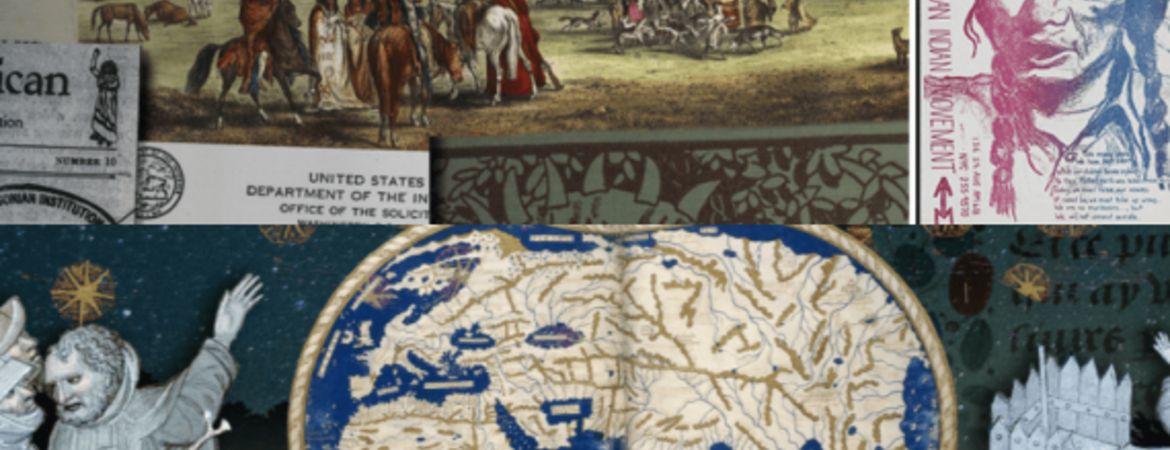
The UCR Library acquired access to several primary source archives from Gale and AM, formerly known as Adam Matthew Digital.
New resources from Gale:
-
Slavery and Anti-Slavery: A Transnational Archive
Slavery and Anti-Slavery: A Transnational Archive is devoted to the study and understanding of the history of slavery in America and the rest of the world from the 17th century to the late 19th century. The archive consists of more than five million cross-searchable pages sourced from books, pamphlets, newspapers, periodicals, legal documents, court records, monographs, manuscripts, and maps from many different countries covering the history of the slave trade.
-
Native American Studies from Archives Unbound
Collection of primary sources and more sourced from the following archives:
- Presbyterian Historical Society Collection of Missionaries' Letters, 1833-1893
- American Indian Movement and Native American Radicalism
- Meriam Report on Indian Administration and the Survey of Conditions of the Indians in the U.S.
- The Indian Trade in the Southeastern Spanish Borderlands: Papers of Panton, Leslie and Company
- The War Department and Indian Affairs, 1800-1824
-
Indigenous Peoples of North America, Part 2
Primary source collection for research into the cultural, political, and social history of Native Peoples from the seventeenth to the twentieth century. The UCR Library has access to parts 1 & 2.
New resources from AM:
-
Colonial Caribbean: Colonial Office Files from The National Archives, UK
Stretching from Jamaica and the Bahamas to Trinidad and Tobago, Colonial Caribbean makes available materials from 27 Colonial Office file classes from The National Archives, UK. Covering the history of the various territories under British colonial governance from 1624 to 1870, this extensive resource includes administrative documentation, trade and shipping records, minutes of council meetings, and details of plantation life, colonial settlement, imperial rivalries across the region, and the growing concern of absentee landlords.
-
Confidential Print: Latin America
This collection consists of the Confidential Print for Central and South America and the French- and Spanish-speaking Caribbean. Topics covered include slavery and the slave trade, immigration, relations with indigenous peoples, wars and territorial disputes, the fall of the Brazilian monarchy, British business and financial interests, industrial development, the building of the Panama Canal, and the rise to power of populist rulers such as Perón in Argentina and Vargas in Brazil.
-
Empire Studies from AM Scholar
This collection offers a rich array of primary and secondary sources for the study of the British Empire. It features material on British colonial policy and government; perspectives on life in British colonies; the relationship between gender and empire; race; and class.
-
Literary Print Culture: The Stationers' Company Archive
The Stationers’ Company Archive is one of the most important resources for understanding the workings of the early book trade, the printing and publishing community, and the establishment of legal requirements for copyright provisions and the history of bookbinding. Explore extremely rare documents dating from 1554 to the 21st century in this resource of research material for historians and literary scholars.
-
Medieval and Early Modern Studies from AM Scholar
This collection provides a wide range of primary sources covering social, cultural, political, scientific, and religious perspectives from the 12th to early18th centuries. Document types include illuminated manuscripts, personal papers, diaries and letters, rare books, receipt books, and manuscript sheet music. The breadth of sources provided within this collection is extraordinary, from sources concerning the Black Death to the Restoration of the English monarchy and the Glorious Revolution.
-
Medieval Family Life: The Paston, Cely, Plumpton, Stonor and Armburgh Papers
Includes five major letter collections and associated manuscripts from fifteenth-century England, which take the user into the world of medieval families, businesses, relationships, trade, politics and communities. Medieval Family Life presents full-color images of the original medieval manuscripts of which these letter collections are constituted, alongside fully searchable transcriptions drawn from available printed editions.
-
Medieval Travel Writing is an extensive collection of manuscript materials for the study of medieval travel writing in fact and in fantasy. The core of the material is a collection of medieval manuscripts from libraries around the world, dating from the thirteenth to the sixteenth centuries and focusing on accounts of journeys to the Holy Land, India and China. Texts include some of the most influential prose works of the late Middle Ages – notably the books of Marco Polo and ‘Sir John Mandeville’ – but also important items by lesser-known authors such as John of Plano Carpini and Odoric of Pordenone.
-
Nineteenth Century Literary Society: The John Murray Publishing Archive
Nineteenth Century Literary Society makes available more than 1,400 items from the archive of the historic John Murray publishing company. Primary source materials span the entirety of the long nineteenth century and document the golden era of the House of Murray from its inception in 1768. Records digitized in this resource predominantly focus on the tenure of John Murray II and his son, John Murray III, as they rose to prominence in the publishing trade, launching long-running series including the political periodical Quarterly Review, and publishing genre-defining titles such as Darwin’s On the Origin of Species, Austen’s Emma and Livingstone’s Missionary Travels and Researches in South Africa.
-
Sourced from the records of the Race Relations Department of the United Church Board for Homeland Ministries, housed at the Amistad Research Center in New Orleans, this resource provides access to a wealth of documents highlighting different responses to the challenges of overcoming prejudice, segregation and racial tensions. These range from survey material, including interviews and statistics, to educational pamphlets, administrative correspondence, and photographs and speeches from the Annual Race Relations Institutes.